
A Conversation with Julia Loktev (MY UNDESIRABLE FRIENDS: PART 1–LAST AIR IN MOSCOW)

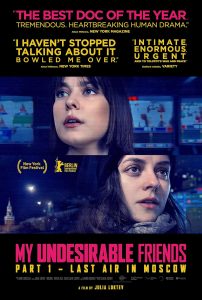
In October 2021, Soviet-born American filmmaker Julia Loktev arrived in Moscow with her iPhone to document Russian independent journalists being declared “foreign agents” by Putin’s regime. At the start of filming she had no idea it would become a five-and-a-half-hour epic capturing one of the most significant moments in recent history: the final months before Russia’s full-scale invasion of Ukraine, filmed from inside a community of young journalists and activists who would be forced into exile.
Loktev shot alone, embedding herself with TV Rain, the last independent news source in Russia, and their tight-knit group of reporters including Anna Nemzer, the film’s co-director and a senior talk show host at Rain; Ksenia Mironova, a 23-year-old reporter whose fiancé Ivan Safronov was jailed on treason charges; Elena Kostyuchenko, Russia’s most prominent opposition journalist and a lesbian in a country increasingly criminalizing LGBTQ people; and the podcast duo Sonya Groysman and Olga Churakova, among the first journalists to be designated foreign agents. The film captures their heroic work, their friendships, their dark humor, and their perseverance as the screws of authoritarianism tightened week by week.
On February 24, 2022, Russia invaded Ukraine. Loktev kept filming as her subjects tried desperately to report the truth under military censorship, forced to constantly repeat “The Russian Ministry of Defense has not confirmed this,” even as videos showed apartment buildings being bombed, banned from even using the word “war,” They did everything they could to stay on air a few more days to report honestly to the people of Russia. She was there when special forces were on their way to raid the station, filming as everyone grabbed what they could and ran. Within that first week of the invasion, TV Rain was shut down and most of Loktev’s characters fled with carry-on suitcases and no idea where they were going. Basically none have been able to return, all face criminal charges if they set foot in Russia again.
This is the first half of Loktev’s extraordinary document of a world that no longer exists, a vibrant Russian opposition silenced by fascism. Shot on an iPhone with astonishing intimacy and structured in five chapters, it stands as both historic record and urgent warning. As authoritarianism rises in America, what Loktev initially conceived as a story about journalists in a distant country under a dictator now feels uncomfortably close to home. The film offers not just a window into how a society slides into fascism, but it shows the importance of resistance, community, and moral courage when the unimaginable becomes real. My Undesirable Friends: Part I — Last Air in Moscow (winner of the 2025 Independent Film Site Network Advocate Award) is one of the most important films of the decade. It was an honor to speak with Julia Loktev in the following conversation edited for length and clarity.
Hammer to Nail: When Anya (Anna Nemzer) asked you to film alone that first night because the group would feel more comfortable without a cinematographer, and then you couldn’t figure out the settings on the borrowed professional camera with guests arriving, so you grabbed your iPhone, Did you have a sense that this might actually unlock something essential for the project?
Julia Loktev: Within five minutes of grabbing the iPhone, I was like, “this is it. This is what we’re doing.” It just felt so natural because it’s just easy to disappear and be present as a person in the room with an iPhone. It did so much. There was just an ease to it. The whole film feels like you’ve gone to visit a friend and they introduce you to other friends. The iPhone just made that happen.
HtN: What was your collaboration like with all the subjects of the film in post-production with so many hours of footage? Did you show them early cuts to gain their approval on what was being shown? Can you also talk about your collaboration with Michael Taylor, how that whole process worked?
I do think of the way I worked with the characters as very much a collaboration, not really just in terms of editing, but in the shooting. When you’re shooting people that have themselves made video documentaries, I think they just instinctively thought, “oh, this would be good.” One example is, there’s a moment where I go into Sonya’s house and she takes me into her bedroom. I don’t know what she was going to show me there. I have no idea. She whips out this diary that she kept at age 15 and starts showing me all these notes she took while watching TV Rain. All I’m doing is following her. She was thinking as a storyteller, this would be good.
It also played a role in emotional moments. There’s a moment where I’m filming another character, Ksyusha (Ksenia Mironova), and I walked in and she was in the middle of crying as everyone was fleeing the country. She was advising someone and she thought she had to stay. Of course, I felt quite bad about filming, shoving a camera in her face as she was crying. I apologized to her for this. She said, “don’t worry, I film people all the time. I know.” There was this incredible comfort in filming people who know what storytelling is.
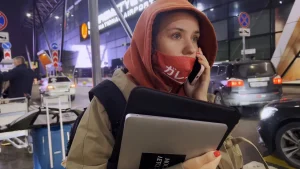
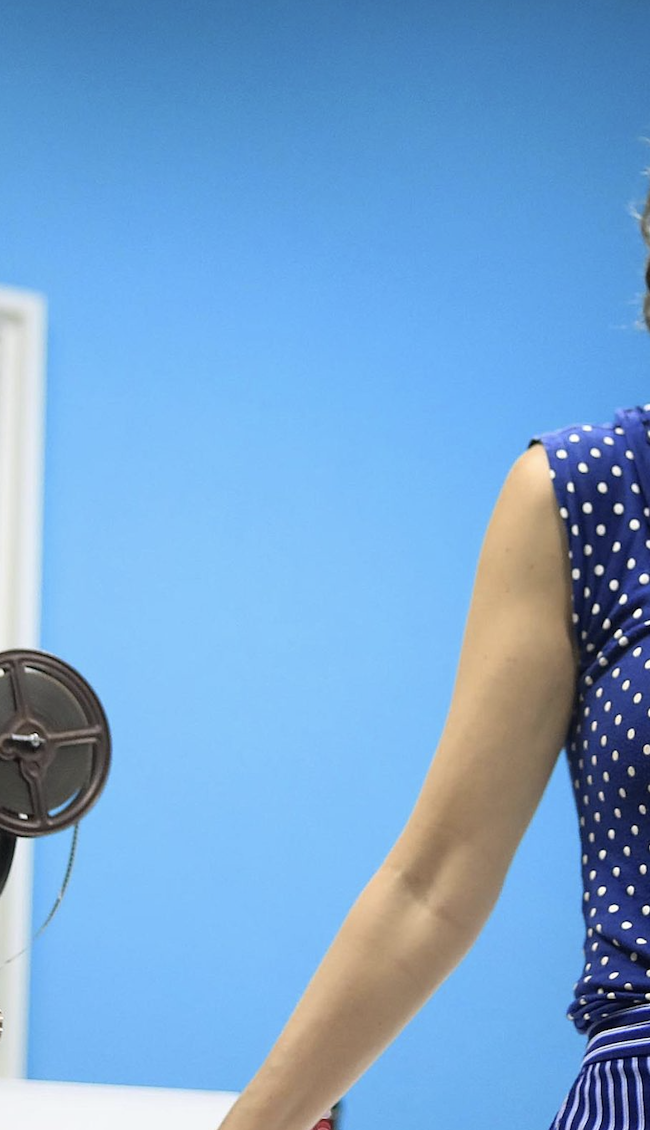
A still from MY UNDESIRABLE FRIENDS
In terms of editing, Anya watched a lot of the footage as co-director. The people weren’t really involved directly in the editing process. But when I had pretty much final cuts, I had an agreement with all my characters from the very beginning, it was verbal, we didn’t even sign it till way into post-production, that they would get to review everything in the film for truthfulness, and for safety of them or their loved ones. I was very clear: if you don’t like your hair, you can’t say I don’t look cute and ask me to take it out. No, it has to be something serious. There were a couple of things we had to edit out about family members because the situation with risk kept changing. It didn’t matter if they consented at the time of filming. For example, there was somebody who loved being filmed, but that we had to edit out because he could be drafted. The consequences were incredibly serious. Everyone you see in the film we consulted at the time we were editing. Even people you see walk by the frame for a second. The risks at the time the film was finished were much greater so we had to be sure.
With Michael Taylor, I’ve been editing for like three and a half years now between this and Part II. It’s a very lonely process. I definitely need someone to talk through things. It’s so important to have that other partner who knows the footage inside out, who knows everything and you can talk through things with. For me, Michael Taylor is that person who really knows the footage and can say, I’m stepping back, seeing the big picture, seeing what works, what doesn’t work. That’s hugely important.
HtN: At the hour and 15 minute mark, we have this scene where Anya cooks a big dinner for the group. They’re all having fun, enjoying the food and each other’s company, cracking jokes about all the crazy things happening around them. At one point, Sonya says, “we’re sitting around this lovely table drinking wine and all, but each of us while doing all this is thinking we’re fucked.” Can you talk about this particular moment and also just the importance of cooking in the film?
JL: The film takes place in kitchens, taxis and offices. It’s kind of unusual now. I realize as I’m watching a lot of documentary films, because that’s not really the world I come from, I come from fiction more, it’s fairly unusual to have films now that are about characters living their lives. Which to me coming from fiction is pretty usual. That’s what I think of as normal for a movie. You have people living life and stuff happens. Sometimes very bad stuff happens. But in the midst of people living lives, you get to know these characters.
So I tend to approach it where you have a scene followed by another scene followed by another scene. I mean, it’s not super radical, but it seems fairly unusual in a documentary. I think much more like a fiction person, focusing on people’s emotions. I’m very patient and quiet when I film. I just hang out and keep filming. I’m also attracted to moments of absurdity. I’m attracted to moments where the most dramatic things meet the most quotidian things. You’re living under a dictatorship, you still have to cook dinner for your kid. You still gather with your friends. You still have all the surrounding life. I think that’s so much of what the film is about.
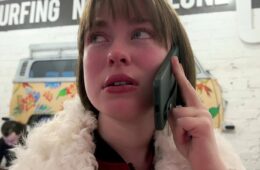
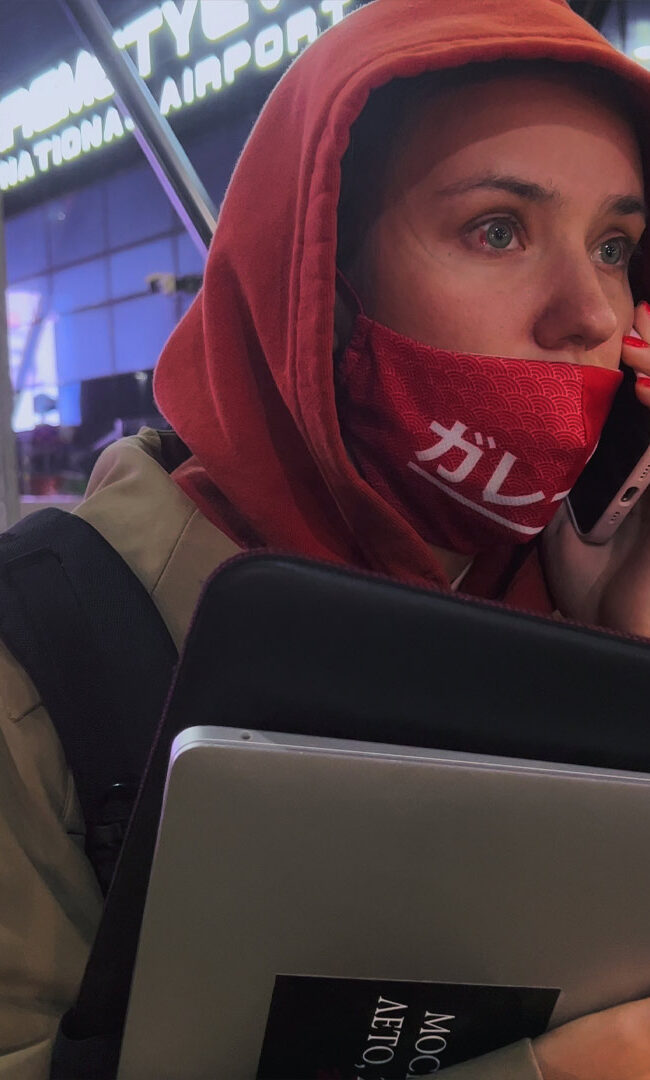
A still from MY UNDESIRABLE FRIENDS
Sonya calls attention to it. There’s actually an interview that she conducts for her podcast with an anthropologist who says, “we’re used to an authoritarian society looking like V for Vendetta.” But actually, people go about their lives, and for most people, it looks really nice and normal. I think about this all the time now, as the surface of my life looks incredibly normal, as masked men snatch people into unmarked vans, and the rest of our lives look pretty nice.
HtN: In chapter two, you ask Ksyusha when she went into journalism, what gave her the idea that it was a good idea? She talks about how she knew it was no longer the golden age, however, she liked that to whatever extent possible, they were doing something to enact change. Someone in the car says to leave the profession, that you make no money and it’s impossible to do anything now that it’s gotten so bad. Ksyusha responds that she loves journalism, she loves the heroes of her stories, filming regular ordinary people. It makes her feel like she’s making some kind of difference. Can you talk about why you felt it was important to include this moment?
JL: That’s all Ksyusha. Meanwhile, the person she’s speaking to is like, what’s the difference? Journalism, PR, you could work in a PR firm. Of course, all of these people could work in various sectors of journalism. They were all working for very little money in independent media. They could have all gone and worked for Russian glossies or to work in PR and to not do political journalism. Russia was a fairly nice place to live. Apparently, I hear it’s partying well during the war too now, but at the time there were Russian Tatler, Russian Elle, Russian Elle Decor, Russian Vogue, all of this was happening. They could have all said, forget it, forget politics. I’m just sticking with lifestyle journalism or go work in PR. But all of them felt that they were doing something out of conviction. Some of them are incredibly young and just wanted to make their society better.
HtN: In chapter three, we have the sequence with Ira, her mother, and Alesya. They have dinner and Ira says to her mother, I know you think I’m sticking my nose in the wrong place, but I think it all comes from your generation, as in the problems Russia is facing. She says that her mom reads some of her articles about corruption and simply says, “that’s how it was and that’s how it will be.” They go back and forth with Ira taking a more hopeful stance about Russia, that the young people are very progressive and eventually will replace the old. Ira’s mother’s not entirely convinced. I feel like this conversation is a good microcosm of the divide of the young and the old in Russia. Can you talk about what was important to you here?
JL: Absolutely. Hopelessness is the best friend of authoritarianism. It’s exactly that—for years, Putin has tried to cultivate a sense of you can’t do anything, you can’t impact this, stay out of politics, do nothing, you can’t change this society. I think that is very common among older Russians. There are, at the same time, incredible older activists. There’s an activist who’s now in her 80s that we see who works for migrants’ rights, and there are tireless old activists. So it’s not exclusive. It’s not only the young that are politicized, but for the most part, the younger generation is much more energetic.
They grew up watching Navalny on YouTube. They believed it could be different, and they really were fighting for this even when it seemed hopeless. I think that’s what I find so inspiring. It’s like what Ksyusha says, it was no longer the golden age. You didn’t have a sense that you were going to change anything, but you’re going to do it anyway, as long as you could.
HtN: Now in 2025 America, the story feels like it’s also about us. I would agree that there are certainly distressing parallels to what is happening now. In chapter four, Alesya says, as the war is breaking out, that everyone is likely reflecting on whose fault it is and what they could have done personally. She says it’s probably everyone’s fault and that they fed a monster for 20 years with their silence and passivity. Can you talk about that moment?
JL: I think what’s really striking to me about all the characters in the film is nobody tries to wash their hands of this. We have a habit as Americans—and I say we, I was born in the Soviet Union, I came here in the States since I was nine, so I consider myself American—but we have this habit of saying, “not my president,” “not my war.” “I didn’t vote for this.” That distances ourselves from the horrific things our country does. Saying, “well, that wasn’t what I wanted.”
I think what’s incredible about all the characters in the film is they have this incredible sense of moral responsibility where they take on and they say,”well, I am complicit in this.” This is also my country that is invading Ukraine. What can I do to take responsibility and what can I do to make this better now?
HtN: Towards the end of the film, we have this extended sequence at the studios of TV Rain. Lots of big news is hitting our characters at once as they’re told no more Apple stores, no more Nike stores, and now, no more TV Rain. They all discuss how much further they can push this and if they should come to work in the morning. Despite how dark and desperate the situation is, everyone still finds some room for levity until someone comes in and says that special forces are on the way. You then capture the panic of this moment as everyone grabs what they can and runs out of the building. Can you talk about what that moment felt like and your decision to keep the camera rolling?
JL: It was terrifying. It was absolutely terrifying. I mean, everyone’s running out. You don’t know what will happen. I briefly stuck the camera in my pocket while I was running out and then just kept filming. But I was incredibly lucky. I was insanely, insanely lucky as a filmmaker because most docs, if you think about it, are about something that already happened. You’re trying to figure out what happened, and you’re doing this retroactively, and you’re telling a story that already happened. I was there as things were happening.
So all you have to do is just run, keep up, keep filming, make the decision: where are you pointing the camera? Who are you following? What person is going to let you be near them at this point? Their lives are falling apart, and I’m filming them. Some of them might not want to be filmed at that moment. So you go with someone else who is okay with being filmed at that moment. Then you come back to them.
For me, it is a film about a huge historic moment that happened. I got to capture history. It’s a mass exodus. A million people have left Russia. It’s a huge, huge historic moment between that time when opposition was possible in Russia and when it became impossible openly in Russia. I mean, obviously there are still people working underground anonymously. I feel so incredibly lucky that I got to capture it through these people that I came to really love. Some of it was luck. Some of it was just persistence and keeping the camera on and knowing who to follow. Just getting to capture it in a way that you live through it and you get the experience of what it feels like, rather than just someone explaining it to you after the fact was special.
You’re really just living through it as these people are standing there and making this decision of, do we come to work tomorrow? Then someone says, no, pack your bags and go to the airport. If you can imagine what that is like, someone says to you, “pack a carry-on, you’re leaving the country now. You won’t be able to come back, most likely”. The only one of our characters to have stepped foot in Russia since the start of that first week of the full-scale war is Ksyusha, who snuck in for a few days to see her fiancé convicted for 22 years for so-called treason. Everyone else has not been able to go back. They all have criminal cases, and will go to jail if they go back to Russia. Just imagining what that’s like to have to leave your home with a few hours warning.
Lena went on a reporting trip to Ukraine. She went to report in Ukraine, leaving her apartment, her cat, leaving all these things, thinking she was going to be back, she was never able to go back.
HtN: One of the things that TV Rain does on their New Year special is come up with one positive thing that either happened to them or Russia generally this year. With the new year approaching, I’d like to ask you the same question. Is there something you’re hopeful or feeling positive about in Russia going into the new year?
JL: I haven’t been to Russia since the first week of the full-scale war. So it also feels like a receding planet that’s further away from me that I can’t speak to very much now. I probably would not be able to go there. It would be very risky.
But I think one hopeful thing for me, and this doesn’t go on New Year’s, this goes on any day, is the characters in the film. What they remind me of constantly is just the importance of community and continuing to work, even when the work seems tough. The importance of friendship, the importance of a sense of humor. I know this sounds like a Hallmark card, but it really is the thing that makes resistance possible. It is gallows humor, it is community.
I was with Sonya and a number of other characters presenting the film at IDFA in Amsterdam last week. We got another question of “why did you make this film 5 and a half hours long?” I answered it in my own way. Sonya said, “you know, I’m so sick of this question. You should just say it’s a leap of faith”. I said, “what do you mean by that?” She said, “it’s a leap of faith. All of us in our work, we’re not choosing the easy path.” She said, “We could have chosen something easier. We could have done this the easy way, but we’re doing what feels right. We’re doing what needs to be done. That’s what you did with this film, Julia. You are just like us, you’re taking the leap of faith.” I said, “yeah, okay, I like this way of speaking about it.” Then she sent me a Jane Fonda video talking about a leap of faith in politics, which I thought was lovely.
– Jack Schenker (@YUNGOCUPOTIS)