





(The 63rd New York Film Festival (NYFF) ran September 26-October 13 via Film at Lincoln Center. Check out M.J. O’Toole’s Resurrection movie review, fresh from the fest! Seen it? Join the conversation with HtN on our Letterboxd Page.)
Can our dreams influence cinema? Or can cinema inform our dreams? Director Bi Gan addresses these questions with alluring visuals in his third feature, Resurrection, a jaw-dropping surrealist masterwork. For those waiting eagerly for the filmmaker’s follow-up to his 2018 3D extravaganza, Long Day’s Journey Into Night, their patience pays off with this fantasia of cinematic wonders, which offers a range of aesthetics, performances, and time periods. Bi experiments with style in his extravagant love letter to 20th-century cinema (co-written with Zhai Xiaohui), but through each segment, you can feel his distinct voice, which whispers questions about the meaning of existence, time, and, of course, the power of the human imagination. If you think about the state of movies in a post-pandemic world, the ways imagination and dreams can inform them are on the verge of becoming fickle with the overabundance of AI and studios trying to capitalize on slop. After leaving the cinema, one could either mourn the current state of movies or take hope that the magic of cinema is made by humans.
The film opens with a captivating silent-era, Méliès-like sequence in which our narrator, referred to as The Big Other (an elegant Shu Qi), introduces us to a future society where the secret to longevity is to stop dreaming. However, there are certain beings known as “Fantasmers” with the ability to dream, but who are considered holed up in their imaginary worlds. To preserve the linearity of time, she seeks out one of these Fantasmers, a hunchback, Nosferatu-like being (Jackson Yee, our protagonist throughout these segments), to wake him up from his dreams. This sequence is a great introduction to the lavish production design throughout by Qiang Lu and Nan Tu, as well as Wen-Ying Huang’s vibrant and versatile costume design. When our narrator soon finds our Fantasmer, she sympathizes with his commitment to his dream life and decides to give him a peaceful demise. When she opens him up and switches on a projector inside of him, our journey into these dreams truly begins. In each segment, the Fantasmer reappears as a different kind of character with a new look. The same fate befalls his characters at the end of each story.
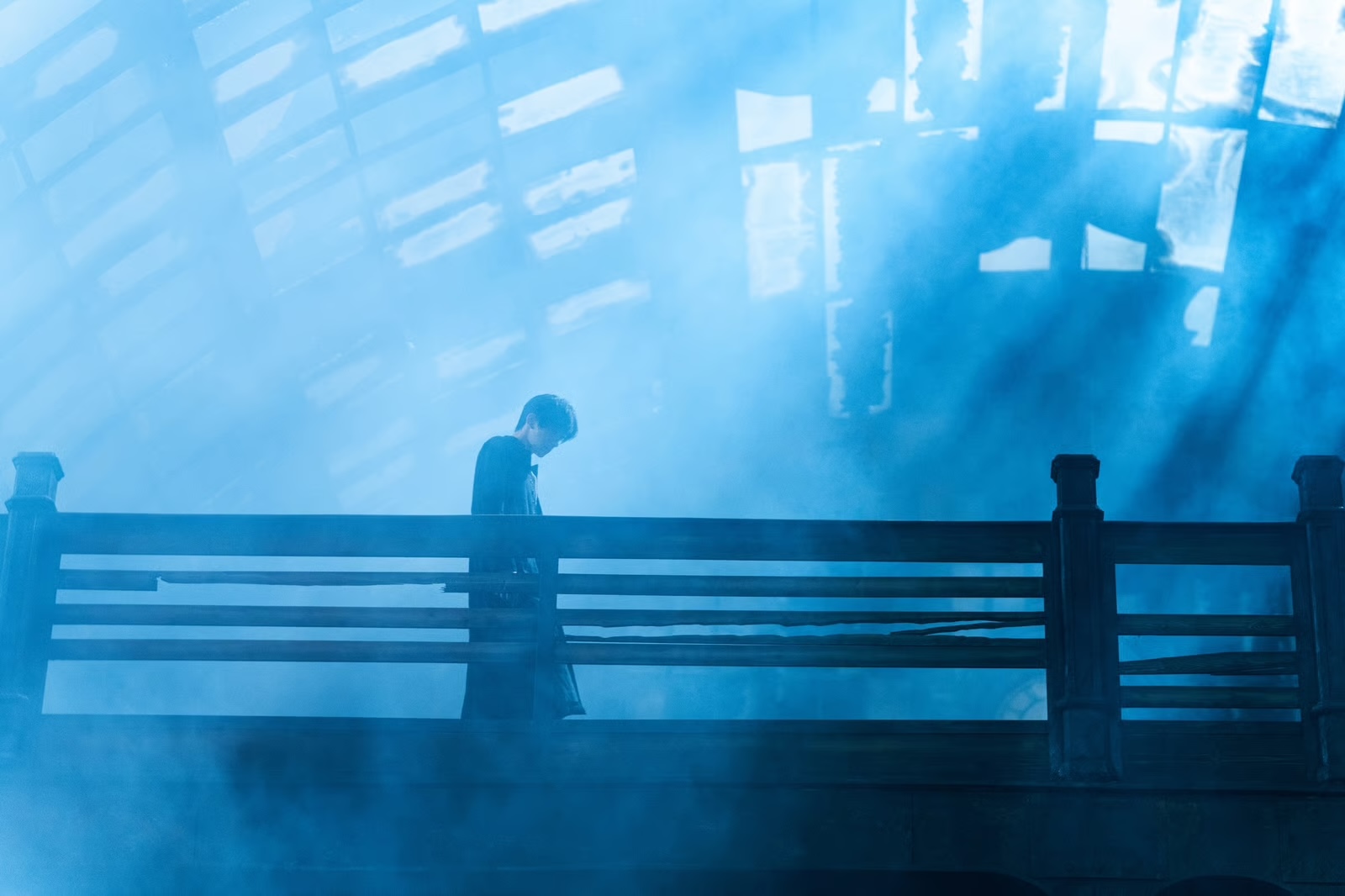
The first segment, post-prologue, has him transform into a handsome young man in a WWII-era spy noir, accused of murder over a mysterious briefcase and pursued by a trenchcoat detective (Mark Chao). The flow of the plot in this vignette may be tricky for some viewers to grasp, but the beguiling, mystical visuals make the experience worth it. From the moody shades of blue, to a captivating shot of a glass ceiling exploding, to a gripping mirror shootout, Bi has put quite a unique spin on the wartime noir genre that feels more in the mold of Andrei Tarkovsky than David Lean or Carol Reed. The rest of the vignettes that follow feature the Fantasmer as a thief in the snowy ruins of a Buddhist temple, paid a visit by a menacing spirit (Chen Yongzhong) in the form of his late father, and a magician-like con man who takes a young orphan (Guo Mucheng) on as an apprentice in a Paper Moon-like tale. Each tale differs in color, shade, and scale of the setting, but the melancholic and poetic tones feel consistent throughout. The final segment brings us to New Year’s Eve of 1999, with a supernatural gangster romance that follows the Fantasmer as a hoodlum with a bleached blonde haircut who pursues an elusive young woman (Li Gengxi) throughout the city as the clock strikes midnight. This portion of the film is shot in one long, continuous take – a signature of Bi’s – masterfully captured by cinematographer Dong Jingsong, who also pulled it off in Long Day’s Journey Into Night. Through dark alleys, karaoke bars, and gangster shootouts, this wild night ends on a boat that sails into 2000 as the sun rises, a new century where cinema will eventually change drastically.
With Resurrection, the 35-year-old Bi Gan has achieved something unique, ambitious, and visionary that most filmmakers wouldn’t pull off until decades into their career. Clocking in at 160 minutes, there is something to be attained from each different vignette, no matter how you may interpret them. Aside from the breathtaking visual crafts, Jackson Yee’s range of performances is a standout, as is the melodious score by the band M83 – especially in the awe-inspiring final shot that will tug on the heartstrings of any devoted cinephile. There’s no denying that this is a celebration of human-made art and how the power of cinema can ripple across time. With feelings of longing and regret in the seams, feelings of nostalgia may surface. But that can also translate into hope that the power of movies can be as prevalent as they are in this spectacle of a film that needs to be seen to be believed. If Bi Gan has shown us something here, it’s that the human effort put together to make such films is not really going anywhere, no matter what technological advances may arise across time, a “resurrection” of sorts. While many viewers will likely try to interpret the overall meaning, my advice is: don’t try so hard to understand it, just feel the magic as it unfolds.
– M.J. O’Toole (@mj_otoole93)
2025 NYFF; Bi Gan; Resurrection movie review