





(Check out Brandon Wilson’s My Brother’s Wedding movie review. Charles Burnett’s second film has recieved the 4k treatment that was premiered this week at the Berlin International Film Festival. It wil hit American cinemas soon. Seen it? Join the conversation with HtN on our Letterboxd Page.)
One of the pleasures of the last three and a half decades of my cinephilia is watching Charles Burnett slowly acquire the respect he deserves as one of the preeminent filmmakers of our time. It started with Killer of Sheep (1977). Widely lauded now as one of the great American films of the last 50 years and possibly one of the single greatest independent films ever made in this country, it was once a seldom seen curio known mostly by academics. But festival screenings of the film eventually turned the tide and thanks to people like Steven Soderbergh (who helped clear the music rights that had long denied the film a proper home video release) the film was released by Milestone in 2008.
Killer of Sheep was inducted into the National Film Registry in 1990, the same year he released To Sleep With Anger, thanks in large part to the star power of Danny Glover riding high from the Lethal Weapon series. Both Burnett films are set in contemporary South Central Los Angeles and focus on the lives of everyday African-Americans. They are not leaders, trailblazers, or artists. But Burnett finds art and poetry in their existence with his camera, his soundtrack, and his editing.
The latter film is a leap from the older film. It begins with a brief surreal prologue before telling a story that draws heavily on Black folklore and transplanted Southern Gothic. A fascinating development from someone associated with realism and the tradition of Italian Neorealism.
But back in 1983, Burnett released a feature that built on the momentum created by Killer of Sheep. That film is called My Brother’s Wedding, and in many ways it is a bridge from Killer of Sheep to To Sleep With Anger. The film has been recently restored and remastered, and while it is not quite the achievement that Killer of Sheep and To Sleep With Anger are, it is a must see for fans of those films.
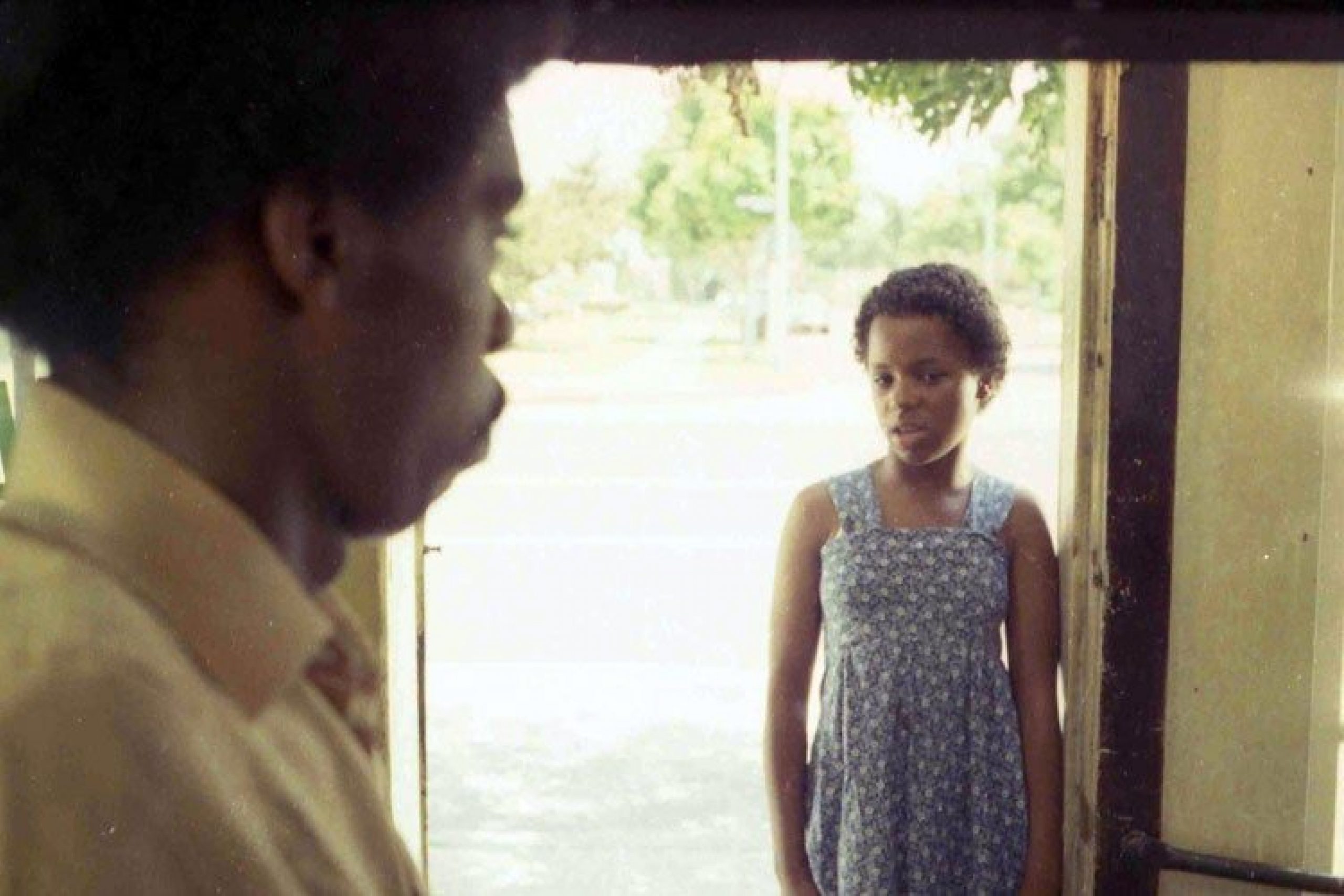
Using color cinematography for the first time in any of his feature films (like Killer of Sheep, Burnett is both writer-director and cinematographer of My Brother’s Wedding), Burnett’s film is set in the same South Central L.A. but in a brand new decade. Everett Silas plays Pierce Mundy, a restless young man whose family owns and operates a dry cleaners. The plot revolves around the ripples caused by Pierce’s elder brother’s imminent marriage to a woman from a “good family” (Burnett playfully gives this family the name of “DuBois” which has to be a reference to legendary Black thinker and writer W.E.B. DuBois who coined the phrase “The Talented Tenth” to describe the educated and upwardly mobile Black folks he saw as the vanguard of the race).
The nuptials are causing Pierce a good deal of anxiety and he begins rather rudely expressing his class resentment toward the DuBois family in ways mortifying to his own. Making matters worse, his childhood friend Soldier (played by Ronnie Bell, who like Silas has never acted again in a feature film since this one) is released from prison. There are echoes of Martin Scorsese here in the way Pierce is being pulled in two directions by both his family and his friend. Burnett is frank about the direction Soldier is pulling Pierce in. Particularly when Soldier uses the Mundy family business to commit an unspeakable crime. In the last act, Pierce will have to choose between his familial duty and his loyalty to his friend in a way he never sees coming.
No one would have blamed Burnett for making his follow up to Killer of Sheep a formal twin to that film, but it is interesting to see the ways My Brother’s Wedding is both a departure from and an expansion on the previous film. The color cinematography makes the film feel more grounded and less poetic, and the editing is a bit more naturalistic and less Eisensteinian as well. There are some lovely lyrical passages to the film, particularly in how Burnett captures Los Angeles. His ear for Black music also serves him well here, though this film’s playlist is a bit more focused than the previous one (which clearly tried to draw on the full range of Black musical expression in the United States). The use of Johnny Ace is particularly effective. And Burnett, much like Yasujiro Ozu, is one of those filmmakers it is easy to rave about in a way that leaves out how funny his films often are. He has a deadpan sense of humor and appreciates the everyday absurdities and idiosyncrasies of Black life in a way that fans of Donald Glover’s Atlanta will appreciate.
Fans of To Sleep With Anger (which joined Killer of Sheep on the National Film Registry in 2017), will see My Brother’s Wedding as something of an early draft of what was to come. The dynamics of the Mundy family are very similar to the family in that film, right down to one of the brothers marrying a “bougie” girl.
But even if you are not a Burnett fan, the film has a lot to offer. It captures a community, and a people, at a crossroads. Pierce’s dilemma was a perfect metaphor for African-Americans dealing with the aftermath of a Golden Age and confronting a foreboding and bleak present.
– Brandon D. Wilson (@GeniusBastard)