



LIVING THE LAND
(Check out Frank Yan’s Living the Land movie review, it’s in theaters now. Seen it? Join the conversation with HtN on our Letterboxd Page.)
Winner of the Silver Bear for Best Director at the 75th Berlin International Film Festival, Huo Meng’s third feature Living the Land is at once intimate and expansive. The story is filtered through the eyes of a ten-year-old boy in the province of Henan, yet Huo’s real protagonist is the village itself, along with the social order that shapes and wounds it. The film patiently depicts the remnants of an old order already in collapse and the pressures of a new one already arrived.
The year is 1991, the dawn of China’s economic reform. Young Chuang (Wang Shang) has been left behind by his parents, who went south to Shenzhen seeking factory wages and become part of a mass exodus hollowing out thousands of villages like this one. Over the course of a year and bookended by two funerals, Huo paints a vivid and honest portrait of rural China in upheaval. Peasants endure crushing tax burdens atop backbreaking labor; women eat separately from men at family gatherings, their subordination so woven into daily ritual it barely registers as cruelty. Government loudspeakers blare edicts enforcing the One-Child Policy. Chuang’s young aunt Xiuying (Zhang Chuwen) is married off to a well-connected but alcoholic man, her own desires silently extinguished. The traditional opera troupe is replaced by television as the new communal entertainment.
Huo Meng’s cinematic lineage is unmistakable. His multi-generational family portrait patiently maps a community’s web of relationships across time through the child’s-eye perspective, as historical forces reshape an entire way of life. All these elements carry the DNA of the two masters of Taiwanese New Cinema, Hou Hsiao-hsien and Edward Yang. Like Hou, Huo builds his film almost entirely from long, extended shots of ordinary events such as meals, fieldwork, gossip, the wedding and funerals, with barely any close-ups and no conventional plot, only the steady rhythm of seasons revealing family dynamics across four generations. The camera often lingers on the characters even though the narrative function of the scene is already finished. This places the film in sharp contrast with Li Ruijun’s Return to Dust, another Chinese entry into the Berlinale competition three years prior, which despite its rural sincerity relied on melodramatic conventions: a doomed love story, a clear arc, and a tragic catharsis. Huo refuses those tropes entirely, achieving something closer to anthropological immersion, where mundane detail becomes its own form of epic storytelling. He simply lets his camera sit with these people and lets these details speak for themselves.
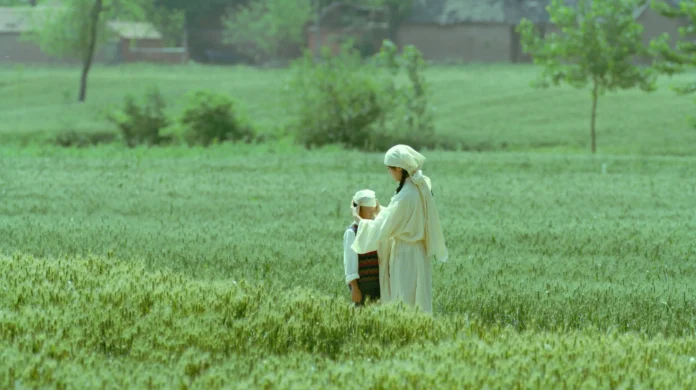
Huo’s vision would be impossible without the exquisite craftsmanship to sustain it. Cinematographer Guo Daming works mostly with natural light, capturing the wheat fields across every season from the mist of early dawn to the midsummer harvest to the magic hour of dusk. The beauty creates a striking contrast to the struggles these peasants endure. One especially indelible scene unfolds at night, when Chuang delivers a letter from his young aunt Xiuying to Teacher Guo (Shao Ran). The frame is lit almost entirely by the flashlights in both their hands, two small beams cutting through an enveloping darkness that subtly marks both figures as estranged from the world around them. Li Tao’s immersive sound design, particularly during the wedding and funeral sequences, submerges you in the textures of local tradition, while composer Wan Jianguo’s haunting score is withheld entirely until the final shot, a restraint that honors the film’s naturalism. Working almost exclusively with non-professional actors, Huo draws performances of remarkable authenticity, with Zhang Yanrong delivering a memorable portrayal of a great-grandmother in her nineties. That Huo elicits such raw, unforced work from untrained performers speaks to a directorial sensitivity that cannot be faked.
Though Living the Land carries the official “dragon seal” of Chinese government approval, reporting indicates it has effectively been blocked from domestic release, unsurprising given how candidly it portrays an era of transition that’s inconvenient to the grand narrative of “national rejuvenation.” That makes its US release all the more valuable. Huo Meng has made a film of rare patience, clarity, and moral weight. Economic reform has not yet delivered prosperity so much as redistributed hardship, draining the countryside of its young while leaving the old, the female, and the marginalized to absorb the cost. It is an elegy for a bygone way of life unfiltered by rose-tinted glass. The vast ensemble may feel daunting at first, but give yourself over to the rhythms of this village and the rewards are immense.
– Frank Yan (@frankyan2)