



A Conversation with Zack Khalil (AANIKOBIJIGAN)

“When I enter a museum, I’m not looking for what’s on the walls, I’m looking at what’s behind them,” says a participant in Aanikoobijigan [ancestor/great-grandparent/great-grandchild]. “I wonder if people know that they’ve paid $20 to enter a museum that’s holding our ancestors hostage.”
In 1990, the Native American Graves Protection and Repatriation Act (NAGPRA) was passed, requiring the return of Indigenous human remains and sacred items to their rightful communities. More than three decades later, most of those ancestors are still waiting—boxed, catalogued, and stored in museum basements and university archives. As North America’s Indigenous populations dwindled due to disease and state-sponsored violence, dispossession, and displacement, the Smithsonian Institution began assembling the world’s largest collection of human remains. Indigenous bodies were especially prized, perceived to be a “rapidly vanishing resource.” Many ended up at universities and museums that displayed them in exhibits informed by the discredited pseudo-sciences of eugenics and phrenology as evidence of Native Americans’ supposed inferiority.
In Aanikoobijigan, filmmakers Adam and Zack Khalil turn their attention to that unfinished work, following the long, often painful effort to bring ancestors home for proper burial. The film centers on MACPRA (Michigan Anishinaabek Cultural Preservation and Repatriation Alliance), a group of tribal repatriation specialists from various tribes in Michigan who carry out this work day to day. For the Khalil brothers—Ojibwe filmmakers from Sault Ste. Marie—this project marks eight years of work and represents something deeply personal. Their mother, Alison Bouchard Krebs, was an Anishinaabe scholar who studied information science and was deeply concerned with issues of Indigenous people gaining control over their ancestors and objects held in institutions. She was a poet and aspiring filmmaker when she passed away, and her spirit courses through the film.
Adam and Zack Khalil’s work has been exhibited at the Museum of Modern Art, the Whitney Museum of American Art, Walker Arts Center, Tate Modern, Lincoln Center, and the Sundance Film Festival. Their previous feature, INAATE/SE/, established them as vital voices in Indigenous filmmaking. Adam is a co-founder of Cousin Collective and both brothers are core contributors to New Red Order, an artist collective whose installations and short films often lean toward the conceptual and irreverent. With Aanikoobijigan, they recognized that the subject matter demanded a different approach—one that balanced their experimental instincts with the accessibility needed to reach a broader audience. That approach resonated: the film won the NEXT Audience Award at the 2026 Sundance Film Festival.
I spoke with Zack Khalil about this film in the following conversation edited for length and clarity.
Hammer to Nail: At the eight-minute mark, an ethereal soundscape comes in as the camera drifts through the white storage halls. “It’s the most stifling feeling when you go into the bowels of the museum where they keep boxes and boxes of our ancestors’ remains,” a film participant says. This leads into an awe-inspiring visual poem. “If an object is animate, an archive is a prison. Cutting to this psychedelic forest the narrator says, “If an object is an ancestor, when can the grandkids visit? Who pays for the plane ticket?” That moment really stood out to me. Can you talk about crafting it? Where does this text come from?
Zack Khalil: That moment was originally crafted quite a long time ago but has been revised recently. We’ve been working on the film for eight or nine years now. That quote and text came from an early sample we put together in 2019 or 2020. It always formed the backbone of our aesthetic intention and what we hoped to achieve with the film.
Starting with Majel’s amazing quote about that stifling, crumbling feeling really grounds it first and foremost in the work of the tribal repatriation specialists themselves, who have to do this fearless, courageous, and often thankless work of being in these institutions, in these really difficult spaces. We wanted to convey that feeling. We wanted to make audiences emotionally connect with what it might be like to be in one of those institutions, either as an ancestor or as an Indigenous person or tribal repatriation specialist.
Me and my brother talk a lot about physiological films—films that you don’t just see and think about or feel emotionally, but that have a physical impact on your body. We think about that in terms of stroboscopic video, in terms of sound, how sound can really hit you in your chest, sub-bass and those types of things.
The text was really important for us to have this other mode of speaking directly to the audience. Sometimes we’re using the text to speak to the ancestors, sometimes to the audience. The film has a narrator in an almost traditional documentary sense, which is unlike us, but felt right for this type of film where we needed to do a lot of education. That text voice is a chance to break outside of the more buttoned-up PBS narrator voice into something more profound, more poetic, sometimes more humorous in a sardonic way, and just really level with people: what are in these institutions, what are in these archives, are not just objects—they’re beings. Literally, they’re ancestral human remains.
The simplest way of explaining repatriation and the need for it is that our grandmothers and grandfathers have been dug up and taken, stolen from our communities, stolen from the earth, and put in these archives. We needed to frame it that way at the outset—these are animate beings, these are our grandmothers and grandfathers in these institutions. If that’s the case, then when can we visit? Who pays for the plane ticket? Repatriation work requires support and funding, grant support from the federal government, from private institutions. We wanted to make those seams clear.
HTN: At the 41-minute mark, we get this sequence, “Infinite Recurrence.” I genuinely was struggling to find the words to describe what happens in this montage. it is one of the great technical feats of filmmaking I saw at the festival. This montage combined with this poem really impacted me. The shot of the sphere turning into the hand dropping sand into the water and back to the sphere will stay with me forever. Again how did this come to life in the editing room?
ZK: It’s great to hear that resonated with you. It was a really difficult scene to put together and felt like being really vulnerable, but it also pointed toward the philosophical depth of the film and realized that technically and visually.
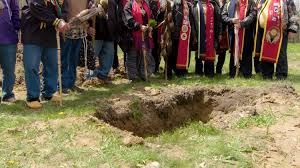
A still from AANIKOBIJIGAN
One small correction that’s intentional: what was being dropped into the water was actually tobacco. In my tribe, tobacco is used daily to make offerings. If you go hunting or pick some blueberries, you leave some tobacco. It’s an acknowledgment of reciprocal exchange. It makes sense that I didn’t explain what that is—that also gets at something about how me and my brother make films. People think about filmmaking horizontally through a timeline, and we like to think about filmmaking vertically, where a certain shot or statement might mean different things to different audiences.
An Anishinaabe audience would probably recognize that as tobacco, but you still recognize the exchange from whatever—tobacco into stars. It still works on different levels.
The film was deeply inspired by our mother, Alison Bouchard Krebs, who was an amazing Anishinaabe scholar concerned with Indigenous people gaining control over our ancestors and objects held in institutions.
She was a poet and aspiring filmmaker when she passed away. The poem, the text of that moment, is written by me. It came all at once, like it just came to me. I’m not really a poet—I like making films—but thinking about the subject matter, I had something I had to say, and it all came out in one sitting. It felt like it needed to work its way into the film.
For me, the language is about short-circuiting our logical brains while also engaging in logical thinking and acknowledging the ways that ancestors shape all of our lives at all times, how we’re all the products of countless generations of ancestors, and that sense of time where past, present, and future is collapsed. Visually, we wanted to aid the language. The language washes over you while we engage in superimpositions and stroboscopic editing, thinking about rocks, magma, lava tunnels, and neurons as all different parts of the same process—ways we’re not so different from how the Earth itself is a living being, how to disconnect our brains from these compartmentalized ways of separating ourselves from others.
HTN: At the 46 minute mark we get this footage from the world’s fair where the people were showcased and we get this expose about the Smithsonian and their intentions with the fair. The head of the Smithsonian was single-mindedly obsessed with collecting bones. Right when the film participant says that this encouraged people to question this objectivity, a really disturbing stab of music comes in as we get this collection of horrifying drawings and paintings of these situations. Subjectivity, ethnocentrism, these images really shocked me to my core. how did you guys source this material the archive here is so excellent
ZK: We worked with a few different archival producers—Grace Remington, one of our producers, and first and foremost Avery Fox, who did some really amazing work for us. Me and Adam, being directors and editors, found a lot of stuff ourselves because that’s how we have to work sometimes. This history is really rich and still really present in so many ways. A lot of it was able to be in the public domain—stuff over 100 years old.
It was really important to make clear how not-so-distant this history actually is, and how institutions of science today—the fields of archaeology, anthropology—really emerge from these racist modes of pseudo-scientific inquiry like phrenology. It was in the 1930s that the American Museum of Natural History hosted the second-ever conference on eugenics before World War II. These institutions less than 100 years ago were still deeply engaged in this fundamentally racist, dehumanizing dialogue.
A lot of the images you’re talking about actually came from political cartoons making fun of phrenologists, making fun of eugenicists, even in the 1930s and earlier. People in the day knew that what they were talking about was horrible and laughable in some ways. People were already making fun of them.
I want to say this because I think it’s too easy for people to view this film or Native people as being anti-science, anti-museum or anti-institution. That’s fundamentally not the case. Indigenous people have had our own scientific practices for millennia. Indigenous people engage in Euro-American science and empirical modes of inquiry today. We just want to do so in a spirit of consent and collaboration. We don’t think museums need to be burned down. We don’t think science should be thrown out, especially in this political context, but it just needs to be done in a way that acknowledges some of its rotten roots so it can change to move forward in a better way.
HTN: You and your brother have talked about the camera as a weapon that’s been wielded against Indigenous people since its invention—anthropology’s obsession with preserving images of “vanishing cultures.” So how do you wield it differently? What specific camera techniques or visual subtleties were deployed to achieve that?
ZK: Some of that thinking is deeply inspired by Juan Downey, this amazing video artist, and our own mother. How do we wield it differently? One is to acknowledge that it still has the potential to operate as a weapon, that there’s fundamentally an unbalanced power dynamic no matter what you do. When you’re pointing a camera at somebody, you’re the one who gets to edit their image and decide what they say later. One approach is just the acknowledgment of that reality and being honest about that with our participants.
Another thing is attempting to craft a film together. I think the word “collaboration” gets thrown out maybe a little too freely. If we’re shooting the images and editing the images, there’s only so much collaboration there. But we do share cuts with our participants in ways that are really open to feedback.
Documentary, especially commercial documentary, has this notion of extraction—how to efficiently extract information, how to efficiently extract soundbites. You might have a script supervisor who has a bunch of boxes to check: “You got them to say this, you got them to say that, you’re good.” That makes sense—making a film takes a lot of time, shooting and editing an interview takes a lot of time. But our approach is much more about visiting with people and talking to them in an open-ended way. Our interviews range from two to six hours depending on who we’re talking to.
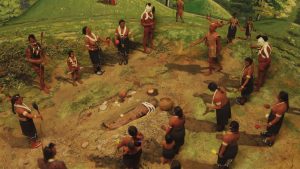
A still from AANIKOBIJIGAN
It’s about going in with a certain idea of what we want to talk about but having open-ended questions that allow the participants to guide the conversation. Especially with these tribal repatriation specialists, from the outset we needed them to tell us that making this film was a good idea, and to set up ground rules for how to do it in a way that avoids the weaponization of the camera.
HTN: At the hour mark, we see many elders carrying the boxes of remains, and one film participant talks about the cosmic connection you feel handling one of these boxes. “When we talk to our ancestors, we’re not just calling on them for spiritual support. We also have to help heal them. There’s the sensation that you feel after handling the ancestor that follows you for a while. You become fatigued.” Can you talk about the experience of being there that day and what was important to you in editing this moment?
ZK: That was one of many repatriation transfers and reburials that we filmed and also participated in. It was really resonant to hear Matthew articulate the reality of what doing this work takes—the mental, emotional, and maybe even spiritual burden that the tribal repatriation specialists encounter by doing this work every day. We needed to highlight that. It’s not as simple as carrying out a box. You’re a pallbearer. It’s even more intense than just being a pallbearer—it’s not someone who just died. It’s someone who died 100 years ago, 500 years ago, who’s been violated in this way for so long. The tribal repatriation specialists need to mentally, emotionally, and spiritually prepare themselves to do that work. It was an honor to show parts of that process. Of course, there are parts we didn’t show intentionally.
The tribal repatriation specialists made it imperative for us to not just document the process but to be participants in it. We might start by documenting the transfer and then stop halfway through and just help carry the ancestors out. There’s a scene in one of the reburial ceremonies at the end where Adam and Shaandiin Tome, this amazing cinematographer, are shooting, and George, the spiritual leader, points to Adam and says, “Get over here.” He pulls him over to the reburial and says, “Get in the hole.” And he gets in the hole and starts handling the ancestors, picking them up, gently setting them down for reburial. Shaandiin was still rolling, so that’s in there.
It was really important for the repatriation specialists that we weren’t just documenting the process but participating in it.
Certain tribes even invite the scientists themselves or the archaeologists and museum representatives to reburials—not to take notes and learn in this anthropological way, but to participate in the process and understand the gravity and love that goes into it. It was important for us to show that as well.
HTN: Your work with New Red Order has pushed for language beyond repatriation and decolonization. You’ve said you’ve been pursuing language that “offers alternatives to the vocabulary of repatriation and decolonization, which centers acts of displacement and dispossession.” With this film, how are you reckoning with that?
ZK: Me and Adam often think of this film, which is a collaboration between me and Adam, and New Red Order’s work, which is a collaboration with a larger group of other people, as really distinct and separate. The reality is they’re deeply intertwined on a lot of levels, but they’re also distinctly different in approach. The work on this film—highlighting the work of MACPRA and their tribal repatriation specialists—comes with deep reverence and carefulness due to the sensitivity of the subject matter. The work of New Red Order, which operates outside the documentary world and more in the fine art and activism world, is approached with a much higher degree of intentional irreverence. There’s humor in both, but with New Red Order we can really lean into that.
Having both practices has been really important. Aanikoobijigan documents such heavy work and has to be handled with such care and concern. New Red Order feels like a pressure release valve sometimes, being able to engage in humor. In terms of how they’re the same, a deep inspiration for us is Eve Tuck and K. Wayne Yang’s “Decolonization Is Not a Metaphor.” People talk about decolonization as a way to improve our schools or the way we think. But decolonization is fundamentally material—it’s fundamentally about the return of Indigenous land and life. Both of these practices represent different sides of that. New Red Order’s “Give It Back” project is focused on the repatriation and return of all Indigenous land and life, but land specifically. This repatriation work is one of the ways in which life is returned to our communities—the ancestors themselves.
In order to move beyond the “De” and “Re” words, we have to move through them first. Rhetorically, you can say “indigenize”—so it’s not an undoing or redoing, but advocating for something different. Maybe one way of thinking about how we move through repatriation and decolonization to get to another place is seeing the work that MACPRA did with Michigan State University to indigenize their way of thinking through the process of getting them to repatriate their ancestors. It’s really about forming relationships where repatriation is the first step that could lead to true decolonization, where these institutions can serve Indigenous people, can commit concrete resources—perhaps even land, and certainly life. It’s about moving through those processes to indigenize and move into a different way of being together. To imagine and create different futures together.
– Jack Schenker (@YUNGOCUPOTIS)