





A Conversation with Lee Byung Hun (NO OTHER CHOICE)
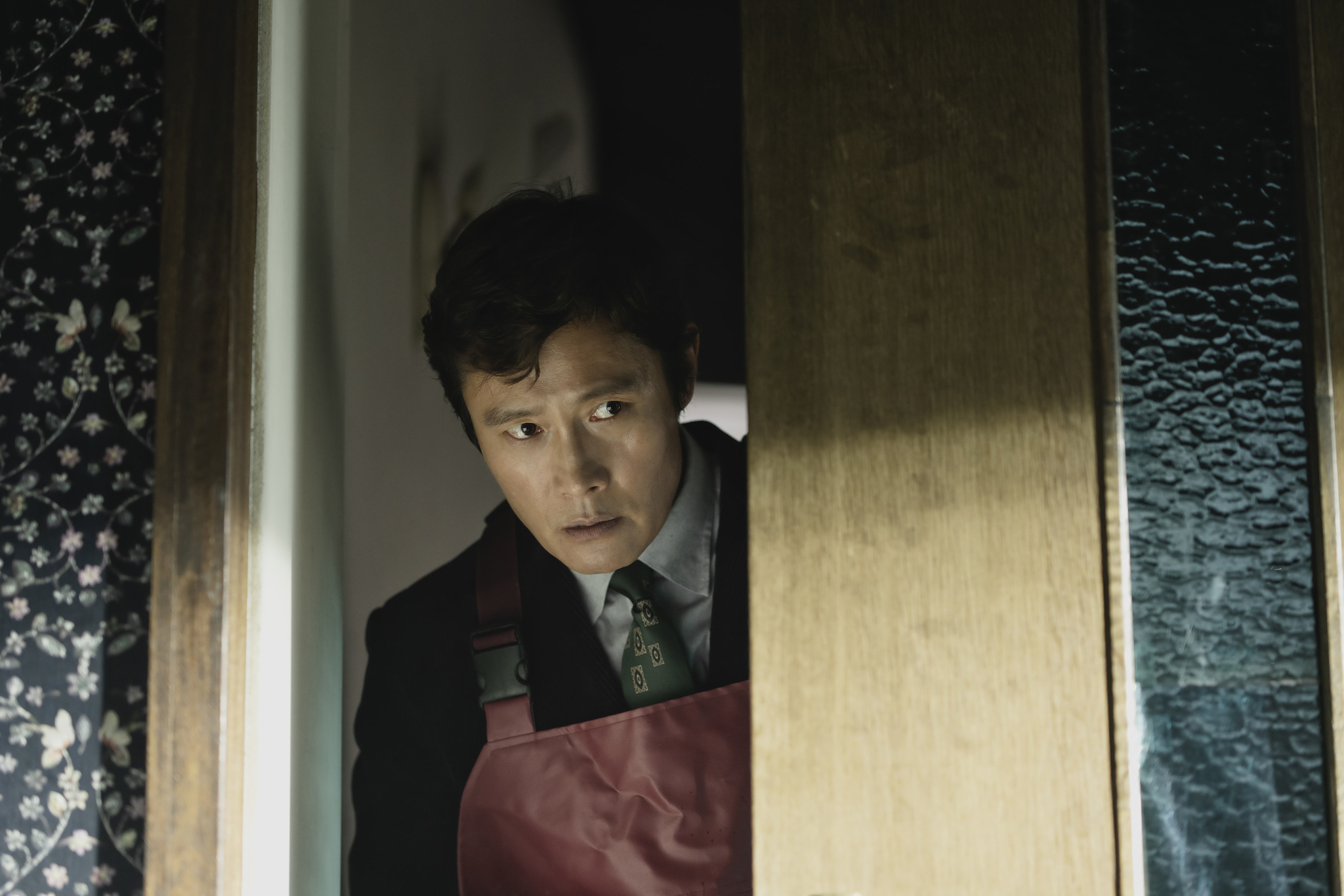
Park Chan-wook returns with No Other Choice, which might be his most wickedly funny film yet. Lee Byung Hun stars as Man-su, a paper manufacturing specialist who has spent 25 years climbing the corporate ladder only to be unceremoniously laid off when American investors restructure his company. Rather than pivot to a new career or accept a diminished role in the workforce, Man-su decides on a different path: he’ll simply murder the three other qualified candidates for his last remaining job prospect, leaving the hiring executives with, as the title suggests, no other choice but to hire him. What follows is a pitch-black comedy about a man so tethered to his professional identity that he’d rather become a serial killer than reimagine who he is.
Lee Byung Hun, reuniting with Park Chan-wook for the first time since the landmark 2000 thriller Joint Security Area, delivers a performance of remarkable tonal dexterity. Man-su is simultaneously pitiable and monstrous, meticulous in his planning yet catastrophically inept in execution. Lee plays him with a wounded dignity that makes even his most absurd schemes feel grounded in genuine desperation. It’s the kind of performance that requires an actor to be funny and to generate sympathy for a character whose actions are indefensible. The physical comedy alone, Man-su’s bumbling attempts at murder, his nervous tics during job interviews, would be impressive, but Lee layers it with a profound sadness about what capitalism demands of us.
The film also stars Son Ye-jin as Miri, Man-su’s wife, who becomes increasingly central as the story progresses. Featuring another inventive score from long-time Park collaborator Cho Young-wuk, No Other Choice premiered at the Venice Film Festival and marks the director’s adaptation of Donald Westlake’s 1997 novel The Ax. Having seen the film twice, I can say it’s one of the most darkly hilarious and unexpectedly moving films of the year, a work that asks the question what happens when a man’s entire sense of self depends on a system that views him as disposable. NEON releases it theatrically in the United States on Christmas. It was an honor to speak with Lee in the following conversation edited for length and clarity.
Hammer to Nail: It’s been 25 years since Joint Security Area. You’re reuniting with Director Park on this film. How has your close personal friendship influenced the way you two work together? And what was different about Director Park’s style on set with this film?
Lee Byung Hun: We’ve been friends for 25, 26 years now. We’ve been good friends. We drink together often. He sometimes comes to my house to have dinner. We watch movies together. We support each other’s projects. So it was very comfortable to work with him.
However, in working with Director Park on this movie, I realized that he had even greater depth and meticulousness in what he was asking of us. The emotions he wanted were even more complicated. It was really impressive to see that as he got older, he was even more passionate about filmmaking.
HtN: At the 13-minute mark, we have this humiliating job interview where the light is getting into your eye. Your leg is shaking, the answers you’re giving don’t seem to be landing with the bosses, and your friend who got you the interview looks upset. You begin sweating as they ask you what your weakness is. What was your thinking here?
LBH: There are two interview scenes in the film: the first interview scene and the last interview scene at the end of the movie. I personally really like those two interview scenes. In the first interview scene, I had to do so many things at once. For the dialogue I needed to have it memorized to an extent that it was automatic for me. There is so much other action happening, avoiding the sunlight coming through the window, I am paying attention to my sore tooth waggling inside my mouth, pressing down on my shaking leg. I had to learn my lines perfectly so I could do all of that at once.
HtN: At the hour mark, we have my favorite sequence of the year. As “Red Pepper Dragonfly” blasts on the speakers, you wake up Lee Sung-min and pull a gun on him. Ara sneaks up behind you and is about to hit you in the head with a sculpture. When you start making points she agrees with about the music café, she can’t help but chime in, which startles you, and you shoot Lee in the shoulder. Ara hits you in the head, and what ensues is a messy, violent, and hilarious struggle that results in Lee’s death. Can you talk about shooting this sequence and what was important to you?
Lee Byung Hun in NO OTHER CHOICE
LBH: In making this scene, I think Man-su sees that Bum-mo reflects himself in many ways. It creates a deep sense of empathy. It’s like he’s almost talking to himself over the loud sounds of music. I knew all of this had to make sense. So it wasn’t just about the humor of the scene or the thriller elements, but rather all these metaphoric elements coming together as one.
Ara really reminds Man-su of his own wife, and their relationship echoes his relationship with Miri. So when Man-su catches Ara cheating on her husband, it creates doubt within himself that Miri might be cheating as well.
One idea I contributed while shooting this scene was that the gun gets released, goes under the credenza, and the three characters wrestle almost like worms crawling on the floor trying to get the gun back. That was some blocking I suggested, and we adjusted it a bit to accommodate this moment.
HtN: At the hour and ten-minute mark, there’s a very hard-hitting argument between you and Miri. You accuse her of sleeping with the guy from the dance. She accuses you of drinking and cheating. You can’t defend your actions because obviously you can’t admit to murder. So you slam your head into the lamp and walk out. This sequence hits the full spectrum of emotion. What was important to you here?
LBH: We all pretend to be elegant and polite in public, but in real life, everyone has these pathetic moments. This fight is so pathetic.
Man-su is saying, “I’m the patriarch, and I’m going through all this trouble for our family.” That is what prompts him to hit his head on the wall. What worried me at the time was that it shouldn’t be seen as over-the-top comedy, it needed to encompass other emotions as well.
From Man-Su’s point of view he feels like he is going through this extreme sacrifice. He cannot say that outloud so he is experiencing major frustration. He feels extremely frustrated and needs that energy to be released somehow, which is why he bangs his head and resorts to self-harm. It can be seen as an overly comedic moment, but it’s really because he has no other way to express himself
– Jack Schenker (@YUNGOCUPOTIS)