



Lav Diaz is one of cinema’s most uncompromising voices, crafting epic meditations on Filipino history, trauma, and identity that routinely stretch past the four, six, or even eight-hour mark. His films, including Melancholia (2008), Norte, the End of History (2013), and the Venice Golden Lion winner The Woman Who Left (2016), use duration as a tool to immerse viewers in the weight of historical suffering and the slow passage of time that shapes a nation. With Magellan, Diaz has made his most accessible work yet: a 160-minute historical epic that examines the 1521 arrival of Ferdinand Magellan in the Philippine archipelago, an event that irrevocably altered the course of Filipino history and began centuries of Western colonization. Starring Gael García Bernal in the title role, Magellan traces the Portuguese explorer’s journey from his early campaigns in Malacca through his fateful final days in the islands of Cebu and Mactan. But this is not the myth of Magellan, it’s the truth of his journey. Diaz examines this moment of contact, interrogating the violence of conversion, colonial ambition, and the indigenous resistance that ultimately ended Magellan’s life.
The film gives voice to the Filipino perspective that has long been sidelined in Western accounts: Raja Humabon, the king who initially welcomed the Spanish before turning against them; and Enrique de Malacca, Magellan’s enslaved translator who was likely the first person to circumnavigate the globe, an achievement history has largely attributed to Magellan. Shot by Artur Tort with Diaz’s signature long takes and deliberate pacing, the film features a remarkable supporting cast including Ronnie Lazaro as Humabon and Arjay Babon as Enrique. It premiered at the Cannes Film Festival before playing at the New York Film Festival. Magellan is one of the best films of the decade, a towering achievement that demands to be seen on the biggest screen possible. Janus Films releases it theatrically January 9th. SPOILER WARNING!!
Hammer to Nail: I’d love to talk about the opening moments of this film. It’s really striking how you begin with the sounds of nature, a woman going about her day peacefully, and then that peace is interrupted by a white man off screen. All we see is her reaction. Was this the first thing you wrote? Can you talk about what was important to you with this opening?
Lav Diaz: There’s an urgency to show it that way. It’s been that way with our culture and other indigenous people all over the world—there’s always this overwhelming belief that the white man is coming to save us, to emancipate us, that the Messiah is coming. That very first image is articulating that culture. Of course, it’s a form of defiance to that idea. You have to confront it immediately. When I was shooting the film, I already knew that would be the first image.
HTN: At the seven-minute mark, we’re told via text that this is Malacca in 1511. The camera cuts between a few different angles of the death and destruction the colonizers have caused. We’re introduced to Magellan as he is seemingly passed out amongst a group of dead bodies. One of his Spanish comrades notices him and carries him out. What was your thinking with introducing Magellan this way, which later parallels the moment where he dies amongst death and destruction with his son?
LD: He is a mortal human being just like us. I wanted to show him as a normal human with emotions and ambitions. It’s a reality. He was part of so many massacres and battles, and he survived all those. That’s why he became so ambitious. He was part of Almeida. He was part of Albuquerque. He was part of Sequeira. All the campaigns in India, all the campaigns in Africa and Morocco, he was part of it. He’s just a human being who was part of these atrocities, and the issue of struggle and survival has been part of it. So he’s just like us. I want to look at him that way. A mortal.
HTN: At the 30-minute mark, after Dom Albuquerque (Roger Alan Koza) has passed away, Magellan, Duarte (Dario Yazbek Bernal), and another soldier sit next to his body and talk. Duarte goes off to puke as Magellan and the soldier laugh at him. They continue to poke fun at Dom Albuquerque, which leads into Magellan saying that, “these viceroys, governors, sultans, they need us more than we need them.” What was your thinking with this moment?
LD: The speech that Albuquerque said there is a real speech. It was recorded. I just improved it a bit, changed it a bit, but it was really recorded that way. I have to show that even then, what we’re experiencing right now, what these people are doing right now, all the heads of state, all these kinds of people destroying the world now, like Putin, Trump, all these guys, they’re still the same. They have the same thinking. Albuquerque was thinking about choking all the trading areas not owned by Portugal, banishing Islam forever. This is the 16th century and they were doing it already. The way they went to Malacca was so atrocious. The massacre,15,000 Malays during that massacre. So bloody.

Gael García Bernal in MAGELLAN
HTN: At the 59-minute mark, we have this fight between Magellan and the poet. The poet says all the crown cares about is conquest, power, riches, that they are killing and selling so many people in the name of God. They stand in silence for a bit, both discuss their disdain for King Manuel of Portugal, and then the poet turns it on Magellan. He says “it’s all the same, it’s a murderous proposal driven by greed.” This causes Magellan to lash out and punch the poet telling him that he is the same as Magellan and in fact has profited even more from the king. This is all depicted in a beautiful medium longshot. What was important to you here?
LD: That’s a real person, a real friend of Magellan. His name is Francisco Miranda, a great poet. All that’s said there is real. I reimagined the way they talked then. It’s important to say that because a lot of people, like poets, were aware of what was happening. It’s all plunder. It’s all fracturing indigenous cultures just to gain things. They knew what was happening. Even Magellan knew these things, but he was overwhelmed by ambition. With Miranda, it’s already an awareness. Miranda went to Italy after that confrontation and left forever. He still has those poems, great poems.
HTN: At the hour and 14-minute mark, we have this strife between Magellan and Juan de Cartagena (Max Grosse Majench) after the sentencing of Antonio de Salamón. Juan asks why they are still following the African coast. Magellan responds ambiguously saying, “security reasons.” This angers Juan, who says, “Why are you treating me like a simple subordinate? I am your co-captain.” Magellan responds, “You know nothing of the sea. It’s obvious we are not equals.” After further back and forth, Magellan screams that he has full control over life and death on this ship and accuses Juan of treason.
What I find most interesting is that the final bit of this argument we hear off screen as the camera sits on Enrique de Malacca’s worried expression. What was your thinking here?
LD: I wanted to reimagine this because Juan de Cartagena is the son of Bishop Fonseca. Bishop Fonseca was the most powerful man in Spain then. He was the advisor of the young King Carlos. King Carlos was just 19 and couldn’t even speak Spanish well because he was trained in French and German. So the one guy running Spain was Bishop Fonseca, and he was the one who signed the contract and assigned his son Juan de Cartagena to be co-captain.
It’s true that Juan knew nothing about these experiences at sea. He was just put there by his father to take care of Magellan. Taking care of Magellan means banishing him at some point. There was a plot against Magellan. He knew it. He was a smart guy. The mutiny had already started. Even when they reached Brazil, there was already a mutiny. There was also the killing of the gay couple. It was happening. It was right for him, for survival, to maroon Juan. It points to how hard the expedition was. There was already a plot from King Manuel of Portugal to stop them at the Canary Islands, and Juan de Cartagena was the leader of the mutiny. Had the mutiny succeeded when they reached Brazil, Magellan would have been gone. It’s an important episode in the film, that confrontation, just to show how hard the struggle was.
HTN: At the hour and 19-minute mark, we have this confession sequence. Magellan asks for forgiveness for having executed Antonio de Salamón. He tries to make excuses that it was his duty sanctioned by the Pope. The priest tells him he has committed a mortal sin. Magellan accepts and quickly shows his true intentions behind this meeting, commanding the priest to tell him who was responsible for the mutiny. The priest pushes back, saying the confession is sacred and Magellan has profaned it. The sequence ends as we watch the priest look off with disgust as Magellan walks away. What was important to you here?
LD: That scene shows how complex Magellan was as a person. He believes in his religion, Christianity, the Catholic faith. But at the same time, he’s also a true Machiavellian. He knew all the secrets were being kept by the priest. The key to ending the internecine conflict was the priest. He’s that Machiavellian. He believes in the Catholic faith, but at the same time, he will destroy all these doctrines just to save the expedition, his ambition. It’s complex, but at the same time, you can see he’s a true leader as well. An ambitious man who will destroy his faith.
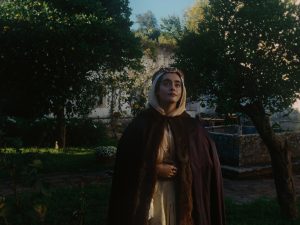
HTN: At the hour and 28-minute mark, we have this first vision of Beatriz (Ângela Azevedo). She tells Magellan as he sleeps that their first son Carlos was born today. He was born a strong boy, but after a few hours, he released his final breath. He had blood flowing from his nose, ears, and eyes. “What curse is this, my love?” she asks. They cuddle in Magellan’s bed for a little bit. The framing and lighting here is terrific. Can you talk about crafting this moment?
LD: We planned that so well. All those scenes about Beatriz show the more human, the more emotional part of Magellan. That really happened. His young son died that way when she gave birth to him. Suddenly there was this bleeding.
Ângela Azevedo in MAGELLAN
There’s this connection. Going back to the idea that we treat him as a human being, a person like us who has a family, who has a father, who yearns for his wife and dreams of going back someday or bringing his whole family to the archipelago. He’s a real human being with that connection, that soul.
HTN: At the hour and 47-minute mark, we get this striking sequence where a woman ritually sacrifices a pig. She plays a gong-type instrument while we see the pig try to escape. She sets the instrument down and screams, “Spirit of the winds, help our children, have pity on us, save them!” She approaches the pig slowly, raises her weapon, and before slaughtering it, lets out a war cry. We cut to her and the surrounding audience covered in blood as she continues to scream, “Have pity!” Can you talk about crafting this moment, and your decision generally throughout the film to never show violence, only the aftermath?
LD: A major part of structuring the film is to have a balanced view, the Malay view, showing our culture during the period. That practice is still being practiced by our indigenous people. The tribes in the mountains still practice this, being led by women like that. We call them the healers, the Babaylans. There are still many of them today.
The healing in the scene actually happened during the period when Magellan reached the islands, especially Cebu. There was a plague, like a pandemic. Young children were dying. You see the scene where the women were burying bodies in the ocean. That was happening. That’s why the conversion was successful when Magellan gifted the wife of Humabon with the Santo Niño.
Of course it was actually the fruit jam. Magellan was making fruit jam before he sailed because he knew vitamin C fights scurvy, the number one killer among sailors then. He was able to use it during the introduction of the Santo Niño to the wife: “Maybe the young Jesus can heal your son, but please feed him this twice a day.” It became a huge thing in our country until now. The miracle of the Santo Niño. The Philippines is 80% Catholic. Every Catholic household in the country has a Santo Niño. The biggest religious fiestas in the country are about the Santo Niño. It’s a mix of pagan rites and Catholic tradition. They’re still reenacting the miracle of the Santo Niño.
HTN: At the two-hour and five-minute mark, after Jesus Christ supposedly heals the child, Magellan delivers a speech to the people. He says things like, “Today you will embrace the kingdom of God,” and talks about how they need to be baptized. This ends in Magellan requesting that the people do not pray to anyone else but Jesus Christ. Seemingly confused, everyone nods their heads, and this leads into a rather disturbing chant of “Jesus Christo” and “Amen.” What was important to you in crafting this moment?
LD: It really happened according to Pigafetta. I reimagined his speech, so I wrote it. The complexity of it is the irony. He’s talking about the very forgiving Christ. Christianity is an emancipatory kind of practice. But at the same time, after the conversion, he imposed a law that anybody who still practiced the pagan things, like our Anitos, our deities, must be destroyed. Anybody who didn’t want conversion would be killed in two days.
It’s a very complex way of introducing conversion while at the same time enacting laws that are so arbitrary in terms of imposing punishment, killing, destroying old traditions. I think that eventually destroyed him. In a few days, Humabon changed his ways. There’s the Battle of Mactan, and then four days later, the Massacre of Cebu.
HTN: I’d love to talk about the ending. You end the film with the people dancing around a fire holding Magellan’s head. In the distance, we see Enrique de Malacca still alive, watching from the bushes. Voiceover tells us that later they held a feast in which they murdered the last of Magellan’s men. Enrique was a co-conspirator, and he had to do it for his freedom. This is actually the true history, Magellan promised that if he died, Enrique would be indentured to no one, but he proved so useful with his translation skills that the remaining men told him they owned him now. This is when he conspired with the people to set up the feast and murder them. Can you talk about these final moments and your decision to sum it up with voiceover as opposed to showing these events?
LD: I needed to put the voice of Enrique, the Malay, as the last voice. Those things actually happened. The Massacre of Cebu, May 1st, four days after Magellan was killed on April 27th. According to Pigafetta, the conspirators were Humabon and Enrique. That was the last Enrique was seen. Nobody saw him again.
It’s important to put it at the end, especially his voice, especially the last line about freedom. “I did it for my freedom.” It’s an imposed line from me. We need that. An emancipation based on struggle, not based on the imposed perspective of the West, religion or whatever. It must be that way. Struggle. Resistance. The idea of freedom must be based on resistance, struggle, and awareness, why we are this way and why we were that way then.
– Jack Schenker (@YUNGOCUPOTIS)