





A Conversation with Brea Grant & Ed Dougherty (GRIND)
The satirical horror anthology Grind just had its world premiere at the 2026 SXSW Film & TV Festival (where I reviewed it). From directors Brea Grant, Ed Dougherty, and Chelsea Stardust, the movie follows an unlucky cast of characters as they fall afoul of DRGN, a stand-in for every mega-corporation (especially Amazon) currently ruining our lives. With actors like Barbara Crampton and Rob Huebel leading the cast, Grind proves an entertaining romp through some of the worst nightmares of our modern era. I spoke with Grant and Dougherty at the festival, and here is that conversation, edited for length and clarity.
Hammer to Nail: Hello to the both of you! You have a third director, as well, who’s not here. Who did what?
Brea Grant: So it’s an anthology and Ed directed two segments, I directed two segments, and Chelsea directed our wraparound.
HtN: How did the collaboration come about? I believe that the both of you did a short film before called “MLM,” which is one of the anthology stories.
BG: We always hoped we’d get to make a feature-length anthology, including “MLM”. Before we shot “MLM,” we actually mapped out the whole world and what it would look like if we got to shoot that anthology. I think a lot of people try to do that and they actually never get to make the full feature. We were really fortunate that we did get to make the full feature. So we got together to do “MLM” because we were sort of just working together. We’ve known each other for a long time and “MLM” served as our proof of concept to see if we could actually do something together.
Ed Dougherty: We were working on several larger things and we were like, “Well, let’s just make something and get it out there so the world can see.”
HtN: So which two segments did each of you direct?
BG: I did “MLM” and “Delivery,” which are the first two.
ED: And I did “Content Moderation” and “Union Meeting.”
HtN: So, why make this takedown of the Amazonian Gig Economy as an anthology film?
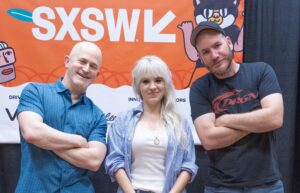
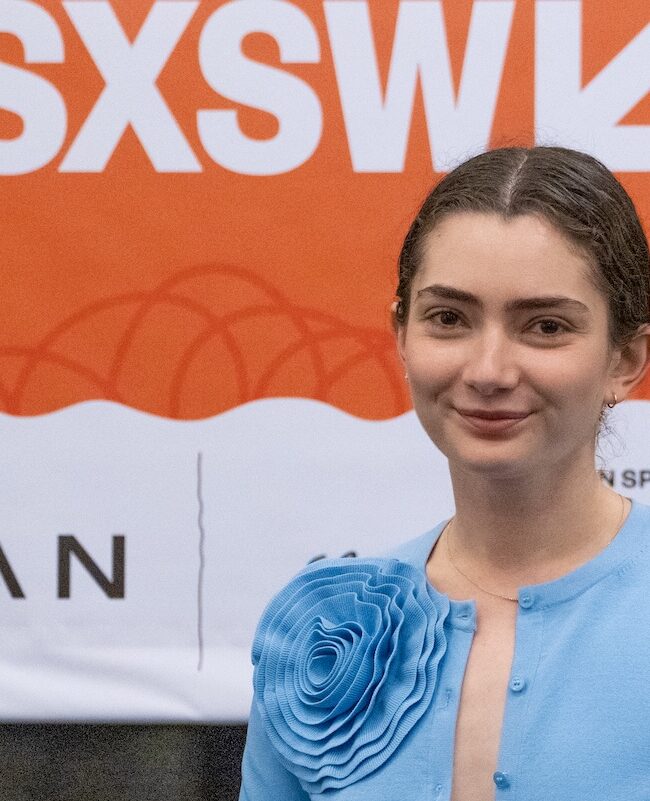
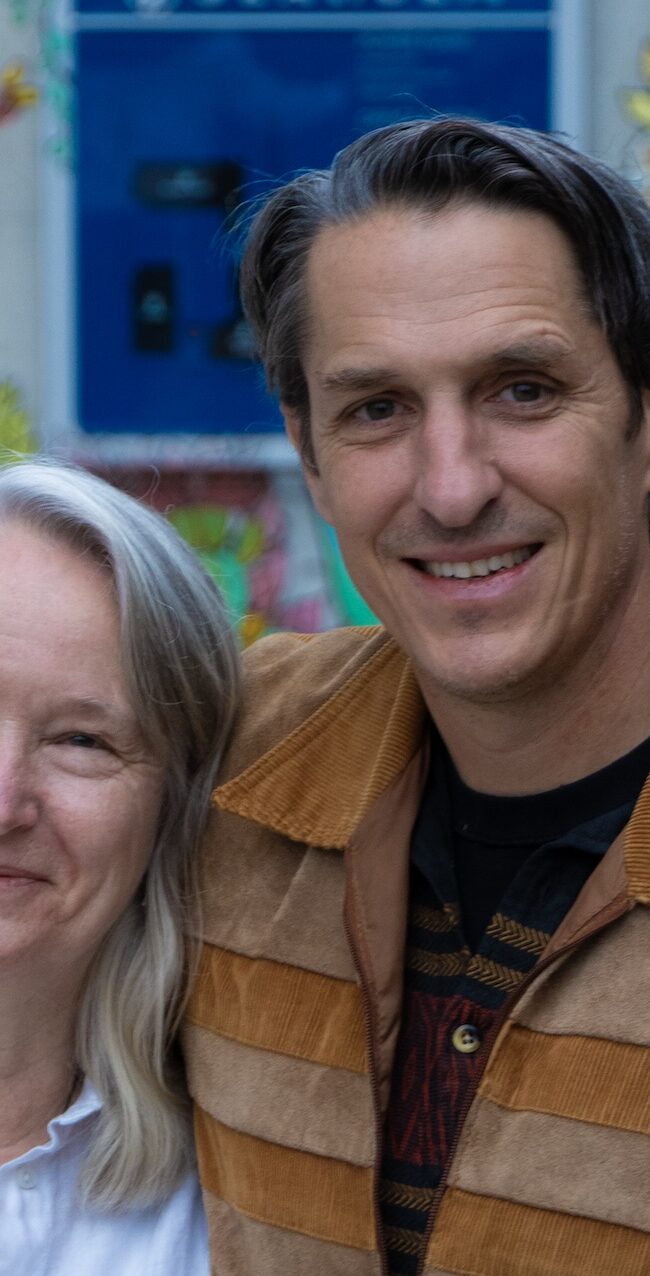
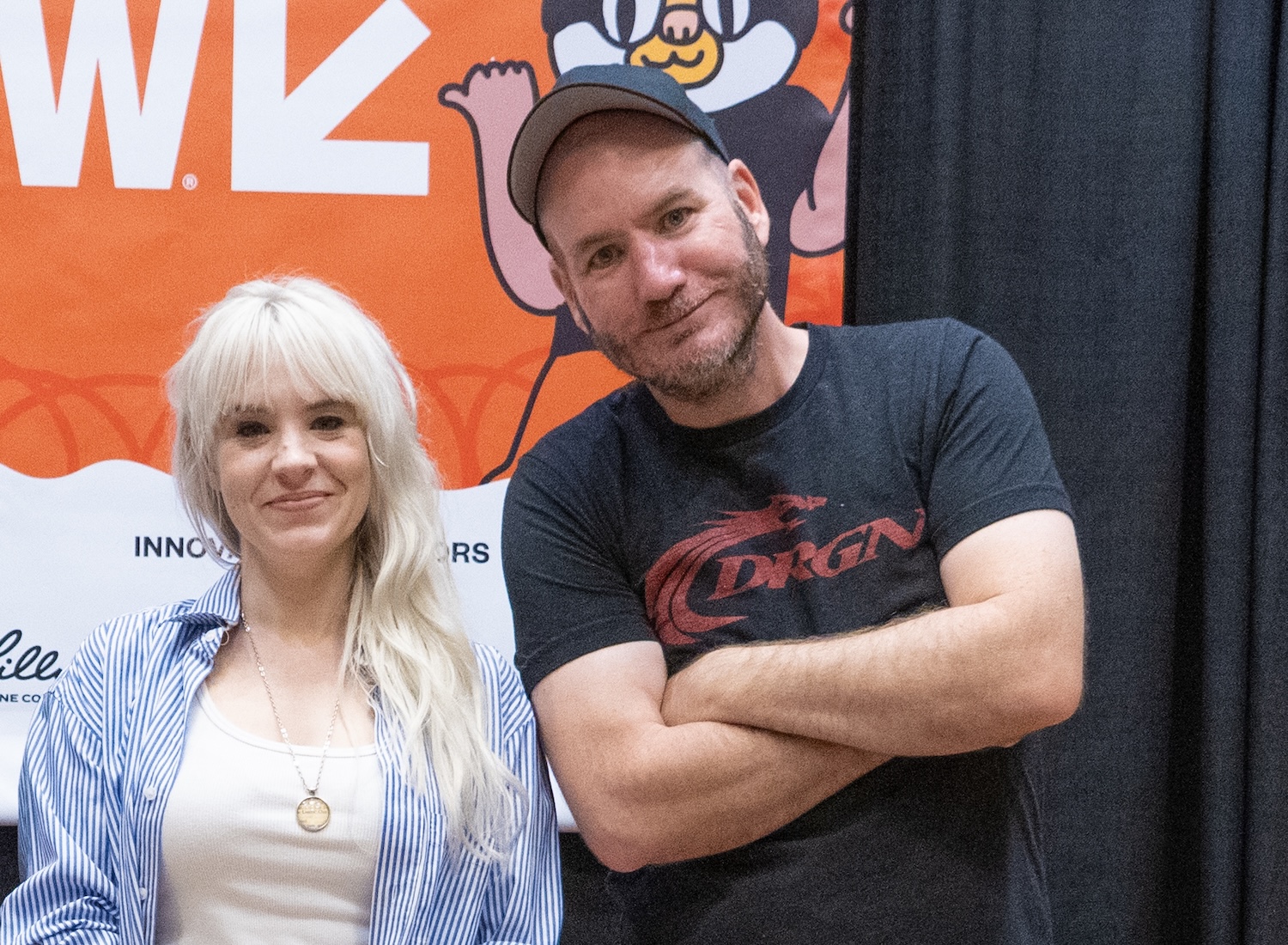
HtN’s Chris Reed and filmmakers Brea Grant & Ed Dougherty
ED: Well, I feel we’re kind of telling a story about the whole economy that we’re all experiencing and living and suffering through. And so if we made it about one job, everyone would say, “Man, that’s one job. Thanks.” So it felt better to do it as a spectrum. And we both have always loved anthology movies and I’ve always wanted to make a good one.
BG: Exactly what you said. I think we were able to feature so many different kinds of jobs. And there are great movies just about someone doing one crappy job, but for us it was important to show that variety.
HtN: You also navigate quite well, I think, the combination of comedy and horror. Why did you want to mix those two and what challenges did you face in marrying the two genres and the two tones?
ED: Well, life is a horror-comedy, so it felt true to life. And I think, for us, navigating those tones is quite natural. I mean, I feel like that’s the world that I’ve always lived in, mentally. I’d say the biggest challenge is if you say the words “horror-comedy” to someone, they throw their dinner in your face.
BG: Yeah, don’t call it a horror-comedy! (laughs) It’s like a bad word in the horror scene. We’ve been calling it a satire. But we are both funny. Even when we try to write serious things, sometimes there are a bunch of dumb jokes. We always lean towards the comedy. I think we both really like stuff that’s fun and entertaining. And so we wanted it to be something that had a message, had something to say, but also was a fun time.
HtN: Can we unpack what you just said about horror-comedy for a moment? Why is it a bad thing?
BG: Do you like them? Do you like horror-comedies?
HtN: I do. Yeah. So why is that bad?
ED: Well, not to argue with Brea here, but you said “in the horror scene.” I think it’s worse in the entertainment industry.
BG: That’s true.
ED: I think it’s perceived as corny or hard to sell, or something, but I think it’s interesting because really, there are tons of horror-comedies that are quite successful. But once you become successful, you get moved out of the horror-comedy area. No one’s going to call Get Out a horror-comedy, but it’s pretty funny and it is a horror movie. Yeah, there are a million examples like that.
BG: Yeah. I don’t know. It’s funny. I don’t know why it gets … It’s one of those things where horror is already a genre that’s obviously outside … I mean, we all love it, but outside of the horror community, it gets a little bit like … It’s not winning Oscars, although we’ll see … (laughs) [Sinners did not win, sadly]. So I think it gets a little bit shoved to the side and then you add comedy, which is another genre that also gets sort of not honored in some ways, and you combine the two and they’re like, “Wow, these two things that we both don’t take seriously.” But I mean, I think you’re right. And I think people are coming around to it. And when I ask people, they’re all like, “No, I do like horror-comedy.” But I think it’s also us dealing with the sales aspect that we’ve been warned not to use those words.
ED: Oh yeah. I think when people think of horror-comedy, for some reason they don’t summon a good example. They summon … I’m not knocking this movie because I actually like it, but The Lair of the White Worm, the Ken Russell movie, like they think of like a corny and a really obscure reference.
BG: (laughs) That is so obscure!
ED: But they think of like a corny example. But I like that movie.
HtN: Of course, your film is also very much a social-horror film, which has become a genre thanks to films like Get Out or, previously, Jennifer’s Body, because it tackles important social issues. So it’s many things … including a satire.
BG: Yeah, for sure. And I think when you’re tackling these issues, maybe it’s a little bit easier to put in a little bit of fun, make it a little bit easier to swallow for people. So putting some fun and comedy in there is always smart.
HtN: Let’s talk about the casting You have, of course, horror legend Barbara Crampton, and then Rob Huebel and others. How did you cast the film?
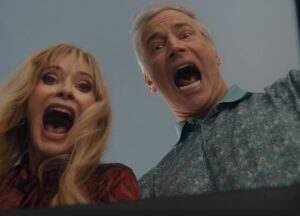
Barbara Crampton & Rob Huebel in GRIND
BG: So we’re very lucky and got to shoot this in LA, which is where we both live and that is so hard to do on this budget level right now. Always has been. I think it’s even harder at the moment, even though we’re trying to bring film back to LA, stay in LA, “hashtag 2026.” But one thing about shooting in LA is a lot of people live there. So we could call Barbara Crampton and be like, “Hey, we need you for a day. Can you come in for one day and just hang out in Ed’s backhouse and we’re going to shoot you on a green screen for a little bit?” So that made it a little bit easier, calling a lot of our friends. And then we had a really good casting director—I think movies of this size a lot of times are not hiring casting directors—and she was able to help us fill in a couple of bigger roles like Rob Huebel, whom we didn’t know, but were big fans of.
ED: Yeah. And James Urbaniak’s another great example. I’d worked with him before. But yeah, our casting director, Chrissy Fiorilli-Ellington, did an amazing job. And then there were just people that we kind of plucked out of different places like Jon Gabrus. I’m the biggest fan of his podcasts. I listen to him like eight hours a week and I tried to play cool like I wasn’t a fan of his, but Brea sold me out and told him before I met him. So I walked up, I was like, “Hey, thanks for being on the film.” And Brea’s like, “I already told me you’re a big fan.” (laughs)
HtN: Well, I’ve been a fan of James Urbaniak for a long time. So it’s nice to see him pop up. I didn’t know Vinny Thomas, who’s in “Delivery,” and I thought he was amazing.
BG: He’s so good. I’m a fan of his because he does these really great online videos where he plays a pigeon in a Gay Pride Parade and stuff like that that’s just really very funny and he’s also on a show called Platonic and I have friends who were working on that show. It was a lot of like begging, borrowing, stealing for this movie, including the cast.
HtN: So, you mentioned the budget. I don’t know what it was, but you said it was not high and nevertheless …
BG: 100 million dollars high, that’s what it was. (laughs)
HtN: (laughs) … but I’m impressed with your visual effects. So can you talk about creating visual effects on a perhaps limited budget?
ED: So the visual effects were really quite a patchwork thing featuring different artists. And I think going into it, I didn’t know much about visual effects and I still don’t, but I do know more now. And we were literally getting shots fixed during color, because it was the first time we watched it on a big screen and I’d be like, “Ooh, is that … ” And we’d all debate like, “Is that one we should?” And we also employed a matte painter for some of the wides. I don’t know if that was budget-friendly, but I liked doing it.
BG: I will say you know it’s a small movie when your composer is doing some of your VFX, and that is where we were at some point. And so it was, again, calling all of our friends.
HtN: So your film ends on a positive note, in a way, in terms of how the gig workers strike back. Do you think that the only way to get our agency back in this world is to break out the pitchforks or, in this case, the Katana swords?
ED: Send more heads in boxes.
BG: I mean, honestly, yeah. I think we both agree that obviously we really want there to be some change and I think maybe we are going to have to resort to some more drastic measures. Wow. I’m not going to incite a riot, but also like, I don’t know, maybe we need more riots.
ED: But let me just take it to a technical level for a second because on our whiteboard where we did all this stuff, you remember that for the longest time we had written, “All that matters is what the audience feels when they leave the theater.”
BG: Yeah. And then we even made an acronym about where we said A-T … it was really long. (laughs) It was that whole phrase, but just the acronym of it, but then that was the goal.
ED: Yeah, because I’ve just seen so many movies at festivals where I felt like the audience was with them the whole time and then the ending’s kind of a downer and then people were leaving and I hear them go, “That sucked.” And I’m like, “No, but I knew you were with it. I was behind you.” And so we wanted like a rousing kind of fun ending.
BG: Yeah. So it’s a fun ending, people get their just desserts. We have a great song, by The Linda Lindas, which was really fantastic.
ED: And we were so specific, because it zooms into the mouth and we’re like, “That needs to be a drum roll.” So our poor music supervisor kept sending us stuff and I was like, “But it needs to be a drum roll.”
BG: Yeah. And then also, this is such a small thing, but we both watched Frogman, too, and they had a really good credit sequence, and we were like, “We don’t have an end-credit sequence!” So I think that also helps. We wanted it to really end. All that matters is when the audience feels … I don’t remember the acronym now, but we just felt like it was important to end on a positive note.
HtN: Yeah. Well, you definitely do. So thank you so much for making the film and thank you for talking to me!
BG/ED: Thank you!
– Christopher Llewellyn Reed (@ChrisReedFilm)