




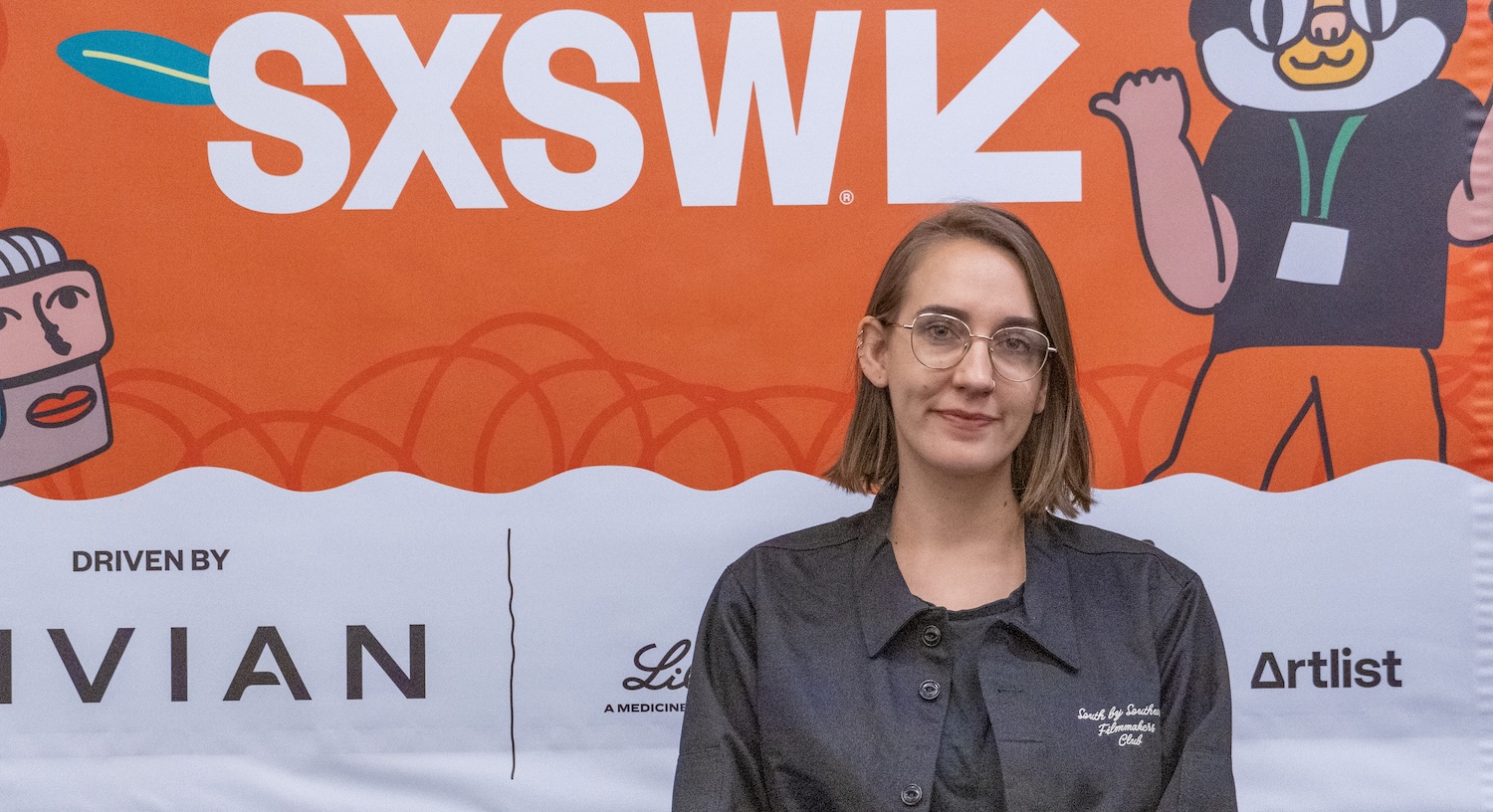
The debut feature from screenwriter Aidan West and director Gloria Mercer, A Safe Distance just premiered at the 2026 SXSW Film & TV Festival (where I reviewed it). In the movie, we follow the increasingly wild adventures of a young woman, Alex (Bethany Brown), whose would-be fiancé, Joey (Chris McNally), abandons her in the woods of British Columbia after she rejects his marriage proposal. Forced to fend for herself (and she does not like the outdoors), Alex comes across another couple, Kianna (Tandia Mercedes) and Matt (Cody Kearsley), who may just be bank robbers she has heard about on the radio. What transpires leads Alex down a completely unexpected path, very much the opposite of a “safe distance” from trouble. I spoke with Mercer at the festival, and here is that conversation, edited for length and clarity.
Hammer to Nail: You’re from East Vancouver, if I’m correct. And this film takes place in British Columbia. Does this kind of thing happen all the time in the woods there—this kind of drama thriller—and you’re just basing it on real life? (laughs)
Gloria Mercer: I mean, it’s possible it does and we just have no way of knowing (laughs), because they’re very good at hiding bodies. But, yeah, it’s obviously a very heightened story, and it was really, really fun to put the story in the woods outside Vancouver, which is a place that I’ve just spent a ton of time in, so it was great to put that setting on film.
HtN: And the thing is, you never really know, because those woods are so vast, anything could happen.
GM: Yeah. You might be finding bodies out there or any … I’m sure weird stuff does happen in those woods. (laughs)
HtN: So, given the vastness of the woods, what was location scouting like? Because really you could, in a sense, choose any bit from this vast resource that’s there.
GM: Luckily, having beautiful locations, if finding them was not the problem, the problem was mostly practical and logistical. It’s an indie film. We had a scrappy little crew. So it was just literally myself and the producers doing a lot of door-knocking in the areas outside Vancouver where people live in these really forested areas and we door-knocked and we asked if we could shoot on their property. And a lot of our crew home bases were literally people’s homes that they opened up to us and they let us use their bathroom and their rooms as a green room and that kind of thing. So it was just logistical. It was a lot of door-knocking, a lot of community support. And then actually finding beautiful woods to shoot in was very easy.
HtN: Well, the film looks great and I’m impressed. But in all seriousness, what inspired this particular story? I know you had a 2021 short of the same title. Was that just a proof-of-concept film?
GM: So, this film is written by Aidan West, the screenwriter, and he’s wonderful. And at the time that we made the short, he had written a feature draft already. And so the short was an exploration of that draft, condensing it into a few scenes and exploring the characters. And I had had some experiences in romantic relationships, which is what this film is about, that I just found very frustrating and they sort of left me feeling … it just felt like it was an experience that a lot of women had had that I didn’t think was really often talked about in film. So I wanted to make a movie about a character who felt very stuck and explore contemporary relationships through that character. And then Aidan was like, “Well, what if this was heightened and what if we kind of played with the genre?” And then it ended up that we married those early ideas with the lovers on the run, Bonnie and Clyde-kind of genre, and worked with that to make the themes come alive.
HtN: I love that idea of having an initial thought about the kind of story you want to tell and then putting it into genre fiction, which is often so great for that. Let’s talk about the creative crew. You mentioned your screenwriter, Aidan West, but I also really like the work of the DP [Director of Photography], Devan Scott; the composer, Caleb Chan; and then some nobody named Gloria Mercer as the editor. (we both laugh) They all do great work. What was it like collaborating with all of them, including that editor.
GM: Well, she’s really hard to work with, particularly, but yeah, Devan Scott and Caleb Chan are both amazing people. And I actually went to film school with Devan, so we have known each other for like 10 years and he’s shot a few shorts that I’ve made and he shot the short of the same name that this feature came from. I could talk about it forever, but I was just extremely lucky to have him super-involved in development. At all stages of writing the script, we were sharing drafts with him and he would always be coming up with little ideas about like … because the film is riffing, like I mentioned, on Bonnie and Clyde. The film is really riffing on those sorts of crime thrillers.
And so Bonnie and Clyde is one. Robert Altman is a huge influence on the visuals and he made Thieves Like Us and McCabe & Mrs. Miller, which is a little different genre, but is a Pacific Northwest movie and uses a lot of zoom photography, which is what we do in the film. We use a ton of zoom lenses to make the forest feel that depth of field and play with that a little bit in the trees and that kind of thing. It was great working with him and having that close relationship because on an indie film, if he had started just three weeks out from shooting, it would have just been completely different. And so I feel really lucky to have that relationship.
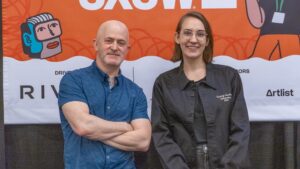
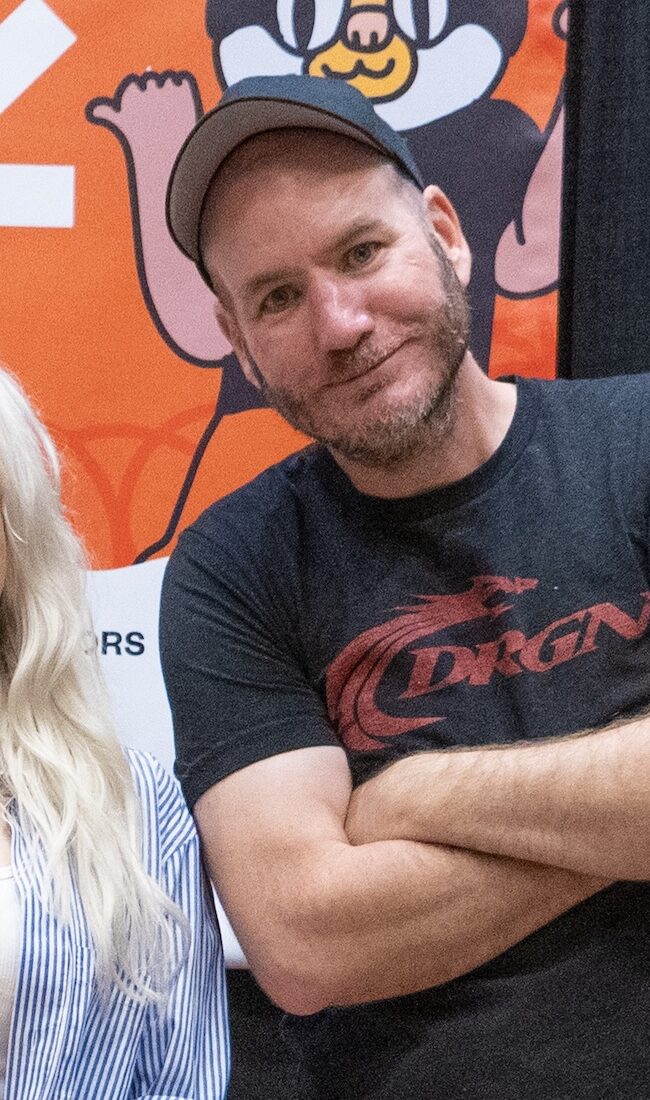
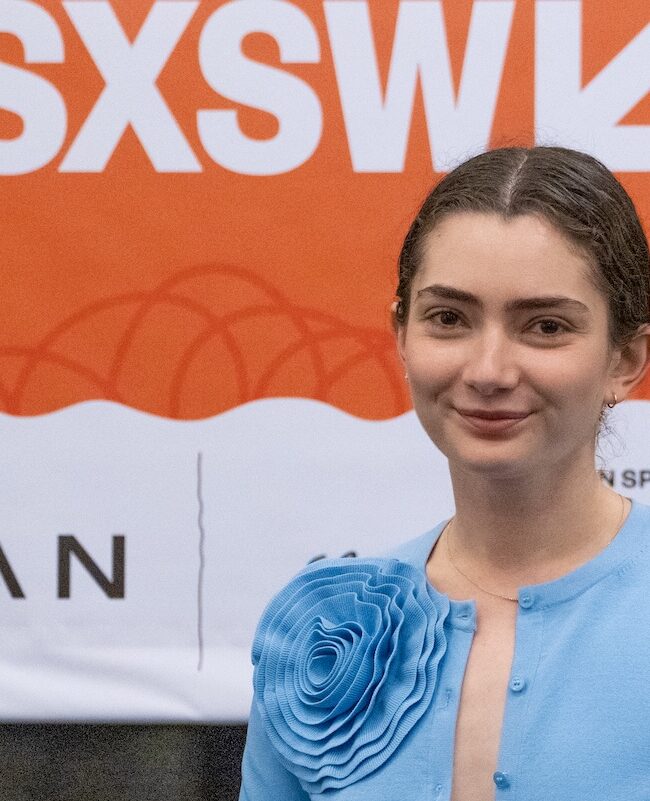
Our Chris Reed and filmmaker Gloria Mercer
And then Caleb Chan is an amazing composer. We cut the film and came to him when we were in the edit. He had said, “I want to do this movie, but check in,” because he’s a busy guy, working on some great projects and some big shows. He sent a few test pieces to us, like test pieces of score to just lay over the beginning of the movie. And he said, “I don’t know what kind of stuff you guys are looking for – this is what came to me naturally,” with very little direction from us. And he said, “If this isn’t the vibe, I don’t know if I should come on because I don’t know if I’ll have time to find it.” And I listened to them and I was like, “It was so perfect.” Truly so much of the score in the movie, there were very few pieces we reworked entirely, like really none. He just came in and he found it so quickly and then we’d steer things, but he just really nailed it. I love the score.
HtN: I was making a joke earlier, but I do really appreciate the pace of the editing and the way you start in one way and then cut back. Was that built into the script from the beginning, that sort of time loop?
GM: Well, there were a bunch of different iterations of the script and some were more different versions of non-linear, but having that tease and then going back was built into the script. That’s all Aidan. That was a great call.
HtN: As somebody who’s made plenty of films of his own, I always find it difficult, though I encourage the students at my university to collaborate, to give up your baby to somebody else to cut; it has always struck me as a difficult process. So I can certainly understand why you’d want to edit your own film.
GM: I really enjoy editing. I will say, though, that I would love to relinquish that control and I hope I don’t just seem like a control freak because part of me editing was just the logistics of having an indie and having such a small team and wanting time in the edit. And sometimes if you don’t have a huge budget, you lose the resources to bring someone on for a really long time. So part of it was just having the freedom to play in the edit a little more. And I do come from a post background, so I like editing. It’s not my first time doing it. But honestly, in the future—because I come from post, I know a ton of great editors—I look forward to potentially handing that over on the next feature or having some sort of collaboration because I do think there is a huge value in having an editor be separate from the director. But also, on this film, it was very fun to edit.
HtN: Let’s talk about your cast. You have Bethany Brown as Alex, Tandia Mercedes as Kianna, Chris McNally as Joey, and Cody Kearsley as Matt. What was the casting process like?
GM: Firstly, I’ll say that all of our cast are wonderful from-Canada/BC locals. I love putting as much of our home talent on screen as I can and they were great and I’m so happy we have them. Our amazing casting directors, Kris & Kara Casting in BC, they showed us Bethany and just immediately I was like, “I feel like she’s perfect.” She is very good at doing so much just non-verbally because there’s a lot of silence in the film and I think I saw Bethany’s reel and she’s a great listener and she does so much without using her words, as well as doing some great line delivery. So I really loved her for Alex. She brought so much to it.
For Tandia Mercedes, this was her first feature film, which I wasn’t even aware of in the moment. And then we cast her and I just constantly was like, “Wait, this is your first?” And it wasn’t a huge shoot, but she was there almost every single day and I was just blown away by how quickly she jumped into it. We cast her through an open casting call and I just loved the energy she brought in her read. And then we had a chemistry read with Bethany and just immediately the two of them had such great chemistry and Tandia really felt to me like the character of Kianna, like she brought—even though she is very different—some of herself and then was just able to really embody her.
And then Cody actually knew our producer, but I had only seen him in the TV series Riverdale where he’s playing like a teenager in high school. And so Nic—our producer, Nic Altobelli—suggested him for Matt. And so I looked at his stuff and then I met with him and he just had all these great questions about the character and though he’s very different from Matt, who’s maybe not a great guy in every single way, he just really felt like he got it. He got the sort of idiosyncrasies of the character and what Matt as a character is wrestling with. And so I was just so excited to be connected with him.
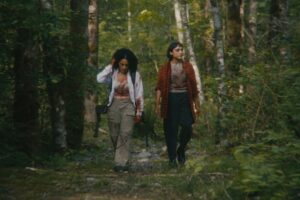
A still from A SAFE DISTANCE
And Chris is a great actor in Vancouver who does a lot of Hallmark films and we put him in the role of Joey. We went out to him, we asked him if he wanted to read the script, and it’s very different from what he does a lot of. But he was extremely game right from the jump, and it’s sort of counter-casting to what he does in some ways, but I thought it worked great and it was just a dream to have him on set.
HtN: So your film has an open ending, to a degree, because only one of the characters is left on a bus while the other one goes off and we’re not entirely certain, necessarily, what that could mean. What does it mean to you?
GM: Well, I think firstly, we really like playing with that image, which is very iconic and used similarly in The Graduate. It’s like people on a bus at the end of a movie where we don’t know where they’re going. So that was definitely a reference. But I think for me, it’s a movie with a lot of moral ambiguity. The characters all have secrets at one point or another that they sort of reveal to us, to the audience and to the other characters. They have shifting alliances. And I just really like the idea of not planting a firm conclusion in the audience’s mind because I think, I don’t know, I just typically like movies that ask more questions than they answer. And I like the idea of not letting Alex off the hook a little bit, giving her this kind of adventure and this new-found freedom, but also making things a little more complicated, as well.
HtN: Although I will say, that as you articulated a moment ago, if the genesis of this idea was to have this character, Alex, start a new life and have something change, you do end on this little smile that’s coming out on her face. So in that sense, the dramatic arc of the film is very much about her life changing.
GM: That speaks a little bit to what I said earlier about Bethany being so good at playing in the silences, because I’ve watched that shot so many times of her on the bus. I don’t want to say too much about it, because she has something with her that really could change her life and she is alone, but then we don’t know if she’ll stay alone or what will happen, but yeah, she does so much in those moments, like there is a little smile, but there’s also so much else. There are so many other little fleeting things that pass over her face in that 30-second shot. And I don’t know. I love it. For me, I’m not sure what’s going to happen. I’m sort of still having conversations about where she could be going and what she could be doing.
HtN: Let me ask you a final question about your directorial choice there. Did you just hold in that moment, waiting to see what Bethany would do? Did she do different things in different takes?
GM: I mean, firstly, I’m terrible. This is my habit on set; I hate calling “cut.” (laugh) Coming from editorial, I think directors always cut too early. So I make actors uncomfortable because the scene will play out and then I’ll just sit there waiting and then eventually, finally, I release them. But yeah, we did several takes of that shot. I think because there’s a little bit of emotion before that moment, she kind of wanted a few to play with and sort of start in one space and then maybe do a few that worked up to getting more emotional so we had a few different options. But also, my memory of it is that she was like, “Just play it out and let me do my thing.” And we talked, of course, about how she was feeling in that moment, but yeah, we did a few options and she just was like, “I’ll play with it.” And we did a lot of that on set, a lot of just letting her try stuff and seeing where it went and yeah, she killed it.
HtN: Well, Gloria, thank you so much for talking to me. I wish you all good things with the film.
GM: Thank you so much!
– Christopher Llewellyn Reed (@ChrisReedFilm)