





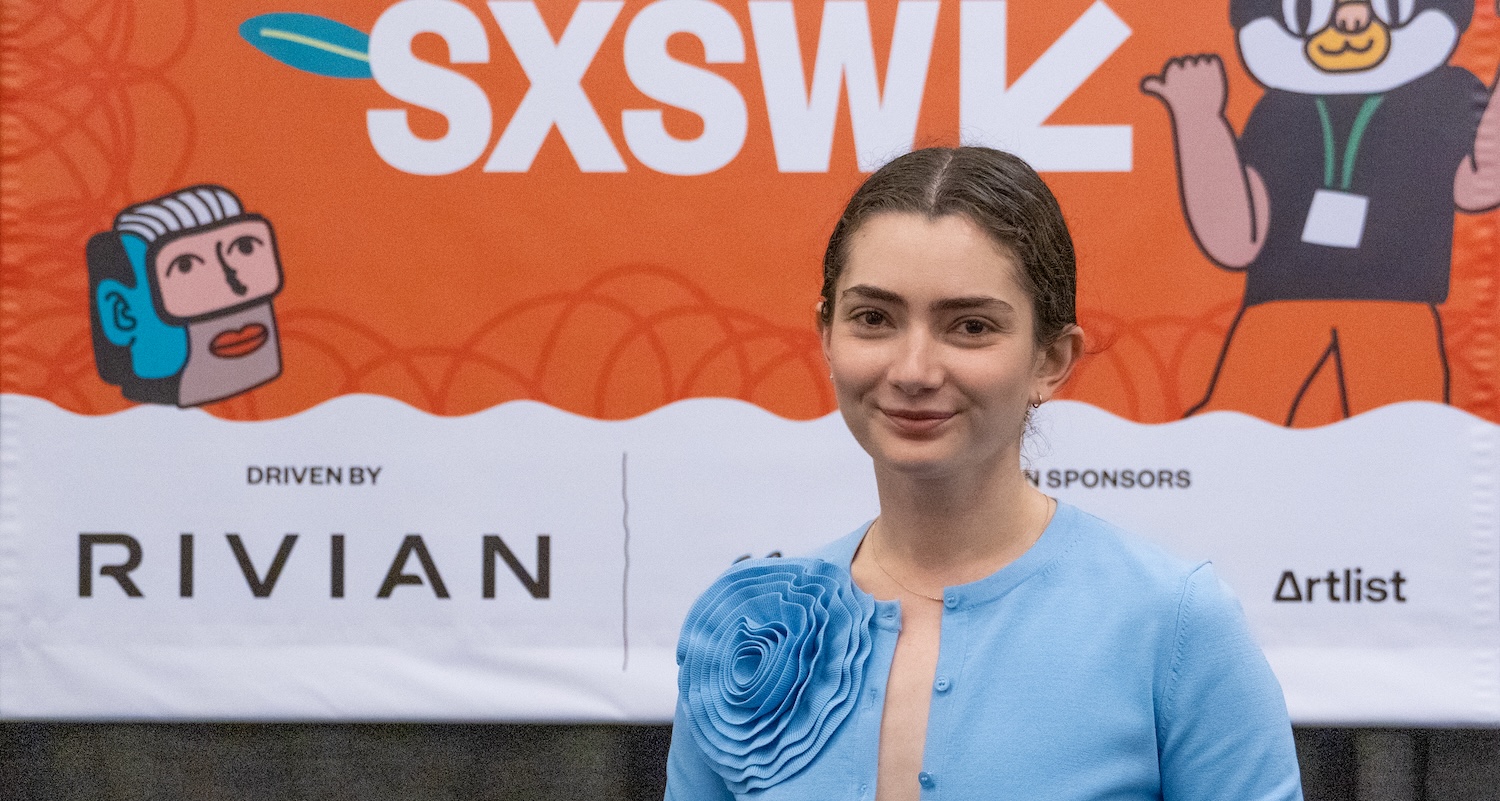
Writer/director/actress Emily Robinson just premiered her debut feature, Ugly Cry, at the 2026 SXSW Film & TV Festival (where I reviewed it). In the film, Robinson plays Delaney James, a 24-year-old struggling actor in Hollywood who faces additional challenges once she hears that a male producer has reacted to a virtual audition of hers by saying that she has an “ugly cry.” It’s hard enough dealing with the common body issues that the world of cinema imposes on women; how does one begin to react to being told that a display of emotion is too strong? In a clever and harrowing take on the subject matter that leans into body-horror tropes, Robinson explores what it is to make a living under the close scrutiny of many different gazes, including one’s own. I spoke with her at the festival, and here is that conversation, edited for length and clarity.
Hammer to Nail: I read your press notes and I understand that this film comes in part out of your experience as a child actor. You write in the press notes that you “learned to objectify yourself before you learned to read.” Did making Ugly Cry help as a form of cinematic therapy to mitigate some of these experiences?
Emily Robinson: It’s funny. I’ve actually said yes to that question before and I don’t know that that’s totally true. It’s like the piece of art that I wish I had when I was younger. It’s the thing that I wish I had during the pandemic when I saw what isolation and being on your phone, doomscrolling, can do. It basically is the synthesis of a lot of thoughts and conversations about performativity and having a body and gendered sexualization and objectification and the pressures to do things to your face and then body and alter yourselves to look like some sort of ideal that can’t actually ever really be manifested.
It was definitely cathartic in some ways because I got to work with people that I’ve been having these conversations with for over 10 years. I got to work with so many wonderful people that I’ve worked with in different capacities and who have also come up in the industry and learned about their own identities in similar ways to me. I wouldn’t say it was a form of therapy for myself, but it was something that I hope people … well, I maybe don’t hope that they relate to, but I hope that if they relate, they find community in it.
HtN: You’ve made three shorts prior to this as a director.
ER: Really two, but one of them was like a photo montage that I made in high school that somehow wound up on YouTube and then wound up on IMDb, which is humiliating. (laughs)
HtN: OK! So you made two shorts prior to this one. And you also acted in those, if I’m correct.
ER: Yes.
HtN: So could you tell me about the challenges of directing yourself and how those challenges were heightened at the feature level?
ER: Absolutely. So, in my first short film, Virgin Territory, I was the lead actor in that, and so I was in every scene, which was definitely great practice for Ugly Cry. I was also 16. It was a long time ago; 11 years ago. And then my other short film was really lovely because it was more of an ensemble and so I was only in one or two scenes. So I had some wonderful experiences getting to be mostly on monitor and then also getting to dip my toes back into acting for that. I’ve been lucky enough to be an actor on feature films where the director was also acting in them. I feel really fortunate to have had firsthand experience of what it’s like being directed by someone whom you are scene partners with and was able to get really valuable advice and wisdom from Alex Heller who did that with me in The Year Between and Brie Larson for Unicorn Store.
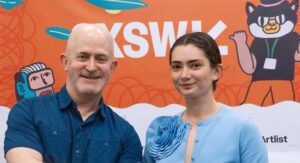
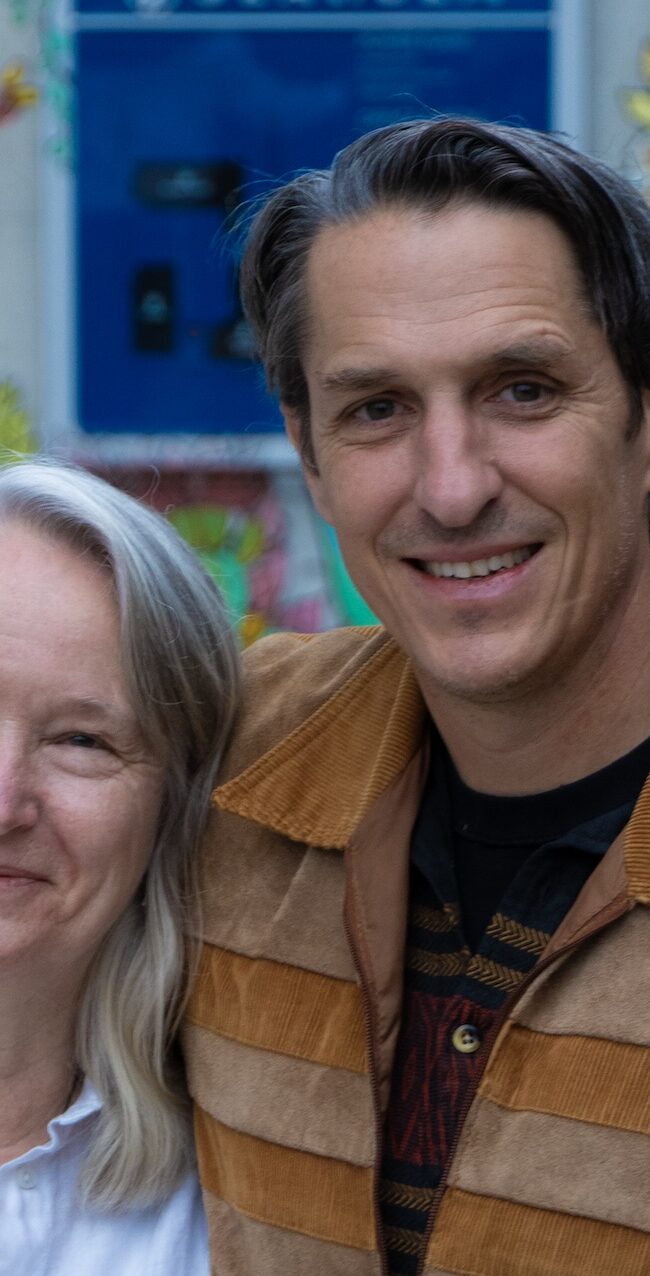
Lead Critic Chris Reed and filmmaker Emily Robinson
And so I think having experienced the acting side of it, I was probably overthinking a lot about how to create an environment for myself that allows me to perform the way I need to because this film is a very performance-heavy film. And also how do I create an environment for our department heads where they still have the support that they need? We need to have all the conversations we need to have and we’re not scrambling on the day and how do I create that environment for our cast where they don’t feel like there are a million cooks in the kitchen or there’s too much happening or like their scene partner is just kind of giving them passive aggressive judgment, right? So how do we create this environment that feels super collaborative and creative and exciting while I’m kind of running around and wearing all these hats?
And the way that I did that (I hope!) was just through complete over-preparation. It was pre-production, talking to actors for years and years. In some cases, [co-star] Ryan Simpkins and I had been improvising and talking about this for truly like three years before we ended up filming it for real. And then when we were actually in production, the night before, every day, like basically after we would wrap, a producer and I would meet and go through the scenes for the next day and kind of talk through all of the notes for department heads, for actors, and go through each of the beats of the scene. And then the next morning I would get to set a few hours early—like one or two hours early—and go through the scenes as an actor and take that time and space so that when we were actually in production filming, I could be there for all the other people and I could be running around. I could be doing all the things and still have kind of that base well of performance thoughts and feelings to dip back into more easily.
HtN: Well, I’m even more impressed now than I was before. It’s a very ambitious work and certainly everything that you took on makes it even more so. Did you have someone you could rely on on set to talk to you about your performance since it’s tough to evaluate oneself?
ER: Yeah, absolutely. So, Sophia Sabella, the producer who I was mentioning that I would meet with, she had performance notes for me and all the other actors, and she was always on monitor. We said she was like my eyes and she would be looking out for things. And then I would kind of run back to monitor in between takes and we would talk about what we had, what we maybe wanted to get, even if it was just variety so that we had some flexibility in the edit, especially since it’s a genre-bending film; we really wanted room to play, both on set and also for the edit. And so yeah, I was immensely, immensely grateful that she was one of our producers, especially because I had been directed by her before in her debut feature that she did with Pablo Feldman, who is also a producer on the film.
HtN: What’s the name of that feature?
ER: Edge of Everything. And Ryan Simpkins, who is one of our leads, is also in that film. So a very small, small world, which was very lucky.
HtN: So I really appreciate how the film tackles both the male and female gaze, while also showing how perhaps the most critical one is often our own. Did you always know you wanted to open the film with that monologue in the car and the push-in to the rearview mirror, so we see you looking at yourself?
ER: Yes. Yes. (laughs) That was from the very beginning. There have been so many times that I have been practicing sides in a car or talking to myself and kind of going down fun performative paths. And I’m like, “If someone looked into the car right now, I would look like I am sobbing and crying and having like a crazy emotional experience.” I just think a car is like such a … I’m from New York and I live in LA now and whenever I’m in a car, I feel like it is both this beautiful, wonderful oasis for yourself and also I hate it, because we are all isolated by our cars and we’re stuck in traffic and I overthink parking and it’s just the worst. And so there’s something so liminal and isolated about being there that can really do all the things. And I wanted you to kind of think, “Is this girl losing her mind? Is she having a mental breakdown? What is going on?” And then immediately, in the next scene, we realize she’s been practicing lines for an acting class.
HtN: I have to say, some of the most stressful scenes for me were the texting and driving scenes. (laughs) And I kept on hoping something wouldn’t happen and something almost does, but not quite. Speaking of stress or discomfort, your film is very much body-horror adjacent. Is that a genre that you like or that you gravitate towards?
ER: Yeah. I love body-horror and I love body-horror-adjacent things. I really love Raw and Sick of Myself and so many others, like so many Cronenberg things. And the way we’ve talked about this film is it sort of is about the horror of having a body. Because it doesn’t go crazy; it stays very grounded even though there are lots of hallucinations and more surreal elements within the psychological thriller-dom. So we’ve been like, “Is it a cringe-horror film? Is it like cringe-horror as a genre or is it like dark comedy?” It very much straddles the line of a lot of things, which is something that we continue to play with through every stage of development.
HtN: I know nothing about Botox. I’ve never done Botox. Is what we learn in the film about Botox, is that all accurate? Like, you’re not supposed to do it more than once every three or four months? And can you just buy it like that?
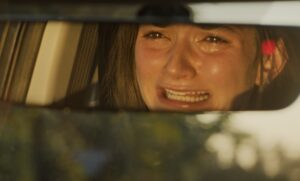
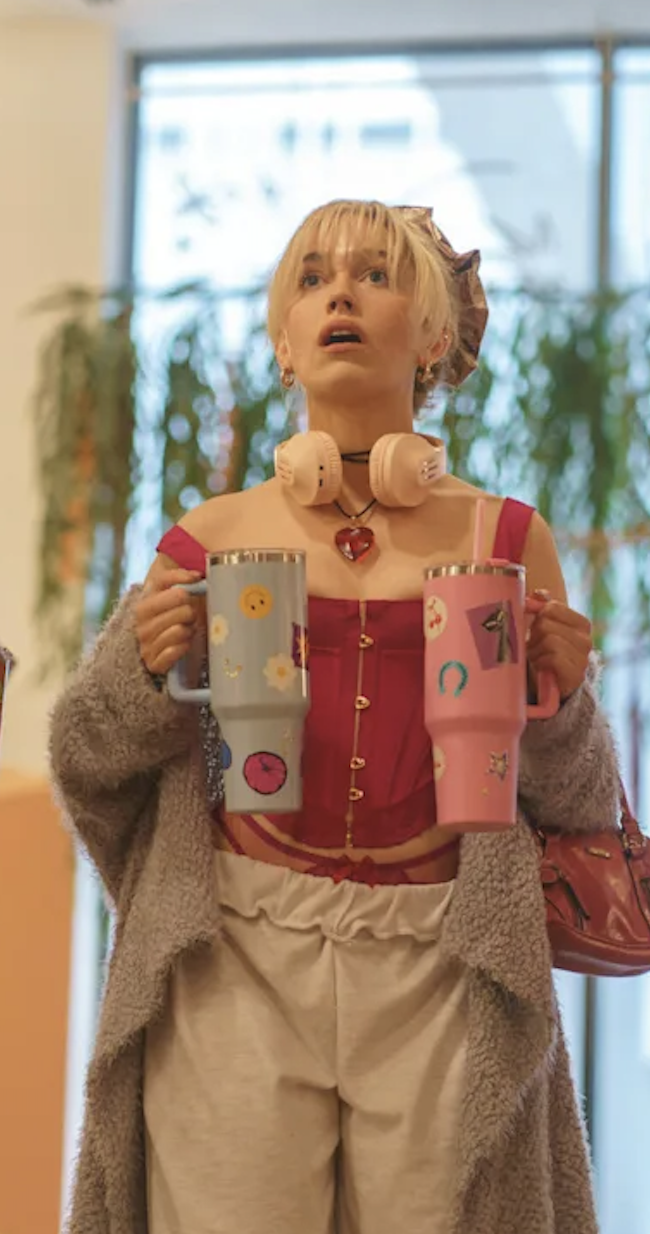
A still from UGLY CRY
ER: So, there are heightened elements. I’ve also never had Botox. I did a lot of online Googling and talking to people, but I am no expert, so do not take my word. But yeah, I don’t think you’re supposed to do it like a million times in the same places. And you definitely should not be self-administering Botox. I have seen things for sale, but I don’t know the reasoning behind it or how it’s justified because you’re not really supposed to do that. It’s supposed to be for professional use, but yeah, more and more things that get closer to the plot of the film have been cropping up on the internet, so I don’t know.
HtN: Have you heard of actors or actresses using it for preventative reasons?
ER: Oh, for sure. Yeah. The conversation that the two leads have is very much inspired by the day I turned 24, when a few of my friends who were 23 were like, “Oh yeah, I’ve been getting preventative Botox for like a few years.” I was told, “I’m not reading as 16 years old anymore and I’m terrified.” And I was like, “Oh my God, this is awful.” And I think within the industry, we create such strange ideas of what teenagers look like because we have 30-year-olds playing 16-year-olds. And so then when they do things that are like really crazy and scary and new and exciting for a 16-year-old on camera, it looks kind of expected and normal because they’re 30 years old and have probably done these things a million times. And also, we have 30-year-olds playing parents, so there’s so little room for the reality of aging. You have to either look like a child or you’re a parent, which is bizarre.
HtN: That’s interesting. I do feel like the teenagers in films today do look at least a little more age-appropriate than in the 1980s John Hughes films, where almost every teenager looks far too old for those parts.
ER: I think it is getting a little bit better. When I was a kid, I just think of Glee, which I love. And Heather Morris [from Glee] is amazing in our film. I was nerding out on set. I went up to her and I was like, “I’m so sorry. I have to just say I was obsessed with you and Glee.” But a lot of the people in Glee were like much older.
HtN: You mentioned Ryan Simpkins, who plays your friend in the film, and then there’s Aaron Dominguez, who plays your boyfriend, and Robin Tunney, who plays your mom. Can you talk about the casting of the film?
ER: Absolutely. I just feel so fortunate that we had so many actors that I’ve admired and respected and loved for so long that agreed to come onto our movie. Robin joined our film pretty close to production. I called up a director/mentor/friend/filmmaking-fairy-godmother, Amanda Kramer, who had just worked with her on By Design and I was like, “Hey, we’re still looking to cast this role. Do you have any thoughts?” Because she is just like the person that I think does the most brilliant casting and she was like, “Two words: Robin Tunney.” And I was like, “Well, yeah, that would be a dream, but really, what do you think? ” And she’s like, “No, Robin Tunney. You should call her agent, this and that.” And I was like, “We’re filming really soon. Our pre-production process is very short. We can’t wait for three months for them to say she’s not going to read it.” And Amanda called her up and was like, “I never do this. There is a script you should read.” And by that night, Robin was calling me up and saying she would do the film, which was insane and never happens. I feel like the luckiest person on the planet. She’s such a dream.
And then Aaron, I was familiar with his work. I really loved some of his movies and obviously Only Murders in the Building, and he and Ryan have the same manager. And Ryan had been attached for a while and I was talking to their manager and he was like, “What about Aaron?” And I was like, “Oh my God, he’d be amazing.” So it kind of just happened organically, which was really great.
HtN: Well, thank you so much. I wish you all good things with the film. I really enjoyed watching it. “Enjoy,” perhaps is the wrong word. I found it fascinating and I’m really impressed with it.
ER: Thank you so much!
– Christopher Llewellyn Reed (@ChrisReedFilm)