


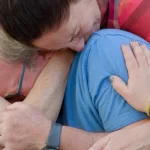

A Conversation with Colette Ghunim (TRACES OF HOME)

In Traces of Home, filmmaker Colette Ghunim takes her parents back to the homes they were forced to leave as children. Her mother returns to her childhood home in Mexico City, and her father finds the home he fled in Safed, Palestine in 1948.
As the Ghunim family passes through Palestine, their tour guide points out a wall separating Israel and Palestine. He notes that the company that built this wall “made a bid in the United States to build the Mexican-American wall,” a cruel connection to the stories of Ghunim’s mother and father, and their separations from their homelands.
The walls don’t just exist between nations, but between people as well. In Traces of Home, Ghunim dives deep into the emotional barriers between her and her family, the traumas and behaviors that built them, and what needs to be done to tear them down. Ghunim’s exploration makes for a personal and candid journey into histories of displacement and the ripple effects these traumas pass down from generation to generation.
Traces of Home had its world premiere at DOC NYC on November 14, 2025. In the following conversation, edited for length and clarity, Ghunim shares the levels of healing that both prompted and came from this film.
HtN: Why did you choose to make Traces of Home at this point in your life? Was there a moment or event that incited these conversations among your family?
Colette Ghunim: I started this film back in 2017 and really, the motivating factor was the family separations and refugee ban at the border. My initial thought was that I really wanted it to be a film to talk about who immigrants and refugees really are by sharing my own parents’ stories of forced migration. And yet, as I started to go deeper, I started to realize that there was something calling me about this idea of feeling disconnected to home, and that this journey that I was trying to go on was actually one that was about me, and not just about my parents. I started going to therapy to talk about racial identity and that disconnect to home, and that’s where I started to learn about intergenerational trauma and the relationship with my mom, my family, and the dynamics just started coming up over and over again. I realized that the film actually needed to become something different than what I thought it was going to be, so it became a nine year healing journey that went very deep within to find home.
HtN: That’s a very personal process to document for audiences. How did you handle this vulnerability?
CG: In one of the scenes, there’s an interview with me and my mom, and it goes really into the heart of everything. I start talking about my own issues with food and eating disorders, and how it was all intertwined with this sense of not feeling home within my body and not feeling home at home. So it definitely got really vulnerable at that point. And yet, I feel like I was able to tap into a realization that this is not a siloed thing. This is something many people are dealing with, and so talking with people and learning about other people’s stories helped me get out of my own head and release shame.
I did a ton of journaling to be able to really dive deep into some really important questions and I used that writing process to make the voiceover narrations. That all helped to unpack and ask, “Okay, what is the lesson here and what is the message I’m trying to share about my own understanding of my family?” So, writing was essential in the process.
HtN: Were your family members immediately on board with bearing their lives on screen or did they take some convincing?
CG: They definitely didn’t know what they were signing up for; none of us did. We were all like, “Oh yeah, It’s gonna be just about the migration stories.” But then once it started actually going into our family dynamics and the trauma and how the pain has been carried on, it was tricky. They want to be seen as this ideal American, perfect family, so to have our relationships and our baggage go out to everyone, it’s not easy.
HtN: How did you ameliorate their discomfort?
CG: I tried to make sure that they were involved in the edit process, and explained that this is starting to become something more about mental health and is something for the healing of many families and parent child relationships. It took a little bit of time, but after they understood the greater purpose and once they actually saw the cut, they felt much more comfortable with it.

Something that was really scary [for them] was the thought of, “Oh, are we going to be considered bad parents because we messed you all up?” But it’s like, no, you did the best you could with what you knew; you literally were just trying to survive as immigrants in this new country. We want to honor that, while also talking about, yeah, there were some really important components missing in parenting. But it was trying to come from a place of compassion.
HtN: As you mention in the film, your father documented your entire childhood on camcorder, and much of the film is made up of this footage. What was it like for you digging into this mine of nostalgia – both as a filmmaker going through these hours and hours of footage, and yourself, reliving your childhood by watching it?
CG: It was amazing! I had seen it before, but just like bits and pieces, I had never made an archival log of every single thing that was in that footage. It was very illuminating to understand my family and our dynamics and what things were there in the past. It was really powerful to go through.
HtN: How many hours of footage was it, in total?
CG: It was like 100 or 105 or something. It took seven months just to log all of it.
HtN: I was really struck by the artistry of the film’s animation. Can you share what your vision was in directing the animation and how you found these incredible illustrators.
CG: I knew from early on that I wanted to use animation for the film. I really wanted to be able to bring my parents’ escape stories to life, for people to actually see them in real time, versus showing random archival black and white footage of Mexico and Palestine. I also wanted to make sure that I hired people from both places, so they would actually know how to draw the landscapes correctly and let the land really tell the setting and the tone.
So for Palestine, I hired a Lebanese animator. I wanted to make sure that there were more natural colors in Palestine, like greens and browns. Then in Mexico, the vibrancy, the colors of the 1950s, the celebrity world, and then contrasting that with the darkness inside of the house. And I hired a Mexican animator for that as well.
HtN: You mentioned that you started making this film during the first Trump Administration, when he both planned and enacted anti-immigration and travel policies that affected Latinx and Middle Eastern communities. Now, this film is premiering during the second Trump Administration, and the homes of your parents are still the subject of conflict and tragedy: ICE raids in the U.S targeting migrants such as your parents, and the war in Palestine posing a direct conflict in your father’s home. What role do you see Traces of Home playing in the wake of today’s current events?
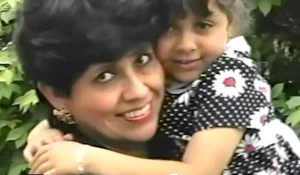
A still from TRACES OF HOME
CG: It feels like this film is coming out at the exact time that it needed to come out. I feel like there’s been an awakening across society from seeing this level of extreme violence that is able to be committed in Gaza and also here in the US. I think that people are waking up to be like, “Wait, something is severely wrong with this system,” and realizing that, yes, we have to do the direct action work, and organizing and mobilizing, but there is a reason that we’ve gotten to this level of suffering, and it is because of the disconnect within ourselves. The cycles of trauma will continue to repeat with the oppressor and the oppressed, and the oppressor and the oppressed, if we do not do the healing work within ourselves. And so my vision and dream for this film is for people to be able to start their own healing journeys, to go within themselves and figure out, who am I, why am I the way I am, and how do I actually want to be of service in the world? But to be of service in the world, we have to be able to be able to create peace within ourselves. If we’re going to harm ourselves, we can harm others. It’s just going to continue.
I feel like something that we have all realized more than ever now is like we can no longer be in isolation. The only way that we’re going to be able to get through this is if we are able to create healthy interdependence on one another. So, learning how to be in community and having this level of community support is essential. And so that’s what I feel like Mezcla Media Collective is able to do for so many other filmmakers that are going on these really intense journeys of telling their stories. And not only that, but now we’re doing mutual aid work, we’re doing so much more because we’re realizing we have to be able to rely on each other for whatever may come in these next phases of the administration. It’s just so extreme that it feels essential to learn how to be in community, and I’m just so grateful that Mezcla is there as a foundation for people to be able to feel that.
HtN: How have you and your family’s dynamics changed, if at all, from making this film?
CG: It’s unbelievable. This film was the healing tool for me and my family to finally be able to really see each other for who we are. After going through this journey, I think they now understand me and realize that, like, I’m an adult and, you know what, this is me, this is who I am. I feel like this film allowed me to back home into my own full self and my full identity. Through the film, and through me doing the healing work within myself, it allowed [my family] to finally do that for themselves, too. So it has completely shifted the relationship with me and my mom in a way that I didn’t even know was possible. To be able to heal that deep wound over decades, it’s profound and really, I’m so grateful.
HtN: You know you mentioned that although this is such a personal story, it’s not independent to you. There are a lot of other people that are going through these family traumas. What is your advice to them?
CG: Number one is therapy. If they can accept access therapy, I would highly recommend it. If you can’t, there are 12 step groups for adult children of dysfunctional families. That is incredible, and is such a huge resource for learning about dysfunction and how it affected us growing up. I also would say not to be afraid of going into the pain. The only way for us to reach the truest part of ourselves and our truest nature is by going all the way into the shadow side. It’s so freaking hard, but it’s so worth it to come out of the other side and realize how much love is just waiting on that other side.
I’m currently becoming a somatic coach, and somatics is also an amazing practice of learning where trauma is stored in the body. I’m actually creating a new community for those who do want to go deeper as well, called Coco Sanctuary.
– Kaitlyn Hardy

Post a Comment