

Christian Petzold was born in Hilden, Germany in 1960. After studying theater at the Free University of Berlin, he attended the German Film and Television Academy Berlin from 1988 to 1994. He directed his first feature in 1995, Pilots. His films include The State I Am In (2000), which won Gold at the German Film Awards, Barbara (2012), which won the Silver Bear for Best Director at the Berlinale, Phoenix (2014), Transit (2018), Undine (2020), and Afire (2023), which won the Silver Bear Grand Jury Prize.
Miroirs No. 3 takes its title from a Ravel piano piece subtitled “Une barque sur l’océan”—a small boat on the ocean. The idea for the film came during the shooting of Afire. Petzold was telling his actors about a letter by Heinrich von Kleist, in which Kleist describes looking up at a stone gate in Würzburg and realizing that all that holds it together are individual stones that want to fall but, in that act, hold each other up. Structures are formed in the process of barely averted collapse. From this came the first metaphor: a devastated family put back together by a young woman who crashes into their lives.
During a weekend trip to the countryside, Laura (Paula Beer), a piano student from Berlin, survives a shocking car accident. Awakening in a nearby house, she finds herself in the care of Betty (Barbara Auer), a grieving mother who tends to her with unsettling devotion. As Laura recuperates, she integrates herself into the lives of Betty, her husband Richard (Matthias Brandt), and their son Max (Enno Trebs). The four form a strange, fragile harmony, but the ghosts of the past begin to stir.
The film premiered at Directors’ Fortnight at Cannes 2025 and played the New York Film Festival, where I reunited with Petzold. It’s another brilliant entry from one of our finest auteurs.
Hammer to Nail: I really love these opening moments. It’s particularly great to revisit them after finishing the film—the blocking, the framing, and especially the silky sounds of the water. Why do you place the credits over this body of water, and what was important to you here?
Christian Petzold: The first day of shooting, I cut out of the movie. I always make this mistake—I always cut the first day out. We had made some scenes inside the university with her on the piano, conversations with another student, things I’d written in the script. When we edited it, I said to Paula Beer, “when I read Alice in Wonderland, the story starts with a rabbit in the rabbit hole. I don’t know who Alice is, what profession her parents have, if they have money or not. You don’t know anything.” So for me, Laura has to be a little bit like Alice.
During editing, I told the same thing to the editor, Bettina Böhler: “cut all this shit out.” We start at this canal in Berlin, this very ugly place under the highway bridge. This movie must be absolutely real and authentic—the wind must be real, no score. I want to hear, to smell, to taste the world. But on the other hand, if it’s something so realistic, you need signs of tales.
My friend Harun Farocki, who died in 2014, his favorite movie was Orpheus by Jean Cocteau, where the entrance to the world of the dead is a mirror. When we were shooting on this canal under the highway, there was this guy with the black paddle—he’s the first sign of the world of tales. He’s the first guy coming from the other side of the mirror.
To stand in front of a river or a sea or a lake—it’s always like standing in front of a wall or a mirror. If you pass through, you’re in another world. The water is the mirror, and the surface is seducing you. The credits are very short—just the four actors and the title, no DOP and so on.
The other thing was that the Ravel piece, Miroirs No. 3, has a subtitle: “Une barque sur l’océan”—a small boat on the ocean. The whole piano work has something to do with this very small boat with people on it. The ocean could grab it and destroy everything. The music is about people who are wrecked by the ocean, floating on the surface with the parts of the boat around them. They have to rebuild a survival craft to rescue themselves. This is for me the metaphor for cinema—to see people who try to rebuild something, to repair something, to survive.
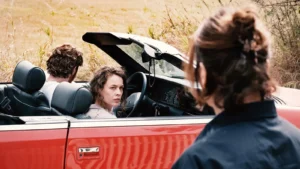
A still from MIROIRS NO. 3
So we are passing the river, passing the mirror. We are in our reality and in the tale at the same moment. We are watching a group of people who are totally destroyed, drifting on the surface of an ocean, and they come together and rebuild a survival craft. Sometimes for actors, this kind of metaphor is more helpful than the individual backstory—”your father was a dentist in Dortmund” or something. It’s better to have one collective painting, and they are part of this painting.
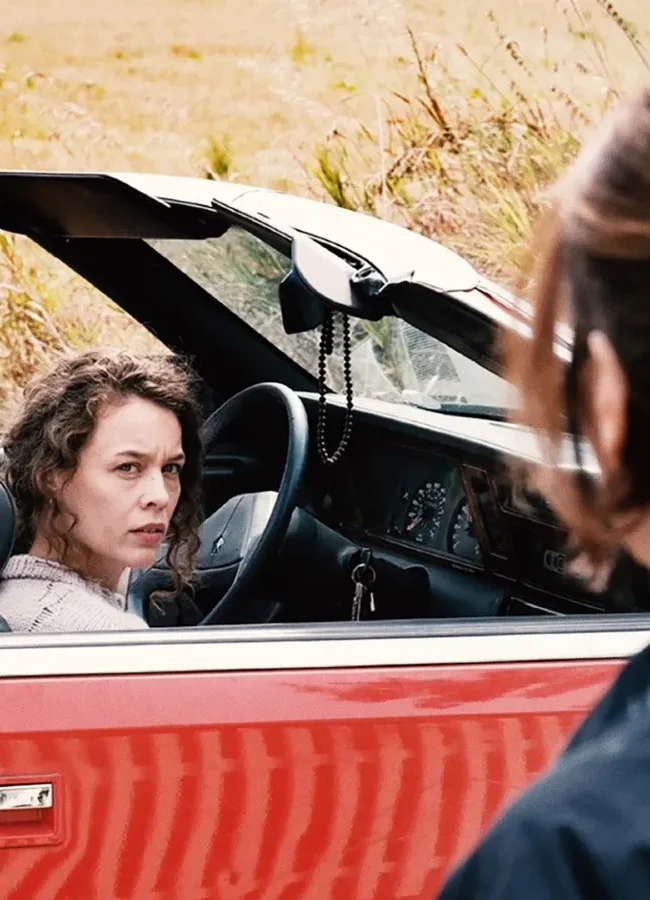
HTN: The red convertible is almost like a character in and of itself. You call it a “fairy tale sign” in the press notes. Talk about finding that vehicle.
CP: In Germany, cars are the most important thing. We have a crisis now because nobody wants to buy the old German cars with their gasoline engines. When I had the first meeting with the heads of departments, half a year before shooting, I talked about the script and what was in my mind. They’re writing it down. It was a good atmosphere. But when I asked what kind of car the main character should be driving, they were really out of their minds. They discussed it as if this is the best movie ever made. Germans, their identity and the type of car—it’s the same.
I said I need a sign of tales. The first sign is the guy with the paddle. Then she loses one of her shoes—Cinderella. I want a car coming out of the world of tales, out of the history of cinema. It must be red because of Le Mépris by Godard. There was another movie by François Truffaut with Catherine Deneuve and Jean-Paul Belmondo—La Sirène du Mississipi. They’re on the run from the police, and they want to buy a car. She says, “I want to have this little red one.” He says, “No, it’s not possible, everybody will recognize us. We need a neutral car.” Next scene, they’re in the red one. She’s so happy she takes her suit off, she’s naked, a car coming the other way sees her and drives into a tree.
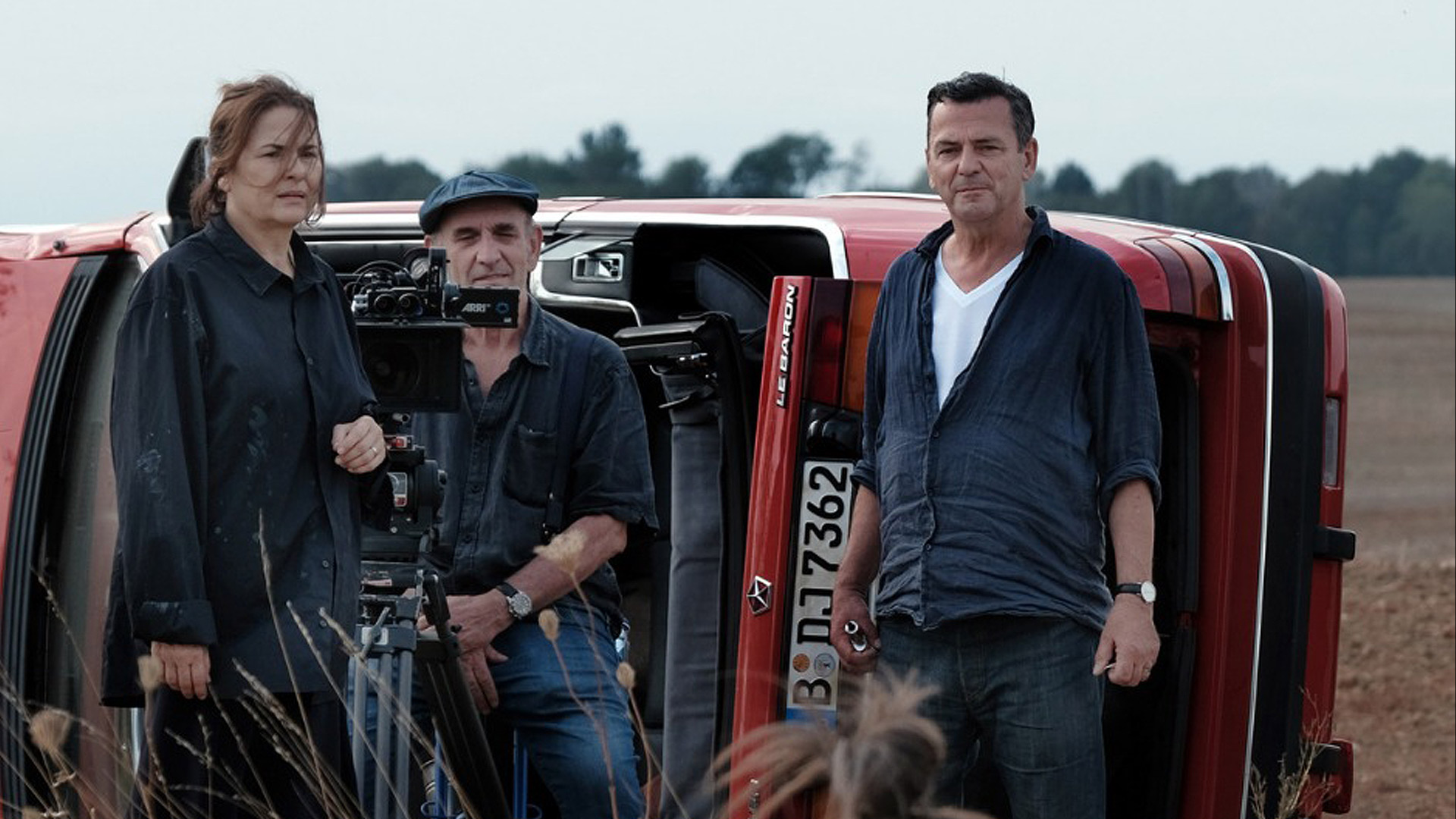
I wanted a red car like this, but not an Alfa Romeo. There’s one really ugly American car made by Chrysler—the LeBaron. It doesn’t cost much because nobody wants them, the engine is very bad. We bought two. It’s a little bit like a Jeff Wall installation—the car, the body, the blood on the glass. This is also one entrance into this mirror world.
HTN: I don’t think I’ve seen a car crash depicted the way you do in this film. Tonally, it beautifully matches the film’s deadpan, despondent nature. Why was it important to experience this moment from the mother’s perspective? And what was important to you in that first interaction between Laura and Betty?
CP: The whole cast and team asked me the same question on the day we were shooting. They said, “You changed the position of the storytelling at this moment.” I said yes—it has to do with the borderline between the ordinary world Laura comes from and the change behind the mirror.
When they pass the mother, Betty, the second time, and we stay at her position as she’s painting the fence, at this moment, we are on the other side. We are not on Laura’s side anymore, her life before. We are now in the life of Betty and Laura. Just by one change of position.
At the end, when Max asks Laura if she’s not sad about her boyfriend’s death, she says, “I’m not sad. I have to be, but I’m not. I don’t know.” Because she’s not interested in this part of the mirror she’s coming from—her father, her friend, her apartment, her piano playing, everything. She’s here now, she has a second childhood. Nobody’s asked about her life before. She doesn’t have a family name, she’s just Laura. They give her food, clothes, comfort and warmth. It’s great to have a second childhood.
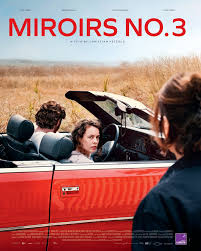
Paula Beer is a really intelligent actress—so intelligent she’s sometimes a pain in the ass. I like her so much. She said to me, “When I take my shoe and throw it at the door, I’m not upset that I’m not the real daughter. I just want this illusion for two, three more days.” Like the mother, when Richard, her husband, asks, “How long do we want to do this?” And she says, “Just a few days more.” Because it’s great to have this time.
HTN: Königsberger Klopse—I had never heard of this dish. It seemed almost like a Swedish meatball to me. Why was that the dish you selected? And can we discuss what you were thinking in this sequence of hilarious silence and facial expressions as Laura serves the dumplings to the perplexed father and son?
CP: I hate Königsberger Klopse. But many people in Germany say this is their favorite food. It comes from Königsberg—the town where Kant was born. It’s a little bit like a philosopher’s lunch. I don’t like potatoes, this white sauce and these meatballs. But it was also a problem that Paula Beer is vegetarian. So we had to make vegetarian Königsberger Klopse.
The cook who made this didn’t know that I’m a one-taker. I do long rehearsals, I don’t need many camera positions. I just do one take because actors are exhausted after doing it 15, 17, 20 times—especially with food. You can see in movies that nobody takes anything in their mouth. So he made 142 meatballs, coming from ordinary productions. But after 15 meatballs, the scene was done. We had 127 left. The next day I asked what happened to them. Paula Beer took them to Berlin and put them in her fridge. She had to eat Königsberger Klopse for half a year. But she loved it.
In this scene, I was thinking about Snow White. The dwarves come from the mine: “Who is eating from my plate? Who is sleeping in my bed?” The father and son come inside and there’s one plate for their dead daughter, and noises from the kitchen like from a ghost. We have this Snow White structure. It’s not that you can explain everything with this, but it’s a sign.
What I like in this scene is that father and son directly know this is a big lie, that the wife or mother is doing something really bad. On the other hand, they see she’s feeling great. She makes jokes, she can smile, she doesn’t need medicine anymore. So they know this is a good lie. There’s a sentence by the German philosopher Adorno: “There is no real life in the lie.” But I think it’s possible to feel comfort and repair yourself with lies. You don’t have to be authentic.
HTN: The next time we see the family all together is a much more emotional moment. What starts as a silly debate about shortcrust pastries turns into this awkward yet transcendental moment where the neighbors are staring at the family and The mother asks Laura to play piano, regrets it, tells her not to—but Laura is compelled to go do it anyway. The family is entranced and in tears as she plays. What was important to you here?
CP: In Germany, a porch like you have in this house is unique—all porches are built in the back of the houses. There are no porches going to the street like in the USA. German families are cells. Their fences are high like in Guantanamo. This family is not really familiar in this part of Germany. They try to make a special life there. Their porch goes to the social world, the outside world. They want to be in contact with the world.
All these neighbors are passing and watching them—they are jealous. This family has books, they love each other, they want to open to the world. This part of Germany is 45% fascist. They have a daughter who committed suicide. The neighbors have schadenfreude—this German word, this bad, mean feeling when your neighbor has a tragic thing. You take joy in their pain.
So they’re sitting there with a new daughter, and the neighbors come over. “Ooo They have a new daughter. This is a lie.” This is the atmosphere. The mother asks Laura to play piano; she needs her appearance as the dead daughter to live on. They built the piano against the wall. She can’t see the family, but they’re behind her. With the music, they have a connection to the dead daughter.
The family is like a portrait, together, but we just can’t see the substitute’s face. I said to the cameraman, I don’t want to see Laura’s face from the front. Because it’s not her face we’re interested in. We’re interested in the ruins of a family who is now recovered.
HTN: I adore the moment between the brother and Laura at the shop. He compliments her performance, they have an interesting discussion about her not being upset about her boyfriend’s death. This leads into the sweet moment with the Frankie Valli song. It’s a small moment but one that holds a lot of importance—especially in comparison to the next time they see each other at the shop. The difference in the way he says “I have something to tell you.” That first time seems like a confession of love, but the second time reveals itself to be something more sinister. Talk about your thinking.
CP: I’m always thinking about a script from all positions of the characters. Max’s position, after the death of his sister, is that he has to stay with the family. Like James Stewart in It’s a Wonderful Life, he has to stay. He can’t go away because then there will be a total breakdown. He has no chance to fall in love with someone. He has no chance to study or have a life of his own. He has no chance to go to Berlin.
Then this young woman comes. She’s beautiful. He falls in love. But it’s his “sister.” It’s a perverted construction. To make love to your sister is incest—it’s forbidden. But also it’s a lie, because it’s not his sister. He could kiss her, and she likes him very much. There could be a love affair. But it’s not possible for him, because on one hand it’s incest, on the other hand it’s a lie. This is his situation.
The moment he falls in love, she falls in love—it’s when they hear Frankie Valli. At this moment, they’re not characters, they’re not actors, they’re really human beings. They’re free for 20 seconds, until the father comes with the car. They’re laughing at each other in a non-fictional way, in a documentary way. Therefore the song is in the final credits. I always want to remember this short moment which is worth living for.
– Jack Schenker (@YUNGOCUPOTIS)