

A Conversation with Andrew Stanton, Daveed Diggs, Colby Day & Jared Ian Goldman (IN THE BLINK OF AN EYE)
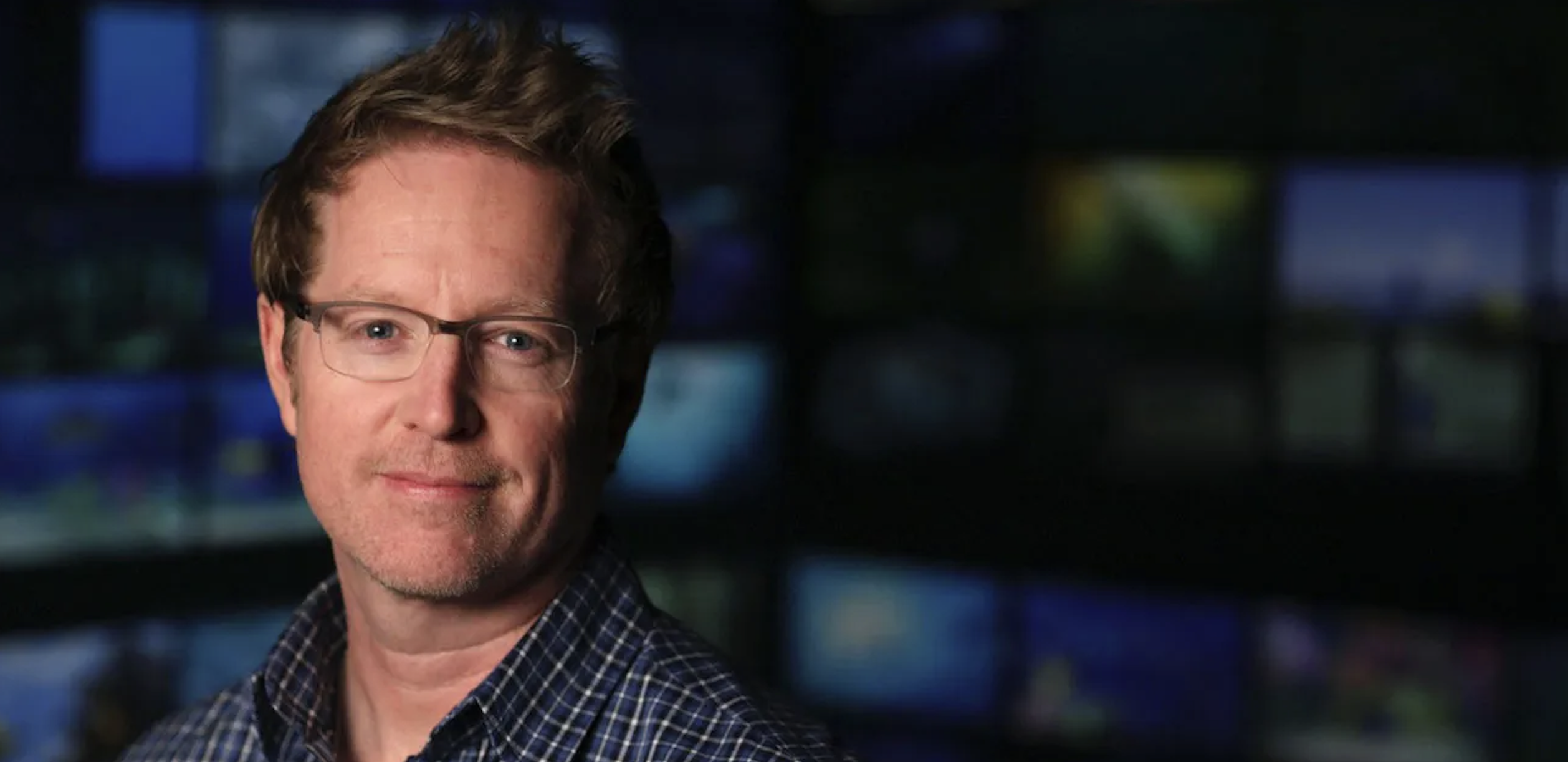
In the Blink of an Eye is a science fiction drama that asks what connects us across the vast expanse of time. Directed by two-time Academy Award winner Andrew Stanton (Finding Nemo, WALL-E) and written by Colby Day (Spaceman), the film constructs an elegantly interwoven triptych that contemplates the essence of humanity across three moments in time. A Neanderthal family (Jorge Vargas, Tanaya Beatty) displaced from their home struggles to survive in 45,000 BC; in the present day, Claire (Rashida Jones), a driven post-grad anthropologist studying ancient proto-human remains, begins a relationship with fellow student Greg (Daveed Diggs); and two centuries in the future, astronaut Coakley (Kate McKinnon) and a sentient onboard computer confront a disease afflicting the ship’s oxygen-producing plants. The film premiered at the 2026 Sundance Film Festival, where it won the Alfred P. Sloan Prize for its depiction of science and technology themes.
Day’s original screenplay was featured on the 2016 Black List—the annual survey of Hollywood’s best unproduced scripts—and put him on the map as a writer. He was subsequently hired to adapt the novel Spaceman of Bohemia for Netflix, which premiered at Berlinale 2024 starring Adam Sandler. A graduate of NYU Tisch’s Department of Dramatic Writing, Day cites the films 2001: A Space Odyssey, Magnolia, and Interstellar as influences on In the Blink of an Eye.
The film is produced by Jared Ian Goldman and Zola Elgart Glassman of Mighty Engine, the independent production company that has established itself as one of the most exciting and reliable homes for filmmaker-driven storytelling in the industry. With over two decades of award-winning creative producing, Their credits include the Emmy-nominated Russian Doll, the Indie Spirit Award-winning Ingrid Goes West, Jeff Nichols’s Oscar-nominated Loving as well as The Skeleton Twins,The Devil All the Time, Marvel’s The Punisher, and the Sundance Grand Jury Prize-winning documentary Nothing Lasts Forever. Mighty Engine’s ability to support pedigreed filmmakers across a range of budgets and formats, from intimate independents to studio pictures, makes them an ideal partner for a project as singular as this one. These interviews have been edited for length and clarity.
ANDREW STANTON (Director)
Hammer to Nail: WALL-E was a love story told largely without dialogue, and Finding Nemo explored parent-child bond through loss. In the Blink of an Eye has a prehistoric storyline where the Neanderthals don’t speak English or have subtitles—their emotions are conveyed purely through looks, gestures, and nonverbal cues. How did your animation background prepare you for directing human actors to communicate without words?
Andrew Stanton: That is exactly it. It gave me confidence that it would not be an obstacle. It was a left brain problem for executives to worry about. Fortunately nobody really worried too much about it. I knew from the get-go, having done all the research I have done on Buster Keaton films—we are so wired up to it. We are watching people all the time. People are watching us from far away right now, not knowing what I am saying, not knowing what you are thinking. But they are observing. We are all experts on it. So it was a non-issue for me.
HTN: You’ve directed episodes of Stranger Things, Better Call Saul, Tales from the Loop, and For All Mankind—all shows with very distinct visual languages. In the Blink of an Eye weaves together three radically different time periods. How did you approach creating visual coherence across a prehistoric beach, a Princeton dorm room, and a spaceship?
AS: I tried to not worry too hard about how it had to connect. I just thought, if I make it seem as authentic as possible to that time period it would work. It would be like if I shot an apartment in New York, an apartment in LA and one in London, you just have to aim for the authenticity of the time and the period. That was the fun of the edit, finding those connections we fell into accidentally. Sometimes it was planned, but a lot of times it was afterwards.
HTN: The script opens with the Big Bang and moves through billions of years in a few pages—hydrogen burning, stars collapsing into black holes, a single cell dividing. How did you approach filming something that massive?
AS: I didn’t. You will see it when you watch it. I found a way through. We flipped it on its head and it works better.
HTN: The script has a remarkable structural device where time shifts happen almost imperceptibly – Neanderthals having sex cuts to Claire having sex, and 45,000 years pass ‘in the blink of an eye.’ How did you and editor Mollie Goldstein approach those transitions?
AS: The transitions were easy because they were built in—the ones that were in the script. What was fun was finding ones that we never would have seen coming. An example—there is a moment that we did not even know happened. Rashida was in the same pose as our cave girl. We were almost at the same emotional moment. So we slid the movie to make it work. There were things—visual, sound, lighting—that had a lot of other patterns that did not just come to life from the page on the screen.
DAVEED DIGGS (Greg)
Hammer to Nail: You watched the dailies from Nickel Boys before shooting your scenes and were so enamored with the performances of the young actors that you said you were just trying not to mess it up. In this film, Kate McKinnon carries the future timeline alone on a spaceship, Jorge Vargas and Tanaya Beatty perform the prehistoric sequences entirely without dialogue, and you and Rashida Jones anchor the present. Did you see footage from the other two timelines before or during your shoot? And how did knowing what the film was doing across 45,000 years affect how you played your portion?
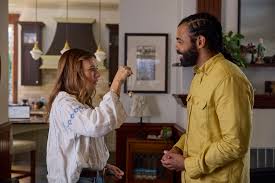
Kate McKInnon and Daveed Diggs in IN THE BLINK OF AN EYE
Daveed Diggs: I did not see it. When I showed up, they were just wrapping the prehistoric stuff. Right when we were finishing, Kate was coming in for pre-production. So they kind of shot them in order like that. I did not get to see them. But Andrew—and this makes perfect sense when you think about the Pixar background—he is so clear on the theme, and he is so clear on how the storytelling is going to unfold. You would think that would make for a stilted set, for a thing with a lot of guardrails on it. It was not at all. It was so free. There was so much room for play. It was so joyful. There was so much experimentation. But he always knew. He was so clear on where it was going that it was like bumper bowling. You kind of could not miss. He was not going to let you fail.
COLBY DAY (Writer)
Hammer to Nail: This script made the 2016 Black List. It’s now 2026. Spaceman came out in 2024 with Adam Sandler. You’ve been writing on For All Mankind. You’re prepping your directorial debut, The Comedy Hour. How has your relationship to this story evolved over a decade?
Colby Day: I started the movie as a New Yorker now I live in Hollywood. I met my now wife and now we are about to have a baby. Everything has changed in this time. It’s really meaningful to share it with the world now and have this chapter of my life close. It is really cool.
HTN: The acorn that appears in Lark’s hand in 45,000 BC becomes a through line across the film, eventually becoming an oak, seeding a forest, symbolizing growth across millennia. When did you settle on that specific image as the film’s connective tissue?
CD: The acorn was an early idea, actually. I knew I wanted something that would symbolize growth, and I grew up under an oak tree. My family home was under an oak tree. So to me, that felt like a big, meaningful symbol. This idea of passing that down to someone was really early. And then it became like, well, wait, how does that work? How do we even do that within the movie? But I knew we wanted some way to connect stories one to three.
HTN: You’re married to documentary filmmaker Emma D. Miller – you produced her short The School of Canine Massage, which premiered at SXSW 2024, and her feature Father Figures. In the Blink of an Eye has documentary-like attention to detail in the Neanderthal sequences. How does living with a documentarian affect your fiction writing?
CD: It has been really interesting to live with a documentarian. What you start to learn is how to capture honesty—small moments of truth, little things, the everyday, the mundane—and use that to tell a story. So much of documentary is about just recording what happened and then trying to figure out how do we imbue that with meaning. Being able to do that and think about a different way of storytelling is so valuable. Anytime I am uninspired, taking in other art—whether it is documentary or music or theater—just expanding your horizons is so valuable as a writer to break out of how I do it the way I always do it.
JARED IAN GOLDMAN (Producer)
Hammer to Nail: The film requires three distinct production designs—45,000 BC coastal caves, contemporary Princeton, and a spaceship in 2217. You’ve said the film explores humanity’s need to connect, exist, and grow without feeling heavy-handed. How do you produce continuity and emotional truth across such different worlds?
Jared Ian Goldman: It is very easy, actually, because it is not about the specific emotional beats. It is the in-between moments. The interesting things in all of our lives are these quieter moments in between what we are doing. That is where the humor happens and the awkwardness. It is what happens across humanity. We all experience these smaller, quiet moments. Even in despair—you could have a relative who is ailing—there is still a little bit of downtime where you look for relief. Balancing that, I think that is what really helps us want to connect with each other. You see something funny, or someone tells you something funny, and you want to relay that and help lift people up.
Hammer to Nail: You’ve said you were drawn to the script’s focus on “quiet, human moments”—that “life is full of downtime, awkward, intimate interactions.” Your credits include Russian Doll, Ingrid Goes West, The Devil All the Time. What is the through line in the stories Mighty Engine champions?
JIG: I am drawn to stories that are filled with hope, playfulness, poignancy, yearning, and melancholy. I was very fortunate early in my career to make two movies with Rob Reiner. He was a mentor of mine. Spending those years with him and being able to hear about that initial run of movies he made was incredible. The genres are all so different, but he had the same rubric of how to approach them. He was searching for playfulness, poignancy, and relatable yearning. You watch Spinal Tap—yes, it is a funny movie, but you see this band that is never going to get the respect they desire. Stand By Me—these friends are searching for community and rallying behind each other looking for their friend’s dead body. You cannot get much more melancholic than that. Even with Misery, James Caan’s character is very self-aware of the types of novels he writes, but Kathy Bates’s character is very real. There is a real need and yearning to preserve this character, which leads to tension. I want to make them laugh and make them cry. If we can do that, we have succeeded.
HTN: The Neanderthal storyline has no English dialogue. The actors communicate through gesture and expression. What gave you the confidence it would work on screen, and what surprised you when you saw it cut together?
JIG: Jorge who plays our caveman is extraordinary. A lot of actors came in and did a Fred Flintstone impression. Jorge came in with this awareness that our actors were out in the wild, struggling to survive—how do I bring that feeling to this character? In bringing that, he’s bringing the joy, the despair, the concern, which is all relatable. Our circumstances have changed from what they were then and what they will be with Kate’s character in the future. But the experiences of just trying to move forward—that is universal.
– Jack Schenker (@YUNGOCUPOTIS)