



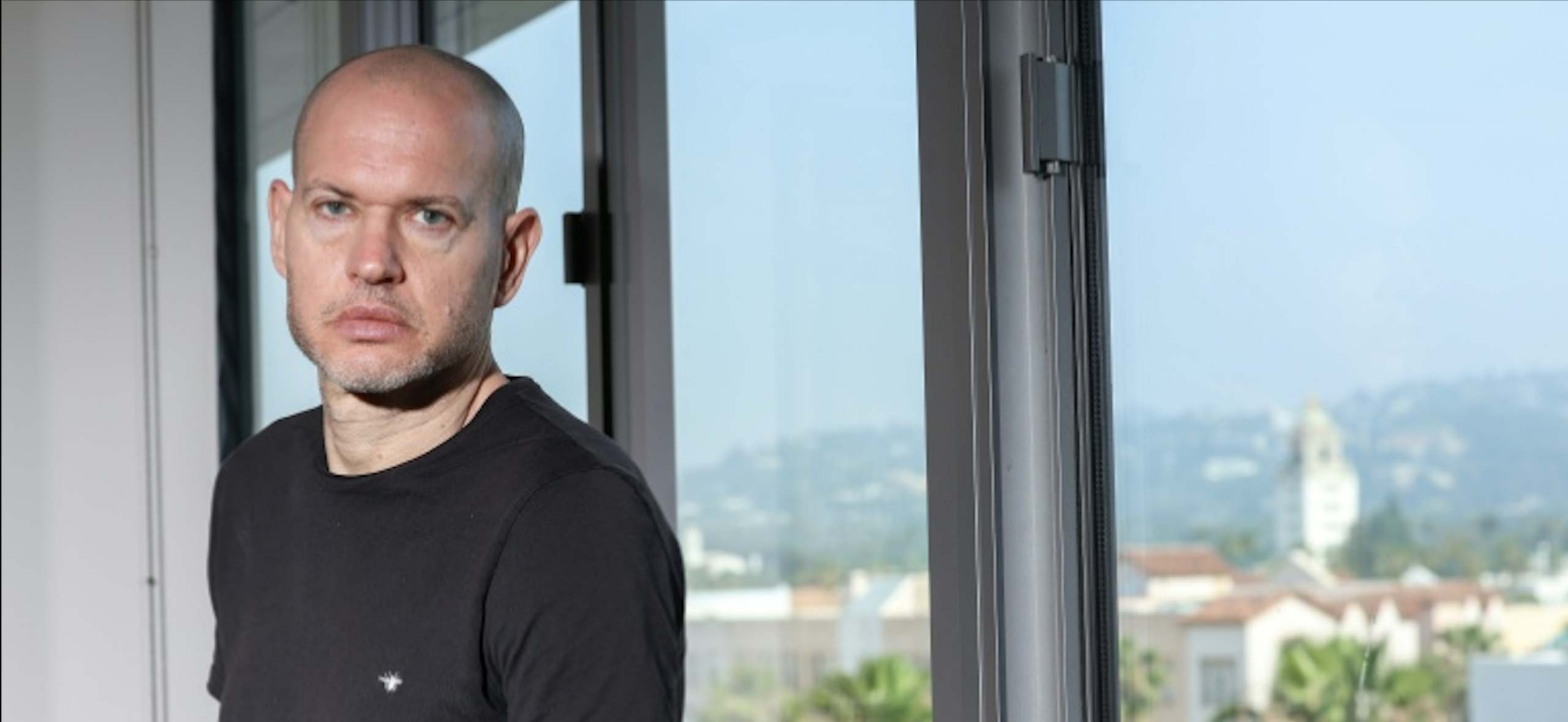
Nadav Lapid was born in Tel Aviv in 1975. Before turning to filmmaking, he published a novel, worked as a literary critic and sports journalist. He joined the Cannes Film Festival’s Cinéfondation in 2007, where he wrote the screenplay for his debut feature, Policeman (2011), which won the Jury Prize at Locarno. The Kindergarten Teacher premiered at Cannes Critics’ Week in 2014. Synonyms (2019), about a man who flees Israel for Paris because he’s convinced he was born in the Middle East by mistake, won the Golden Bear at the Berlinale. Ahed’s Knee (2021), about a filmmaker confronting the Israeli government’s cultural censorship, won the Jury Prize at Cannes.
Yes marks a departure. Where Lapid’s previous films raged against the state, characters screaming into the wind and bashing their heads against walls. Yes takes a different approach: total submission. In the days following October 7, Y. (Ariel Bronz), a jazz musician, and his wife Yasmin (Efrat Dor), a dancer, resolve to say yes to everything. They sell their bodies and their art to Israel’s social, political, and military elite. They perform at decadent parties for generals and billionaires, licking boots and ears, doing whatever is asked. Soon, Y. is entrusted with a mission: compose the music for a brutal new national anthem.
Lapid wrote the script in Europe before October 7, 2023. Returning to Israel two weeks after October 7, he saw what was happening. Everyone, in their own way, was working for the Israeli government. It became a great common cause. Art in Israel had chosen its path.
He rewrote the film around the horror and shot it in Israel during the ongoing genocide in Gaza. Crew members walked off set every day. Actors dropped out. Every makeup artist in Israel refused to participate—they had to hire someone from Serbia. When they filmed on the “Hill of Love,” a hillside where Israeli families go for picnics to watch bombs fall on Gaza, they were in a forbidden military zone. The soundscape was filled with real explosions. “When you film a kiss on a hillside overlooking Gaza,” Lapid has said, “you wonder how many people will be dead by the end of the shoot.”
The result is a film Lapid calls a “musical tragedy”—a movie where the mouth says little but remains very active, singing, kissing, licking, devouring, vomiting. Y. never stops moving or dancing, but his willpower has been sterilized. As he tells his infant son Noah, born at midnight on October 8: “Give up as early as possible. Submission is happiness.”
Yes premiered at Directors’ Fortnight at Cannes 2025. After the festival, no American distributor would touch it. The film sat for months. Finally, Kino Lorber stepped up and acquired it for U.S. release—one of the only companies willing to put a film this uncompromising in front of American audiences. It’s a film all humans should engage with in 2026. I spoke with Lapid about the film in the following conversation, edited for length and clarity.
Hammer to Nail: I’d love to talk about these incredible opening moments. What first seems like an intimate kiss between Y. and Yasmin is revealed to be a performance as”Be My Lover” plays, party lights come on and the crowd cheers. Yasmin puts whipped cream on her tongue and has a man lick it off. She dances as the camera pans, lenses flaring, and we see this massive party unfolding underneath a neon flashing Star of David. The camera cuts back and forth between Y. and Yasmin doing vulgar acts, notably Y. putting something phallic in his mouth and sucking it. The camera begins to spin furiously, finding Y. at the piano adding to the track. The sequence continues with Y. dancing with a woman outside, getting his face squashed into disgusting food, drowning in the water, being resuscitated by Yasmin, and finally having a song battle with the chief of general staff. What was important to you in crafting this sequence? Was this party the first thing you wrote?

A still from YES
Nadav Lapid: Yes. It was the first scene I wrote, and it was the last scene that I succeeded in formulating visually. It was the beginning of everything in my head. And yet, when we started to analyze the script with my DOP, we didn’t know how to tackle this scene. We put it aside, as we do with complicated scenes.
I had in mind this idea of a decadent, obscene party. But these are only words. It’s very complicated. You don’t want to be one of these filmmakers, there are several who are very successful, who provoke a certain bourgeoisie with provocations that are not really provocations. It’s hard to create a provocative and decadent party, because what is so decadent? I live in Paris, there are decadent parties all around me each evening. In the history of art, in the history of mankind, there have been many more. You try to understand how it will become more than expletives. You start to invent examples for decadence and it’s very bad because it is illustrative.
For me, there were several key moments. One was when I understood that Y. needs to die in this scene. The moment he falls into the swimming pool, the appearance of these red bubbles—a kind of artistic death, but a real death. As if a huge secret mouth is suddenly opening up. A decadent party is not dramatic enough. From the beginning, I understood that the whole movie moves on this edge between love and death. You need both values inside this opening scene, which is a microcosm of the whole film.
You begin with an act of love that looks the most intimate, the most passionate, the most real, the most sincere—and it turns out to be a performance. Something public with no real connection to intimacy. Or maybe the intimacy of this couple is also based on prostituting itself together. This creates a dynamic that exists throughout the whole movie—an inner battle between a love film and a political horror film. Terrifying, obscene, unbearable.
So you understand it’s a spectacle. Spectacle for whom? For rich, powerful people. Based on what? Humiliation, prostituting yourself, sexualizing yourself, becoming a clown, becoming a whore. And who are these people? They’re not only rich—they’re the military elite, the chief of staff. He’s shouting “Love Me Tender,” maybe the biggest love song in history, as if it’s a war song, as if he’s encouraging his troops to annihilate the enemy. And where does this lead? To death. To the extinction of Y.
The moment I had these values, the scene could go far. It could have been informative—who are these people, what do they do, let’s see an example. That’s how the great majority of movies work. I don’t care about informing. The scene should include the main values and the main sensation. The scene should solidify the melody. The duel of songs, the fact that it goes to chaos, that you cannot enjoy one song because another interferes, this backlash between vulgarity and love, between the intimate and the public. And then at the end, everyone disappears and they are together again with “You Are My Destiny.” Everything is there. In a way, the film could have stopped at this moment.
HTN: At the 20 minute mark Y. and Yasmin sit with their baby Noah in silence. Y. asks Yasmin to turn on the radio and she says, “lets listen to the silence.” Slowly the annoying sounds of motorcycles and construction in Tel Aviv start piling up and she turns on the radio playing The Ketchup Song. Immediately Y. rushes into the kitchen and starts making a mess, spilling lemon juice everywhere and spitting water up in the air. He brings some drinks back into the living room and the beat to the song intensifies greatly. Next, we have this fascinating moment where they are communicating with their hands high up in the air about Y.’s missing glasses. They begin to dance as the beat drops again. We get this bridge in the song before another escalation in intensity, as the camera leaves their apartment shaking frantically all across Tel Aviv. The sequence ends on Noah. Can you just talk about how this scene came to life from the script to the page? What was your thinking?
NL: I think it’s a profound, essential thing—silence is impossible. We can profit only from a few seconds of dear and sacred silence, but then noise and chaos come back again. The noise in the movie is an existential political thing. It never permits you to meditate, to think, to reflect. It puts you in an endless storm, endless confusion, endless survival.
I use a lot of music and dancing in my films, and the way it’s used is unusual in the sense that it’s not a narrative thing, it’s not informative. The characters dance themselves. By dancing, they address the audience: look at us, here we are, this is what we are. So what are they? They dance this desperate, hopeless, failing attempt to preserve beauty in the middle of war. To create intimacy.
You think you dance in your salon. You turn on music, you think you can cover the noise from outside. But actually, the whole Middle East is one huge earthquake. The whole Middle East is shaking to the beat of this Song. When you put this popish, silly, funny music—it’s fun, it’s innocent, but nothing is only fun and only innocent. The same way “Be My Lover” becomes the hymn of blindness and decadence, the same way “Love Me Tender” becomes this ballad of war—The Ketchup Song, which begins as something funny, shakes the whole skyline, everything and everyone
HTN: At the 31-minute mark, Yasmin is chopping limes and her phone buzzes. Over the sounds of carnage, voiceover and text tell us the death toll in Beit Lahiya has risen to 93, according to medical sources in Gaza. The raid struck a building housing 200 people. The army is investigating it. She continues chopping. Y. comes in and plays “Stand By Your Man” by Tammy Wynette. Yasmin plays a death metal track over it, drowning it out. She picks Noah up screaming, “What personality!” throws him to Y., who throws him back screaming, “What charm!” Yasmin throws Noah against the ceiling and says, “His Wikipedia page will read: Noah, born October 8, 2023, one day after the disaster.” They shove each other through the house, Y. smashes both their heads through the door, and they kiss. This match cuts to them kissing outside. Can you just talk about crafting this moment?
NL: The beginning is obvious. The whole first part deals with blindness, intentional blindness, refusal to know, to see. These people from Tel Aviv, where I was born, grew up—who live one hour driving from Gaza—they don’t want to know, they don’t want to hear. They want to live between the beach, the house, the bike, the kindergarten, the park, etc. But inside penetrates—not the visual, but the audio. What you know deep inside, what you can easily imagine, suddenly takes real presence. It’s covering everything. Everything is simple but charged. Every cucumber cutting is carnage. Every Ketchup song is an earthquake.
Moving from “Stand By Your Man”—when a guy plays that for his girl, there’s a hidden message—and she transforms it to a punk thing. This punk thing is a childish answer to death, to carnage, to bombing, to noise. It’s turning noise to music, or music to noise. There’s a lot of violence because they’re a part of the violence. Everything that is harmonious—we’re a couple with a baby—they throw the baby, they hit each other and they burst through the door. Yet it ends in this romantic gesture, a kiss, which is filthy, doomed, desperate. Clinging to something in order to be saved from everything else. The kiss is like a shelter. But even this will not save them.
Yes was fabricated in the middle of a horror. It makes a choice: the only way to talk about the horror, the madness, is to create a chaotic film. The only way to talk about craziness is to create a crazy film. The madness of cinema should reply to the madness of life. Each scene should be pushed beyond boundaries like crashing through the door.
HTN: At the hour-and-35-minute mark, after asking some soldiers where to get a good view of Gaza, Y. and Leah head to the “Hill of Love,” where families go for picnics to watch the bombs fall. Y. asks Leah to tell him about sorrow, about the stories she posts every day. She says she gets paid for those posts. Y. says he needs it, he needs to hear what happened on October 7.

A still from YES
What follows is a horrific monologue describing deaths during the massacre. The monologue transitions into responses from outsiders: “Colonialism. Genocide.” Leah says, “Don’t act superior. Like if you were us you would be different. They say you cannot understand what it’s like to be in Gaza, and I say you cannot understand what it means to be Israeli.” Y. responds, “They don’t understand. Nobody understands. Me neither.” Leah continues with the gruesome details of October 7th until they reach their destination and she breaks down in tears. This is one of the most striking moments in a film full of them. What was your thinking?
NL: It was clear to me—it’s not a question of political outlook. The film is a radiography of this moment in time. It goes beyond Israeli society. Today, this film could have been shot in LA or New York and would have had the same relevance. But it’s clearly the radiography of a society in total loss of any moral boundaries, falling into a terrible moral abyss, carrying its tormented soul and tormenting others.
The presence of October 7 is so enormous, so fundamental, so mythological in the heart and soul of this society. It justifies for people all the horrors they commit. I couldn’t imagine not including it in the film. But how? I don’t want to be an idiot doing illustration. I told myself the thing is so enormous that you should count on the most basic and primitive things—the power of words.
Combined with another simple element: it’s one sequence shot in a shaking car on a bumpy road. What was important is losing my control, losing my impact. It’s not written in the script that Leah bursts into tears at the end. I didn’t want to fix an idea of what’s supposed to happen after the actress articulates this monologue. If she keeps being very cold, it’s powerful. If she cries, it’s powerful. For me it’s almost an experiment. You tell someone: you’re going to talk for seven minutes, you’re going to mention killing 25 times, rape 12 times. Let’s see what happens when all these words are said again and again and again. It was the same with this bumpy road. We did not know at which moment the road would shake more or less. You let yourself go. As a director you throw yourself at the mercy of the geographical conditions. This goes beyond the character of Leah. What happens to a human that needs to face all of this?
We were shooting for three days, getting closer and closer to the border with Gaza. Each day you hear the bombs louder. You see the smoke rising. Truth is not a word anymore. Truth becomes a material at such a moment. You can really touch it with your hands. We didn’t do many takes. It happened pretty quickly because it was inevitable. I think your biggest dream in cinema is to make shots that are inevitable, and this was, for me, inevitable.
– Jack Schenker (@YUNGOCUPOTIS)