

A Conversation with Sara Dosa & Andri Snær Magnason: (TIME AND WATER)
Sara Dosa is an Oscar-nominated documentary filmmaker whose work centers on human relationships with the natural world. Her films, including Fire of Love (2022), The Seer & The Unseen (2019), and The Last Season (2015), have won numerous awards, including a Peabody and the Directors Guild of America Award, and were nominated for over 40 awards, including an Academy Award, BAFTA, Emmy, and Independent Spirit Award. Her latest documentary, Time and Water, premiered at the 2026 Sundance Film Festival.
The film follows renowned Icelandic poet and author Andri Snær Magnason as he chases something elusive. As the glacial ice of his homeland melts, he constructs a cinematic time capsule to hold onto this moment and send it to the future, before everything he loves slips away. Using his own collected archives, his grandparents’ photographs and films, as well as traditional songs and folktales, Andri interlaces his family’s story with that of the land around him.
From Dosa’s director’s statement: “In a time when the violence of the climate crisis ravages the earth, we need stories that can act as maps for our shifting world. Time and Water is a gesture toward such a map, one that traces the ice of Iceland through the human story of one family.”
Magnason is an Icelandic writer and documentary filmmaker who has written poetry, fiction, plays, nonfiction, and science fiction. His book On Time and Water, which inspired this film, has been translated into more than 30 languages. He is also the co-director of documentary films, including Dreamland (2009) and The Hero’s Journey to the Third Pole (2021).
I spoke with Dosa and Magnason about this extraordinary film in the following conversation edited for length and clarity.
Hammer to Nail: Sara, you first connected with Andri while making The Seer and The Unseen in Iceland. And Andri, you’ve directed your own documentaries like Dreamland. How did those earlier experiences shape the collaboration on this film? And what was it like for a filmmaker like yourself to be a subject, entrusting another director with your family’s most intimate archives?
Andri Snær Magnason: I’ve been filming all my life, and we have these archives that stretch back 70 years. After Dreamland, I got into the 8mm and 16mm archives of my family, and I saw instantly that this was material that could become something in the future. I directed three documentaries, but I was never really in the driver’s seat technically—it was more about the ideas, the feeling, the editing, the general vision rather than the technical side. You could say that Time and Water has been in the making since 2009. I was collecting interviews with scientists, with my grandparents, all sorts of material with a very broad scope. That collapsed and became the book On Time and Water. I gave up on the documentary.
When Sara connected, it was an excellent opportunity to get somebody good on board to help me make the film. And then I thought, “Oh shoot, I’m too late because she’s getting so famous for Fire of Love.” I thought I’d missed her. So I sent her the trove of archives I had, and she went even further. It was out of my comfort zone to become the subject. When I’ve made my documentaries, I’ve taken great care to cut myself out if I was seen anywhere. But I made a documentary about very sensitive issues, about people struggling with bipolar disorder. It would be unfair of me to expect others to open up but not myself. When Sara and the team started finding quirky family moments of my kids doing random things, I was like, “Are you sure people want to see that? It’s funny for my family, but what does this have to do with the bigger picture?”
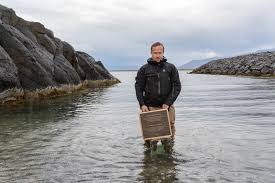
TIME AND WATER subject Andri Snær Magnason
We have an Icelandic saying: “Sharp is the guest’s eye.” Getting Sara’s perspective on my 30 years of filming brought out lots of things that I could never have imagined would belong in a film.
HTN: Sara, your cinematographer Pablo Álvarez-Mesa shot this film. What visual grammar did you develop together for filming ice? Andri, did Pablo’s outsider eye show you anything about your homeland that surprised you?
Sara Dosa: The premise of the film, it’s about the death of a glacier. Andri is tasked with writing this eulogy. But in order to really feel the meaning and power of a death, we talked about how essential it was to illustrate life. In a lot of climate storytelling, there’s this iconic shot of a calving glacier. That’s really what a lot of people who don’t live in glaciated areas first understand: calving glaciers equals climate disaster. But without really getting a sense of the life.
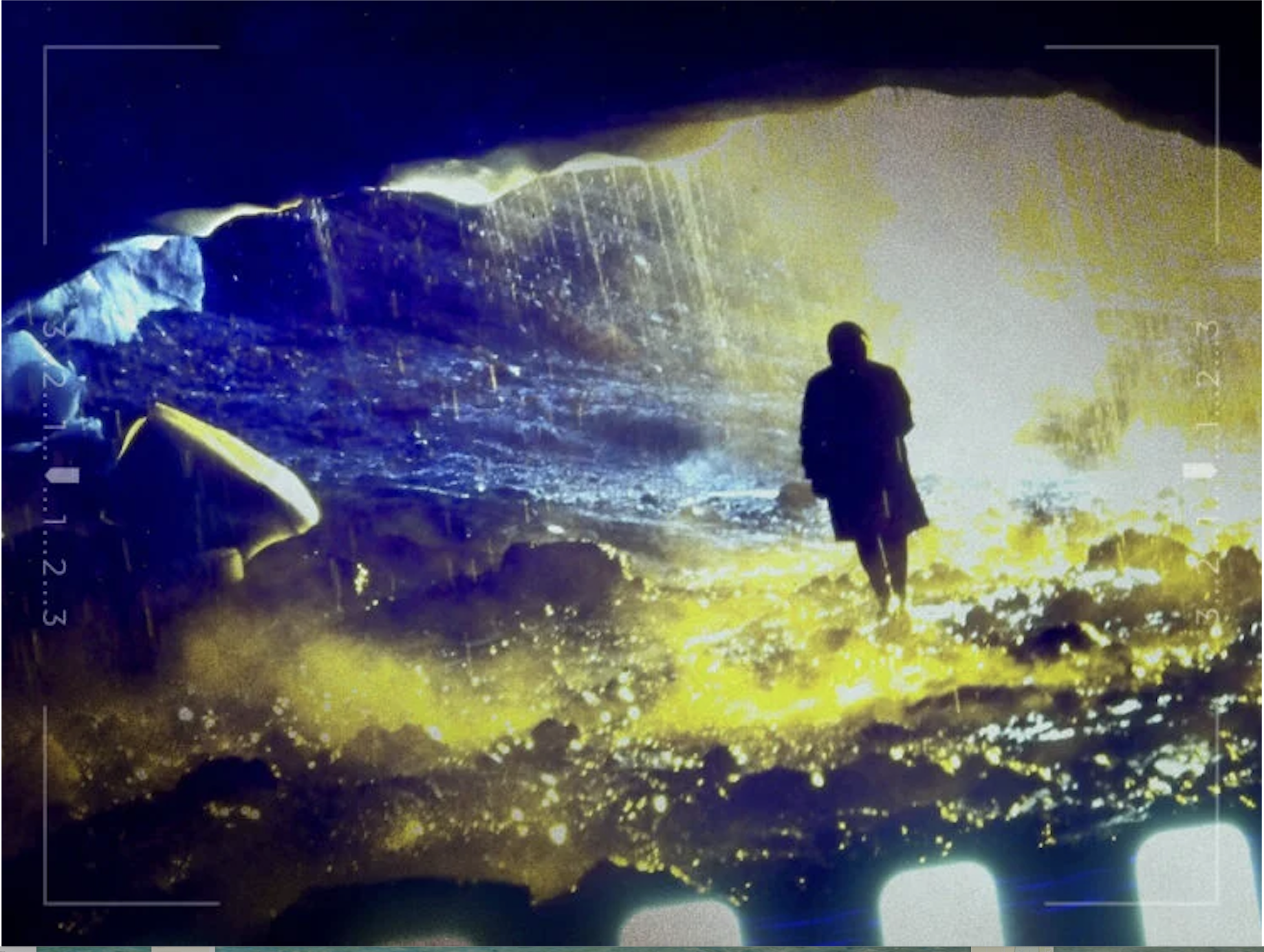
That was key to our approach to cinematography—to show sentience, life force, movement in the ice, as well as how glaciers are an archive of planetary memory. As the ice freezes, they trap traces of air containing chemical information, volcanic ash, soil, feathers. All kinds of things become layered into this haphazard record of planetary forces. Pablo is so adept at connecting in this intuitive way to the flows of water, finding compositions that emphasize both stillness and movement at once. He was able to tease out that sentience, that real force the ice has, to show how alive it really is. He’s also an amazing shooter on 16mm. We used a Bolex to dialogue with archival material from Andri’s family. It was never meant to replace the archive but to prompt the feeling of memory or myth—a bridge between the new shooting, Andri’s grandparents’ archives, and Andri’s own prolific filming.
ASM: Pablo is an excellent filmmaker and not shy to share his excellence with my amateurism. My grandfather also had ambitions in his filmmaking. Pablo says he’s collaborating with 70 years of family for this, which is a generous way to talk about it. I was very happy to see how he shot it. I wasn’t on set, but you’re always worried as an Icelander that somebody from abroad—I know Sara has good taste, so I wasn’t really worried—but the obvious concern would be that someone would come and drone-porn it. The obvious magnificence, the low-hanging fruit of glaciers, which is kind of a trope you’ve seen a hundred times before. But they went really into the glacier, into the cracks, into the ice, and captured a very different Iceland than has been seen on screen before. It’s not the Instagram Iceland. It’s another Iceland. I’m very glad to see that.
HTN: Near the halfway point, we get a montage of awe-inspiring photos that your grandfather took on those glaciers. Andri, you say the photos take you to the place that he loved most. For Sara, can you talk about crafting that sequence? And Andri, what was it like returning to this archive for the film?
SD: I feel profoundly lucky to have collaborated with three incredible editors: Erin Casper and Jocelyne Chaput, who were on the project all the way through, and Mark Harrison, who came on towards the end when we needed an extra push to meet some deadlines. There was so much archive and so many beautiful photos to select. For that scene in particular, it was a really exciting opportunity to thread the needle on these concepts about archives being transportive—specifically how a single photograph could elicit a memory for Grandpa Árni. We wanted to select photographs that situated you in place, in this surreal world that had a sense of transcendence to it, where you could feel why Árni was so connected to this place of glaciers. It also got at that sentience I was mentioning, showing how alive it was. That way it could contrast with the images we see nowadays that mostly focus on the terminal face of the glacier, its ending. We wanted to show its expanse.
ASM: My only regret regarding the images is that when my grandfather was alive, I didn’t—because when I see them now, I think, “Wow, he was a very good photographer.” He never claimed to be one. He always had a camera hanging, but he would never say he was a photographer. I regret that when I saw this on screen, I thought, “I should have used my contacts to make a big exhibition of his work while he was still alive.” It’s really beautiful that they’re making that come true, even though he’s not with us. Many of these photographs are very historic documents, because of the glaciers—and I was sometimes complaining, “You should have taken more photos of grandmother when she was young. You could always film a glacier, but grandmother would only be young once.” But apparently, the glacier was as temporary as a person.
HTN: There’s another montage that was incredibly impactful for me. It starts at the birthday party. Narration tells us that he will not remember this birthday party. When asked about it, he’ll say, “How fun, how old am I?” You ask him about his honeymoon, and he says he does not remember it. Narration tells us that his memory just went away one day like a crack. This cuts into the shot of them during New Year’s with the fireworks, kissing. Then we get a bunch of archival footage which include the biking, them in the car, some beautiful shots of nature. Can you talk about how this moment came alive in the edit?
SD: That was actually a scene we edited very early on. The edit took many twists and turns, but that one stayed very similar through to the end. We always knew we wanted the film to parallel the experience of human memory with planetary memory as encased in glaciers—not to overly instrumentalize the metaphor of human memory loss, but to show a resonance between what it feels like to access the power of memory, how it elicits story and transmission, but also the pain of losing memory. That scene was always critical to our overall arc. We were hoping to find an associative editorial language that could elicit the feeling of subjective memory. That was true for the film overall, but specifically in that scene, we wanted it to culminate. We wanted it to emphasize the feeling of time.

Filmmaker Sara Dosa
The New Year’s shots—Andri so poetically is looking at his watch as you see midnight strike, as he’s asking his grandparents to kiss. Then you see this montage of Árni in his older years jumping to a similar shot of his younger years. We’re really playing with time loosening in that moment. We were hoping that would spark this feeling of time spinning and loosening for Andri in his own experience. That’s something we really felt coming out of his archive. We hoped it would start to weave these things together and serve as a catalyst into the next section of the film, which is more about loss and how we comprehend feelings of grief in a way that feels both human and is also situated in the natural glacial world.
HTN: Sara, your director’s statement talks about landing on “agentive uncertainty”—that too much hope breeds complacency, but too much dread convinces us the future is lost. Andri, does that match your own philosophy? How does that manifest itself in the film?
ASM: This is something we discussed quite a lot. When I told my friends I was writing about global warming, they were like, “Kill me.” But if I told them I was thinking about time and water, they were like, “Well, that’s interesting.” So the idea was: how do you bypass the fatigue and the tropes and this overdense area of language and images that has been used about this important issue? How can you bypass that and tell this most important story of our time?
Should we expect people to have the knowledge? Do we have to tell them global warming is happening? Or could we, by this time, expect that people already know? The glaciers are melting. We don’t show pictures of factories, data or scientific graphs—we just expect that knowledge to exist.
The question of hope is one I’ve struggled with myself. Sometimes we can have “hopium”—we can believe that somebody like Elon Musk will make an app that solves it…well at least the old Elon. this magical thinking, it can be very shallow if you’re pressured into offering a solution in 15 minutes or as an epilogue to a film. The answer is on the plaque: we know what is happening, and we know what needs to be done. But the big question is, are we going to do what needs to be done? We didn’t reveal grandmother’s proposal to grandfather, because not saying it makes it much bigger than the words themselves. “We know what needs to be done” points to a very large scope of things. If I counted them up as a list of five things, it would not be sufficient.
This was something we needed to pinpoint, and I think we hit the right spot. Too much dread makes you feel like you don’t have any agency. Too much hope might make you think it’s not actually a real problem, that things will solve themselves. But installing a strong emotion is maybe what we need to get the strength for doing what needs to be done.
– Jack Schenker (@YUNGOCUPOTIS)