



A Conversation with Stephanie Ahn (BEDFORD PARK)
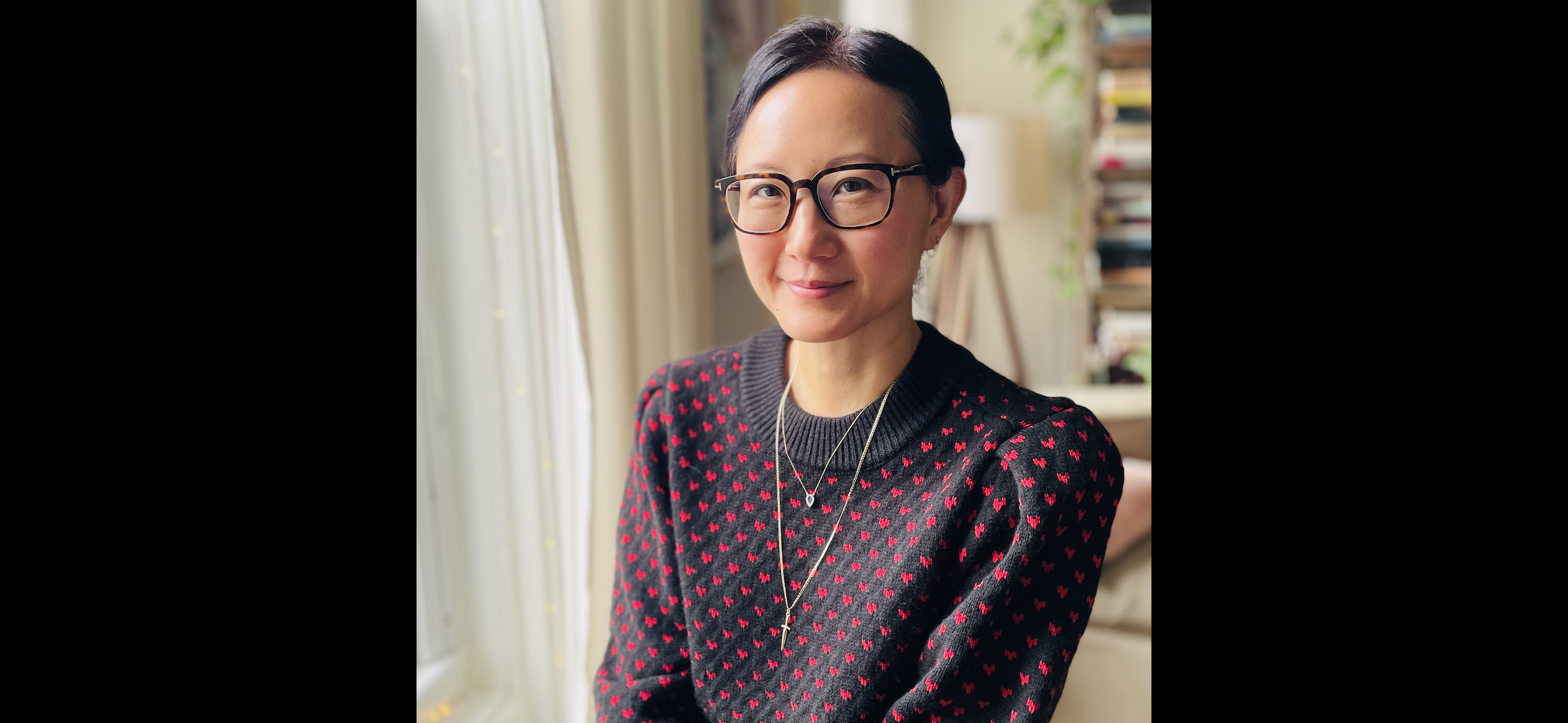
Stephanie Ahn is a Korean American filmmaker who came to the United States at age two. She worked as an editor on films including Debra Granik’s Winter’s Bone (2010) and Israel Horovitz’s My Old Lady (2014) before setting out to write and direct her own deeply personal feature, drawing on her experience as a Korean American navigating the space between cultures. Eight years in the making, Bedford Park originated as her 2023 short film Accident and follows two Korean Americans in New Jersey whose lives collide after a car accident: Audrey (Moon Choi), a woman in her 30s struggling with family expectations, and Eli (Korean star Son Sukku), an ex-wrestler haunted by his past who was adopted by a white couple. What begins as conflict gradually gives way to a fragile, tentative connection as both characters wrestle with childhood trauma, cultural identity, and learning to love. The film premiered in the U.S. Dramatic Competition at the 2026 Sundance Film Festival, where it won the U.S. Dramatic Special Jury Award for Debut Feature and was acquired by Sony Pictures Classics. I spoke with Ahn about crafting the film’s central relationship, the cultural dynamics at play, and her love of Rocky. This interview has been edited for length and clarity.
Hammer to Nail: At the eight-minute mark, we get our introduction to Eli but also Marvin. Eli goes to his car and before he gets in, he spots Marvin, walks over to him, and asks where he is going. Marvin rambles about some appointment he has booked. Eli takes him to his house, gets his shoes, puts him back in the car, buckles his seatbelt. They high-five and they are off to the hospital. Was this always the introduction for Eli’s character? Can you talk about your thinking here?
Stephanie Ahn: I cannot say if it was in the very early drafts. I can say that it was part of the introduction early on, but I do not know how early. I wanted to introduce him as someone who—and this is for both my characters—there is a theme about kindness, and kindness as a gift that is exchanged, that they both participate in. I wanted that to be something that we took away with Eli before we went on the rest of his journey: that he was a kind person and that he had relationships with his neighbors. I think those small moments speak a lot to a person’s integrity and character. And I love the character of Marvin.
HTN: I love that moment, and I also love the character of Marvin. At the 20-minute mark, Audrey and her mom go to Eli’s house and try to strike up a deal regarding payments for the damages to their respective cars. Eli had a bit of an emotional morning and takes that out on Audrey and her mom. Audrey hands him the gift basket and, without saying a word, looking rather annoyed, he takes it inside. Audrey hands him the quote for the damages and explains that her mom is willing to pay for her own damages and Eli can do the same. Pissed off, he says, “No, we agreed to go by the police report.” Eli starts scolding Audrey’s mom, saying, “You were in the wrong lane.” Eli begins cussing and this really upsets Audrey’s mom. She yells, “How could you be so rude to your elder?” as Eli slams the door shut. Audrey guides her mother to the car and knocks on the door, scolding Eli for how he talked to her mother. He gives back the gift basket, saying, “I don’t need your charity.” Audrey takes the gift basket and starts making a mess of the front of his home with the fruit. Was this always how Eli and Audrey met? Can you talk about crafting this crucial moment?
SA: Yes, that I can say pretty confidently was always the moment they were going to meet. I wanted that moment to come from conflict. I also tried to design the plot so that we have these two parallel stories happening. We actually do not know what the connective tissue is going to be until that moment—we know about Audrey’s mom’s car accident beforehand, we know that Eli has been in some sort of road rage moment, but we do not know they are going to be connected. I wanted to connect those two parallel stories so that they come together because of this car accident.
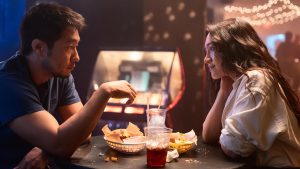
A still from BEDFORD PARK
As I was writing, I wanted to tell a story in that moment with some cultural references to what expectations are from a Korean American elder, and what the expectations are of a Korean man who does not have the Korean background that we later find out he has. I find that to be a nice surprise—that he is treating fellow Koreans that way is unexpected. Koreans normally have a sort of unspoken understanding of each other. And then Audrey being stuck in the middle, as is her theme, being stuck between these two parallel worlds of the Korean American traditions and the American culture that she has also been brought up with. It is an encapsulation of all that.
HTN: I think all that comes through. It is a really great moment. At the 35-minute mark, after their harrowing experience together, Audrey shows back up at Eli’s home, this time in a much different register. Audrey returns his pants and asks to see the invoice. She takes it and says that her mom will take care of it. Eli says, “A deal is a deal,” and Audrey responds that her mother insists. Audrey asks how he is getting around without a car, and Eli says the bus. A light, hopeful soundscape comes in as Audrey writes her number in a cute, color-coded way. She holds out the piece of paper and says, “Here’s my number. I will drive you.” They go back and forth with Eli denying the offer until she says, “Yeah, you know what, I’ll go crazy if I sit at my parents’ house all day, so.” He takes the piece of paper and she walks off, but not before Eli stops her and asks for his pen back. “That’s my pen,” he says. “You should get a new one,” she responds. I think this is just such a great moment. Can you talk about what was important to you?
SA: This was a shift, obviously, in their relationship. It is the beginning of the plot being more about this relationship now. As I mentioned earlier, there was an idea brewing for me about this exchange of kindness that they are both capable of. Her desire to give back—because he had done something very meaningful for her in a previous scene—I think she just wanted to return the favor. Also, there is a very Korean thing, maybe it is just in my family, of never wanting to be burdened with someone having done you a favor without returning the favor, so that you do not feel like they have something over you. That may be part of it, culturally speaking.
But I wanted it to feel real, and there to be awkwardness. I did not want it to be saccharine or sentimental. Eli needs his pen back—that is his pen, he wants it back. I just wanted it to end on a note of not being sentimental. Realism.
HTN I love both their performances in that moment. Another moment I love their performances is at the 50-minute mark, where Audrey brings Chinese food to Eli’s house. They both reveal some pretty deep secrets about themselves. Eli was adopted. Audrey cannot really have kids. Eli prefers a fork to chopsticks. Without being prompted, Eli says, “I know how to use chopsticks. I just like the fork better.” Eli asks if she normally goes out with frat guys like the one he saw her with. She says it was a casual thing. Audrey shares her condition regarding having children, and Eli coughs. He grabs some tea, and Audrey, kind of rolling her eyes, says, “I don’t know why I’m telling you this.” Eli reveals he has a daughter and talks about his aspirations to be a social worker. He discusses how he was a wrestler and shows Audrey how to do a chop in wrestling—and this shot is framed so we see Audrey smiling as he grabs her. This is kind of their first date in a way. Can you talk about crafting this moment?
SA: It was a tricky scene because I have an allergy to exposition, and exposing a lot of backstory through exposition is not something I am a fan of. But it felt real that two people in this position might reveal some things about each other. I think it is a slow dance. It is not just about the words spoken, but being in this intimate space with the two of them and seeing the glances, seeing the quiet, hearing the environment where he lives. I think all of that is part of this dance of communication that they have. And the wrestling move is part of the communication.
He is proud of having been probably a star wrestler. It is something that he can show her. She went to Columbia. She is fancy compared to Eli. But this is something that he has authority in and he can demonstrate it. I think it is endearing and embarrassing for her. I just tried to let the scene really breathe, to be a dance in addition to revealing actual things about themselves.
HTN: I think it definitely did not feel like too much exposition. It felt like a very natural scene to me. Shortly after this, at the 55-minute mark, we get maybe my favorite moment in the film, which is the two of them sitting in the car listening to the Rocky theme song. Audrey flips around on the radio until she comes across the Rocky theme. Eli tells her to keep the station and turns it up. Eli begins doing hand motions as if he is conducting an orchestra. Audrey asks, “Is this Rocky?” And what starts as a funny moment becomes strangely moving as Audrey begins to well up. Eli remains in the same register, making this hilariously serious face and conducting with his hand. Right as the song ends, a car honks, a tear goes down Audrey’s face, and they begin to drive. This is just such a great and unexpected moment. Can you talk about your thinking?
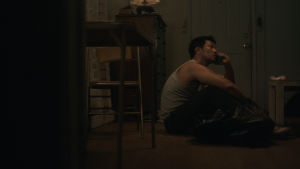
A still from BEDFORD PARK
SA: I should start with the fact that I am a huge fan of Rocky. It is a childhood film that I carried with me throughout my life. It is something very meaningful for me and my family. This underdog story, I think it resonates with immigrants in general. It was just something I always found so powerful. And that score—that fucking score just always kills me.
Because from my experience as an immigrant, that film has an association with being an immigrant. I gave the character Eli this backstory that he always loved that film. He is from Pennsylvania, he is an athlete, he is kind of an underdog. So it was a film that he always loved and a score that he always loved. When it comes on, I wanted to give that character a moment where he gets to be himself with barriers down, maybe for the first time in front of Audrey.
Yes, it starts off with her almost teasing him about it, but I wanted them to have this moment of real emotional complexity and a shared sense of emotional levity through music and without any words. They are sharing it, but they are also very much in their own heads. It is such a privilege for an audience to be able to see this unfolding. Thank God they pulled it off—their performances are so beautiful. It is one of my favorite scenes too.
HTN: Such a great moment. I wish I could be in the theater for the premiere to see everyone’s reaction to it. At the hour and 16-minute mark, Audrey goes on a date with their Korean family friend. He starts by saying, “Your parents are lucky to have a doctor in the family.” And Audrey responds, “I’m not a doctor. I’m a physical therapist.” The man tries to play it off like that is splitting hairs, and Audrey says, “Not really. One requires a medical degree.” The man senses this is a sensitive topic and tries to push the conversation forward, asking how she got into physical therapy. Audrey says, “I don’t know. I guess it was a consolation prize for my parents.” The man seems a bit taken aback but asks about Audrey’s brother. Audrey gives another answer that does not give him much to work with. So he cuts to the chase and says, “Look, I know that the way we are being set up is weird. Our parents don’t understand that the world is different now.” Audrey takes this opportunity to lay it all out there as well. She says, “Please tell your parents I can’t give them any more grandkids. I’m an atheist. This dress is not mine. Might as well cut to the chase.” I really loved this moment. Can you illuminate your thinking?
SA: I think it is the moment where Audrey, very sadly, is giving in to something that her heart does not want to do. Seeing that to me is tragic. She has relegated herself to a life at that point that she does not really want, but she thinks that maybe it is all that is offered to her at this point in her life. What other alternative does she have?
It turns out Edward is not a bad guy. I think it would be easy to make that character some douchebag, but he is not. He is actually a really good, kind person. When she realizes that, I think she is like, “All right, maybe I can do this. Even if I am not feeling it in my heart, maybe I can take one for the team.” It was her way of connecting with him, of saying, “Look, this is really it. Take it or leave it.”
– Jack Schenker (@YUNGOCUPOTIS)