

A Conversation with Mascha Schilinski & Fabian Gamper (SOUND OF FALLING)

Sound of Falling, Mascha Schilinski’s ravishing and uncanny debut feature, traces a century of girlhood on a single farm in Germany’s Altmark region. The film moves between four time periods—Alma in the 1910s, Erika in the 1940s, Angelika in the 1980s German Democratic Republic, and Lenka in our present. Each girl navigates the particular cruelties and confusions of her era while unknowingly echoing the others across time. They share bedrooms, stairwells, and the same view of a river that changes meaning with each generation: a site of childhood play, a political border, a place where village women drowned themselves to escape advancing soldiers.
Schilinski developed the film with co-writer Louise Peter over a summer spent at the actual farmhouse where the story takes place. The property had been abandoned for half a century, its rooms frozen in time, everyday objects still resting where their owners last placed them. While researching, the writers uncovered fragments of women’s histories. The result is a work of extraordinary formal ambition. Cinematographer Fabian Gamper, who also operated the camera, employed pinhole lenses to render certain sequences with the soft indistinction of half-remembered dreams. His roving Steadicam doesn’t just observe the action, it participates in it, drifting through doorways and across decades as though the camera itself were a presence haunting the house, trying to piece together what happened here. Dialogue is sparse; the film operates primarily through image, sound design, and voiceover narration that captures each girl’s consciousness. The approach yields something genuinely new: a portrait of intergenerational trauma that doesn’t explain or diagnose but simply shows how pain echoes forward through time, lodging in bodies that have no language for what they carry.
Sound of Falling premiered in Competition at the Cannes Film Festival, where it won the Jury Prize. It has since been selected as Germany’s official submission for the Academy Award for Best International Feature Film. MUBI released it theatrically on January 16th. Seeing the film at NYFF 2025 in Alice Tully Hall was a mind blowing experience. Returning to the film at home prior to this conversation, the film only got better. The following conversation was edited for length and clarity.
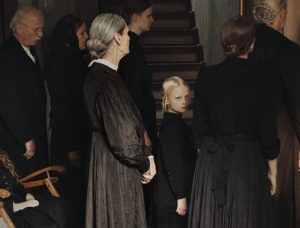
Hammer to Nail: At the seven-minute mark, we’re introduced to Alma’s timeline in this amazing one-er. Alma (Hanna Heckt) and her sisters look over Berta (Barbel Schwarz) as she pretends to be seriously injured. The camera sits behind Alma from just outside the doorway. Berta screams and chases after the girls. The camera follows Berta in her pursuit until we find Alma again. She screams and all sound besides her breathing and footsteps cuts out. Alma rushes around the corner as static begins to come into the soundscape. She sees her mother walk into a room with two boxes and the shot ends as she peers into the keyhole. Can you talk about executing this moment and what was important to you here?
Mascha Schilinski: I wanted to make sure from the very beginning that the things you see might not be what you think they are. Alma is in the middle of a very lively situation, running with Berta and her sisters around the table, and suddenly everyone has disappeared. She’s the only one left, and you can’t say where the others went. It’s impossible that they could be gone so quickly in one second.
This film is about memory itself and how memory and imagination flow into each other. So Alma is remembering this scene, and suddenly her remembering is connected with these rooms, because we are all very strongly connected with rooms in our memory. we can all immediately tell some memories: this was in the living room, this was there etc.
Then she’s suddenly in another situation, like in a dream, the same, but completely different. She’s remembering something she tried to repress. She will find out she has a sister who died, and that her name is the same.
Fabian Gamper: This shot has all of the problems you usually have with one-er shots. Obviously you have to light the space so you can look everywhere and do not have the light fixtures in frame. You also have to make sure the exposure is set for all the places you look at with the camera. Then you have to get the choreography and the timing right with the actors.
This is the great part with Masha and her vision. She really wrote the screenplay together with Luisa Peter with the effect that this sequence has totally in mind—this kind of memory-like quality where the scene changes, not in a completely realistic way, but more in a way you would see it in a memory. The memory and the imagination kind of overlap and you have a very precise way of remembering a feeling. So the way to shoot it was to try to capture more the feeling that Alma had when she remembers that, rather than creating it one by one as it happened. This was the idea behind it—to have this mood change where all of a sudden everybody disappears.
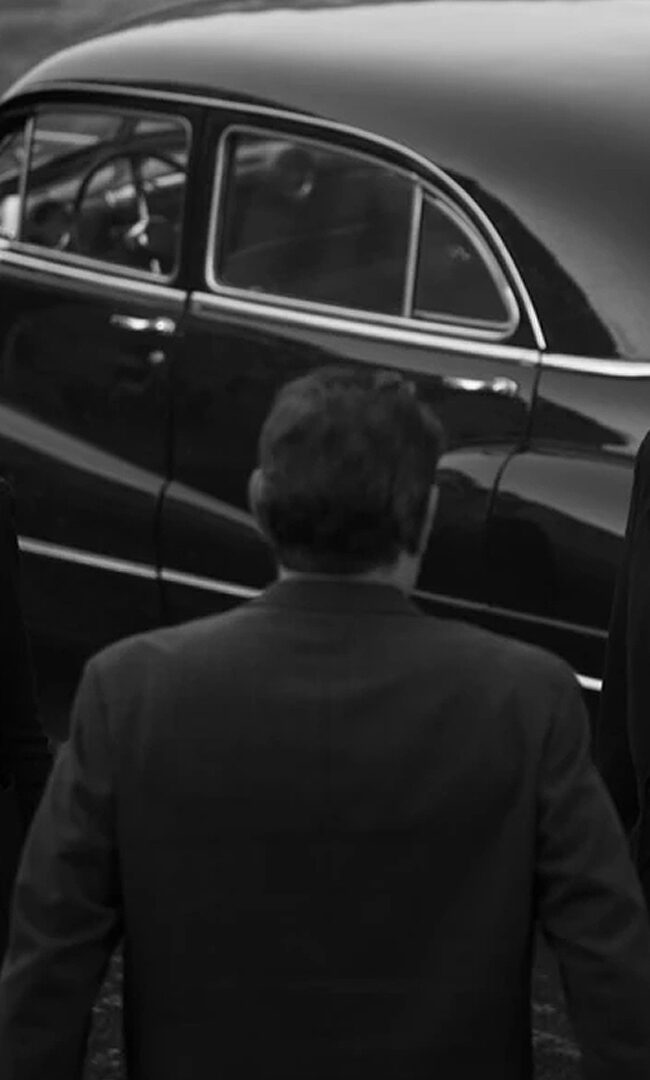
A still from SOUND OF FALLING
The challenge was, since we were on such a small budget, we did not have a lot of time and we could not rehearse it that much. But on the other hand, it was also nice that we did not have that much dialogue in the scene, so we could really focus on the movement through space and the whole choreography. The actors were very much in sync with those ideas. Masha did not have time to rehearse it a lot, but I think she managed well to get it done with the actors pretty quickly to make it work for the camera.
The technical challenges with the lighting—the obvious way to deal with that is to light mostly from the outside. My gaffer and his team did an amazing job with the limited resources we had. We had to stabilize the lighting because we wanted it to feel very natural, but we had to deal with a lot of light changes because the sun came and went and we had rain and everything going on outside. So we really had to create step-by-step lighting. In this sequence, we had it mainly on one side in the main room. In the other room, we were a bit luckier because the sun was not hitting directly, so we could use the available light that comes through the window.
What came in very handy for me in the shooting of Sound of Falling was that I was operating myself. We did it with a Steadicam, which has its pros and cons, but for us in this case it was great because I could react instinctively. The little micro decisions you make during a take, you could jump into it and feel it. I love to be close with the actors and get an understanding in a body language way when operating. We really took our chance. I think we did just very few takes and Masha gave her directions on what to change and then we got it because we really had to rush through those takes.
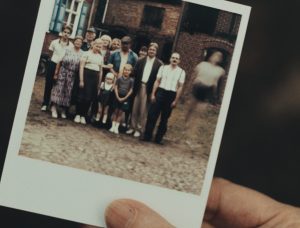
HTN: At the 28-minute mark, Alma gets into bed with her older sister and asks, “What did you mean by she just didn’t wake up?” Her sister dismisses this concern, rolls over, and tells her to go to sleep. The camera sits in a close-up of Alma’s face. It then switches to a reverse shot of her perspective of the bench where that photo was taken. Alma whispers, “What happens when you die?” Her sister responds, “Nothing.” We then jump 100 years into the future as the camera drifts up the bodies of Hannes (Lucas Prisor) and Christa (Luise Heyer) having sex. One of their daughters has had a bad dream. We then get this transfixing moment where, in slow motion, Christa pulls her daughters on a loose blanket on the ground. What could have been a moment of levity becomes almost disturbing due to the slow motion and rising static. What was your thinking with this moment?
MS: I wanted to capture this feeling that Alma had, that we maybe all know—when we first really understand or realize what death means. It’s just too big for our brain. You can’t handle the imagination of infinity, of endlessness. You can think infinitely, but you also can’t think about nothing. When there is nothing, what is nothing? It’s threatening when someone says to you, “Oh, there is nothing, you’re dead, it’s nothing.” Alma is thinking about this nothing.
I love the idea that in this moment where she’s thinking about this, we have our first transition to the next time period. It starts with a starting point, so to speak: they’re having sex with each other. In sexuality, sometimes you’re not aware of your body anymore. When you close your eyes, you’re not in that body, in that situation. There’s a sense of infinity because you’re just in that emotion. There’s nothing in a way as well.
Then we see that Nelly (Zoe Baier), Lenka’s (Laeni Geiseler) little sister, has this nightmare, and there’s this fly that lands on her face. We saw before that Alma saw this fly during the death ceremony, which reminded her of the neighbor boy who died. That’s where she was first confronted with death. This gives you a hint that when Nelly is lying there and the fly is coming and she’s dreaming, something is coming back to her that she has no words for, because she didn’t experience this herself. But she can feel something. It’s a hint that we all can feel things that happened before we were even born—things that shaped us.
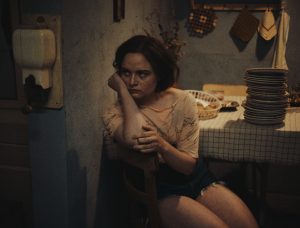
HTN: At the 46-minute mark, we’re introduced to this static camera situation. Christa is resting by the lake reading a book. She closes her eyes and we cut to this static camera some distance behind her, up the hill. The static sound rises as we faintly hear someone sing “Stranger” by Anna von Hausswolff. The camera slowly drifts toward her until it’s hovering over her face in a close-up. All sound cuts out besides faint breath and wind. Then she wakes up and the natural soundscape returns. We remain in this static camera observing as her daughter complains that she didn’t see her trick. What was your thinking here?
MS: This was about playing with perspectives. The film is about memory itself and imagination, and I wanted to show that we all have these images in mind that actually never happened, because we are prisoners in our bodies. We look through our eyes, but later we can sometimes remember and see ourselves from an outer perspective. Suddenly we see ourselves sitting on the sofa. For example, right now I look at you and I can’t see myself. But when I remember this later, maybe I can see myself sitting in this lobby here. So I have a picture in my mind that actually never happened. But it’s building my identity.
I wanted to create this feeling that these characters are looking from a million years later on their lives and have this glimpse of, “Oh, I was alive” or “there was something.” It could be the first image or the last image, like when you die and all the images run through you one more time. Because memory is not linear. It’s erupting, it’s associative, it jumps through time.
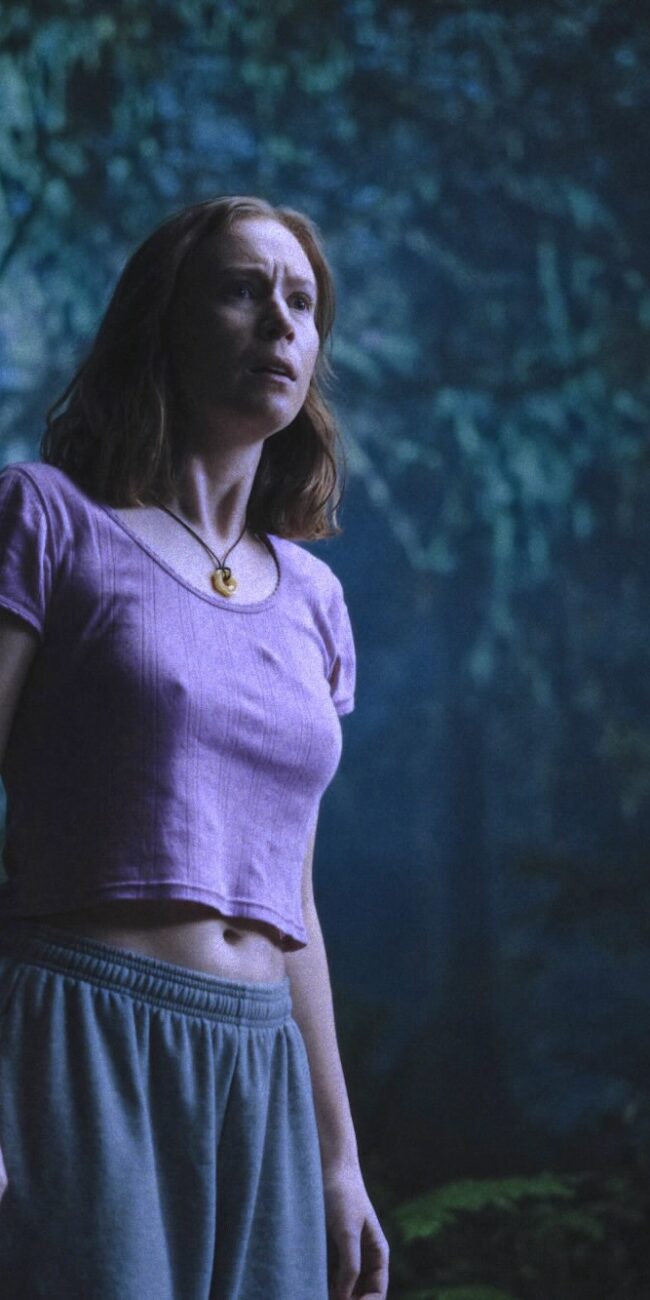
A still from SOUND OF FALLING
In my head, this is Lenka’s point of view. Later in the film, Lenka says she tries to remember that one summer when her sister jumped down there, what actually happened and why she jumped. She’s basically scrolling through her own material to find this tiny puzzle piece of why her sister jumped, and all the images come back from that last summer they had together. Of course, she will never find the puzzle piece, none of them will, because there isn’t one puzzle.
HTN: How did you actually achieve that static camera look? Was it a post effect or all in camera?
MS: This was all in camera. Fabian was also the operator, so he operated Steadicam. We worked with pinhole lenses because we were trying to find how we could capture this feeling that you can’t reach a memory anymore exactly—that it’s sometimes blurry or unsharp. When you try to remember a face from a beloved one who passed away and you can’t get some details, or maybe you remember some details but you can’t grab the whole face anymore. We were trying to find, on the technical side, a translation for these kinds of feelings.
It’s also about places and the simultaneity of time. That exact spot where Christa rests, you see Angelika (Lena Urzendowsky) there with her uncle (Konstantin Lindhorst) in the ’80s doing swim lessons. This river, for example, is just a river, but in the ’80s, it’s a border. In the present, it’s just a river where the kids can swim. In the ’40s, in Erika’s (Lea Drinda) time period, the river is a place where all the women from the village committed suicide to avoid male violence from the Russian soldiers that were coming. We are defining the meanings. Nothing has meaning by itself.
All these characters are connected by a longing to exist in this world without the meaning that was created before they were born. This longing that we all can be here for one moment and feel how it is to be ourselves, without someone telling you, “You’re a human being, this is a river, and it means it’s a border.”
FG: This pinhole lens was the first effect we discovered that we actually felt had the effect we were looking for. We were really trying to find images that look like memory dust, those inner images that you see when you are not actually looking but you are remembering something. That was kind of the goal for the whole film, to make it look like that. For me, it was really a great challenge to create that because it was a very clear direction on what to look for.
I tested around, and the pinhole was the first thing that we looked at and felt it does not feel like just an effect you usually see. I think it is a very thin line to get something that does not feel like a music video. We did not want it to be “effecty.” We wanted it to really evoke this feeling of memory. With this pinhole lens, it is so defocused, and it has a very unique way of flaring the light that enters the lens when light is shining at the lens directly. When testing that, that was kind of the first footage I showed Masha, and we both felt this resonates somehow and looks like memory does.
For this specific scene, it is interesting you picked this one because that is kind of when two of our concepts really met. The other idea is that the camera should be a bit like a character, like a ghost who is moving around, moving through the places but also through time. We wanted this ghostly feel of a camera that is not just being operated in a way you have in cinema usually, when you try to hide the movement of the camera and just pan or follow an actor. We wanted to have this curiosity of the camera, so you feel it is alive and looking around.
In this sequence, the camera needed to be very low and also a little bit higher, so we had a bigger range of motion that you could not do with a Steadicam. We tested some approaches, and an obvious approach would be to work with an ARRI Trinity system that provides shots that can be very low or go up high and it is perfectly smooth if you have a good operator. But it would not have been in our budget to do it with the Trinity rig. So what I did was I had a gimbal, which is electronic stabilization, and put it on top of the Steadicam, so you can operate it a bit like a Trinity. It is not as perfect at executing shots as the Trinity system. When we tested it, we felt the way it behaves, when you feel the movements of the camera a little bit more, it worked perfectly with the camera that held the pinhole. So this became the approach for those kinds of scenes.
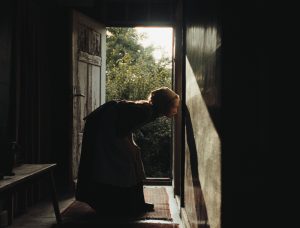
HTN: At the hour and 20-minute mark, as Fritz (Flip Schnack plays the younger “Fritz”, Martin Rother is older “Fritz”) wails in pain, the camera drifts through the house. Alma says “a work accident” a few times. She says, “if you say a word many times, it loses its meaning.” The camera goes up the stairs as we find ourselves in the girls’ room as they’re all kept up by the screaming. Alma’s sister remarks that this might be phantom pain. The camera falls out of the room and into the room with Fritz, Trudi (Luzia Opperman), and Alma’s mother (Susanne Wuest) as they struggle with him. Alma’s mother takes a step outside and gags. Then the static sound rises slightly as she stares directly into the camera—as if she feels or sees whoever or whatever is observing them. Alma then says, “Funny how something can hurt that’s no longer there.” This sentiment is repeated throughout the film. Can you talk about crafting this moment?
A still from SOUND OF FALLING
MS: This is a planned sequence we did with Steadicam. I wanted to create the feeling that we are Alma’s thoughts or imagination at this moment. Alma is lying in bed with her sisters, listening to Fritz’s screams, and she’s going there with her mind. So we see something that maybe is just her imagination of what’s happening in that moment.
Fritz has lost his leg and has phantom pain, and phantom pain became a metaphor for the whole film—this pain that you don’t know where it’s coming from, but it’s still there. My co-writer Louise and I discussed for a very long time this feeling we both know: that we sometimes feel like a stand-in for someone from another generation, and that themes come into our lives that we ask ourselves, “Why is this theme back again? It’s not in my biography. Why do I have to deal with this? Why do I have to fight for this as well?” Sometimes you have the feeling it’s coming from another generation and you have to fight for them because maybe they couldn’t finish it. It’s unfinished business. Previous generations’ lives weren’t long enough to overcome what they should have overcome. So the next generation has to figure out how to solve this trauma. Sometimes it takes many generations to overcome one trauma.
And then Emma, Fritz & Alma’s mother, gags and bites her hand. She’s gagging constantly in this film because she doesn’t speak. She’s just stopped talking. You can feel that her stomach is damaged from all this repressing. She almost feels this camera, which is a ghost in this film. The camera is a character of its own. Fabian was always dancing with these actors. He really became this ghost. We decided that this camera is not invisible in the film, because most films try to avoid you feeling there’s a camera, but we wanted this camera to be like a character itself, like a ghost walking from room to room and through time, curious and watching things, trying to get behind these obvious images in order to get the truth.
FG: This whole traveling of the camera through the house is again an example of this idea of how we wanted the film to be felt. This ghost that has this curiosity. It was very much inspired by the farmhouse itself, because it was empty for such a long time. We had this feeling that when you go there through the night, you could imagine you are in another time. It is kind of this what-if idea: what if you could, as a ghost, look into what happened there in another time period? So we wanted these shots kind of flying, floating through these empty staircases and then arriving at this scene.
From a technical perspective, it was again an example that I shot with this gimbal on a Steadicam system, because the camera was quite low on the floor. This was a very helpful technique to execute those shots. The challenge was to light it, because we really wanted to make it feel as dark as it would in real life when you are at such a place and you really have trouble seeing. From not seeing it correctly, you get this certain suspense. It adds to this curiosity.
For creating the images, it is always this kind of challenge if you want to be really dark at night. I feel if you do it for too long and just have a very low exposure, it becomes just flat and boring. When you are watching it in the theater, it does not feel dark anymore because you start seeing the screen and the audience, and it kind of loses its intention. But I felt it works for short periods of time when you are coming from a brighter scene and then you are in this darkness and have this moment as if you come in real life from a bright scene to a darker scene and you do not see anything. The eyes have to adapt to the darker environment. So I like to use that very low light level for some moments to enter the scene.
Then, at a certain point, we started using the practicals, and we often used them a lot for real, so the practicals were really giving us exposure to the actors’ faces. We had this effect where, for example, in the scene afterwards where they are going to Fritz’s room, the maid is carrying a little oil lamp, and since she is holding it quite close to her face, her face gets exposed quite brightly, it is even kind of overexposed. I really love the effect of that because I felt it is quite close to how you would normally see such a thing when you go to a place that is so dark and you have a light source very close. So we went for it. We fine-tuned it a little bit and we had our LED panels here and there and created on top of that. But as a general approach, we really thought it is interesting to have really dark darkness and then those practicals give us hotspots in the places where the characters are moving.
I think it is about the balance, because those very dark moments, if they are coming and they are balanced against bright scenes or bright moments, then it becomes interesting. It is really this balancing question on how to use it. It makes it more interesting when you have those dark moments because then you are curious. But just after a certain moment, you need more information in the picture, because if it would not change to something or have this rhythm in it, I think the boredom would start.
HTN: At the hour and 30-minute mark, after her cousin comes on to her and then insults her, Angelika is out in the field watching her dad do field work. She walks along the field until she stumbles upon a dead deer. The camera switches into the vehicle’s perspective, really showing its power. We go back to Angelika, who, with the soundscape almost silent, curls up next to this deer, and we watch as her father’s machine on the ground crushes her and we cut to black. We find Angelika back in the field musing on what makes someone what they are, looking at the hole now where that deer was, it is now gone. If you could talk about what was important to you crafting this moment?
FG: For all the scenes when we had stunts involved or potentially dangerous situations, we had to plan them very clearly because we were very restricted in the budget. We really had to make sure we used approaches that work for the budget. We were often trying to find the easiest way to do it. While testing or thinking about it, we often felt it was also the strongest way.
I am talking about the moment when the machine is actually approaching her, or approaching us, because it is directly driving from the background towards the viewer. It is really just this shot. We figured out a technique to achieve it in a very simple way because the camera was locked, so there was no tracking or anything. We could just lay the actress in the position and have just a tiny bit of green screen behind her and shoot this take. Then we just removed her and the green screen and we could approach the camera and come with the tool in front that cuts through the hay, and come to a point where it seems to be really, really close. It could even drive past the position where the actress was laying. It was not dangerous at all because it was just a camera standing there at a safe distance. It was a very easy comp in the end because everything was static.
I felt we got this danger from the machine. It is not a point of view of her really, because she is in the frame, but still it is this point-of-view perspective that this machine is coming towards you. It is just this simple frame. That was the usual approach we had for these moments of danger: to find this one frame that tells this moment, as opposed to finding a lot of coverage to make it action-driven or what you would maybe do in another kind of story. We really tried to find this one image, hold it and experience sinking into this one frame.
HTN: At the hour and 40-minute mark, Alma sits in her room and notices her black dress. She puts it on and wanders over to the couch where that picture was taken. She positions herself in the same way that dead child was positioned and sits there for a second. The camera first sits in a medium shot of Alma positioning herself. It cuts to her first-person perspective as she flops her arms and twists her feet. Then we go back to that medium shot, but this time all diegetic sound has been cut out. The deep soundscape is introduced as we slowly zoom into Alma. The camera gains this static texture as we zoom in. Can you just talk about what was important to you guys here, technically crafting it?
A still from SOUND OF FALLING
FG: This subjectivity was a very important concept throughout the film. There are two aspects within the scene. First we have this point-of-view shot when she actually looks down. We really have the camera seeing what her eyes would see in this moment and see this dress. Then we have the external perspective, which for us is something that happens in memory because if you would stick to this concept of point of view and be really accurate with the concept, you could not see the character from outside, you would have to stick in that. But we felt that when the scene has taken place a while ago and it turns into memory, the memories of the pictures that you actually saw at that moment interfere with your imagination of this moment. In the imagination, you also have these wider shots of yourself where you can see yourself from the outside. This is why we thought we should not stick to just real point-of-view shots.
Then this zoom shot is also a point-of-view concept, actually a point of view of the memory. I feel that looking at something in a distance and focusing on it has in a subjective way an effect of a zoom lens somehow. You could argue that it is technically incorrect because the human eye is not a zoom lens, but the way you see the image feels like that. Your attention is to a very precise spot, and you do not pay attention to everything else. Since you have a very high resolution in the eyes, it actually feels like a zoom, and it can also feel like the lens is zooming in. So this is the association we had with using zoom lenses.
What happened in this moment is we actually did not do a zoom with a push in when filming it. Afterwards in the editing with Evelyn Ruck, they extended the movement of the camera and zoomed in digitally. We did this at some moments, usually just a little bit, because we did most of the zooms in camera. But at this point, they figured out that zooming in really, really close had an interesting effect of actually seeing the digital pixels, seeing the limitation of our resolution. The camera, the Alexa Mini we shot on, its resolution is great and you really can zoom in a lot and still get information. But at this point, we really cracked that and went to see what was actually there. At a certain point, the image gets bigger but you do not get more information out of it.
For me, it is a bit like imagination as well. You try to remember this moment and you can, in your memory, go close to it and try really hard to remember it, but it does not get more clear because that is how your memory is. You cannot see it clear in your memory. So that is why the digital zoom developed in the editing process was just an extension, but I felt what happened there—that you see those pixels in this kind of way—really worked with the main concept of the goals we had in mind for the other scenes.
HTN: At the hour and 50-minute mark, Alma and her sisters rush out of the barn. Alma first walks through this insane labyrinth tunnel and finds the boy in his carriage. She’s now surrounded by her sisters. The competition is: the last person out of the barn gets dragged into the realm of the dead. Classic fun game. Alma just beats her sister out of the barn. The soundscape slowly fades out and narration tells us that Alma had been waiting all summer to drop dead. We watch as her sister, in genuine desperation, tries to escape the barn. Narration tells us that many members of the family would die this summer. Alma turns around and finds this static camera observing her. It drifts up and floats to the sun, delivering a stunning lens flare, which transitions to the ’80s timeline.
MS: This is a real game I found through research. kids are playing in the hay in the barn, creating these tunnels under the hay. But I also wanted to show that memory is unreliable. As a kid, sometimes a room seems so big, Then as an adult you return and you’re like, “Oh, I thought it was so big. It’s not big actually.” So in Alma’s memory, these tunnels are these shaped tunnels, but in reality it’s completely dark and they’re not this shape, they just dug a few tunnels through these mounds of hay. In some historical descriptions we found, they said there were mounds of hay that reached up to the sky. Of course it’s not true, but it’s in these kids’ imagination. We tried to capture this feeling that you remember, not the reality, because the only thing that’s real is the feeling that’s left.
Then it’s a game they’re playing, that the last one out of the barn will be dragged back by the corpse stored there. It was an actual historic ritual that there’s one barn where all the dead from the village are stored for a week before they’re buried. Of course, the kids are sneaking in. I love this idea that kids don’t have a concept of death and yet are surrounded by death in this time period. Later, in the present, death is excluded, no one has access anymore, it’s outsourced, no longer in the house. In Alma’s decade, you’re surrounded by birth and death. I love the idea that the kids are listening if there’s a fly still in the body or not. It’s morbid, but kids are not afraid in the way we are.
It’s also about how superstitions are formed over a century. You can see Alma is thinking, because her sisters told her when she was looking at the photograph of her dead sister that maybe she’s next. She asked, “Why is she seven and I’m seven now? Maybe I’m next.” She’s obsessed with the idea that she could die suddenly. Then there’s the song about God deciding if you’re waking up or not, an actual lullaby that every little one knows in Germany. I know this feeling as a child, being afraid to fall asleep and not wake up.
So Lia (Greta Kramer), Alma’s sister, thinks she’s next because she was the last one in the barn. We shot it with a zoom and I love the idea of playing with the horror genre in that moment. With her trying to claw her way out.
– Jack Schenker (@YUNGOCUPOTIS)