

A Conversation wtih Luka Sabbat and Indya Moore (FATHER MOTHER SISTER BROTHER)
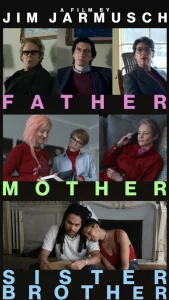
Jim Jarmusch has spent over four decades crafting films about drifters, outsiders, and quiet souls navigating a world that rarely accommodates their rhythms. With Father Mother Sister Brother, the legendary independent filmmaker delivers what he calls “a kind of anti-action film.” It’s a triptych of three separate stories examining the relationships between adult children, their somewhat distant parents, and each other. The first segment, “Father,” features Tom Waits as a reclusive nonconformist visited by his adult children Adam Driver and Mayim Bialik in rural winter. The second, “Mother,” stars Charlotte Rampling as a Dublin romance novelist hosting an annual tea party with her two very different daughters, played by Cate Blanchett and Vicky Krieps. But it’s the third and final segment, “Sister Brother,” that moved me most deeply—and features two of the film’s most revelatory performances.
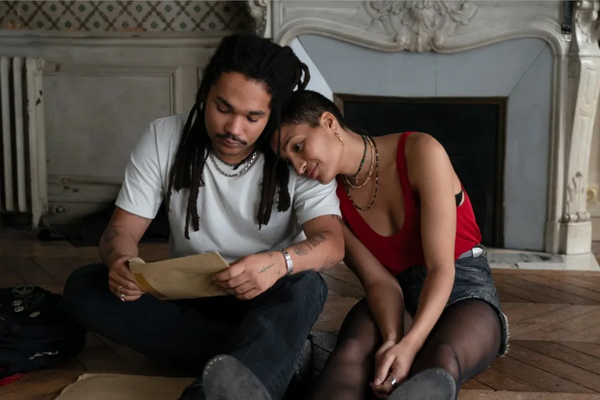
Luka Sabbat and Indya Moore play Billy and Sky, twin siblings in their twenties who reunite in Paris following the sudden accidental death of their wild-living American parents. Their closeness is immediately evident as they move through the city in a vintage car left to them, eventually spending an afternoon in the now-emptied Parisian apartment where they partially grew up, discovering family secrets through documents and photographs. Shot by Yorick Le Saux and Frederick Elmes, edited by Afonso Gonçalves, featuring costumes by Catherine George with wardrobe supplied by Saint Laurent and Anthony Vaccarello, Father Mother Sister Brother premiered at the Cannes Film Festival and arrives in theaters via MUBI on Christmas Eve.
Hammer to Nail: Your chemistry is a major part of what makes your segment so great, and you’ve both spoken about building a sibling connection in real time on and off screen. Can you describe a specific moment where that bond clicked into place? How much time did you get to spend together before shooting?
Luka Sabbat: We spent a little time before shooting, but all of our schedules are crazy. I was already kind of in Paris, but a lot of the time we spent together was during filming, in the downtime between setups, between shots. We just spent so much time together.
I don’t want to say too much, because Indya has her own life and stories, but we were both going through things in real life that had nothing to do with the movie. We were just there for each other, being sensible to each other, understanding each other. Not every day filming was easy for some of us. It’s just being judgment-free, being understanding and nice to each other, knowing that not every day is the best day and some days are better than others. I think that helped a lot when we were on screen.
Indya Moore: It was really beautiful being able to film under the circumstances and having Luka as my scene partner. He was really present. At the time, I had been working more closely on a refugee crisis that was happening in Gaza. It was really difficult to interface with some of the things I was seeing, having to respond to and be present for while also working. I was horrified and I was navigating that.
Luka was really gracious and present through that experience. Everyone was feeling the confusion of that time quite viscerally as it was happening while we were filming. It just felt like—what am I doing here filming a movie when stuff like this is happening? It was really difficult. It was really nice to have human support in a way that reflected the emotional reality a lot of people were having. I really appreciated that from Luka, and it definitely affected the way we were able to learn the chemistry of our characters.
HtN: Costume designer Catherine George dressed the film, and your clothing is so essential to your characters. Can you discuss the costuming process and how you found your outfits? How did your costumes inform who Sky and Billy are as people?
LS: Catherine’s awesome, and so was the YSL team. That’s what I love about film—how much collaboration goes into it, from costume to cinematographers to sound. It’s the biggest collaboration with so many checks and balances.
I wanted Billy to be stylish, but I didn’t want him to be a fashion guy. He rides a motorcycle. There’s that scene where we’re in the coffee shop talking about how dangerous it is for them to ride motorcycles. YSL and Anthony Vaccarello did a great job not making it feel like an ad, because obviously it’s not. Sometimes brands can be so focused on product placement, but they made these not feel like costumes, it’s just what we wear.
Engineer boots are something I wear every day, so I got to wear my own personal pair. We really wanted to do a vintage leather jacket, but we couldn’t obviously do actual vintage. I got to develop a silhouette that YSL had already made but in a leather they don’t normally use for that jacket. When we wrapped the film, I asked if I could keep it—it’s super rare because they don’t make this specific jacket in this leather. It’s this patinaed, vintage-looking leather. Catherine had all these crazy techniques for aging it.
IM: I feel like maybe Sky and Billy made the wardrobe feel something, rather than the other way around. Maybe the person wearing the clothes creates the energy around how it’s felt. If you have a unique experience with someone, you’re going to associate the way they dress with that character.
The clothes were really cool. There was something smooth about it—the leather boots, the leather jacket, the stockings. Catherine did an amazing job. YSL and Anthony did an amazing job organizing and producing the fashion of the film. It was really cool to feel how I felt with the clothes on. It was more somber, more chill.
HTN: At the hour and 16-minute mark, you stop on the way to your parents’ home to get coffee. Luka, you say to Indya, “Hey, where are you?” Indya responds, “I’m in nowhereville. Nowhere special.” Luka examines the water and says it reminds him of an indigenous girl he was seeing who believed water to be medicine. Indya, your head is in a different space as you say, “Damn, the world is so fragile.” This leads into the reveal of how your parents passed. Can you talk about what was important to you in this introductory sequence?
LS: Everybody grieves differently, and grief affects everybody so differently. It can be heavy or it can’t be, and you can pass it on. Sometimes you can grieve for somebody.
I love the way Jim carefully constructs films. It starts off sweet—we’re hanging out, I’m getting shrooms, we’re showing this bond. Then we go to the coffee shop, and this bomb of information, this really heavy thing, gets presented. But the way he constructed it, you can see the sweetness and comfort Sky and Billy have with each other. The characters already knew this. This is something we’re going through. Being able to be like this around each other, considering our parents passed. When that line gets delivered, it helps you understand who we are to each other and how we’re grieving.
IM: I was thinking about our entire system and the infrastructure of everything. I was thinking about how so many people are treated like they’re disposable. There’s something that happened when I realized the world literally doesn’t revolve around me. The way we experience being alive is from the center of our bodies, so the world kind of revolves around you, but it doesn’t. Every single human being, every single life, is a vast world that actually exists and is so precious, is so alive, true and is entitled to exist by way of existing.
I was thinking about the gravity of that, and how people are fragile but should be treated with care because of that. Luka sharing about the indigenous girl talking about water as medicine made me think about Indigenous people, about colonialism, about occupation, how cruel it is. Cruelty, greed and lying because it can’t be justified truthfully under the principles and values we’re taught in our culture. So it has to be lied about, and we have to be deceived and manipulated into manufacturing consent for it to happen. It was so serious for me in that scene. When she says “the world is so fragile,” the weight of those words were what I just shared.
HtN: That’s part of the power of the film. It’s very quiet and stripped back stylistically, but that gives the audience, and clearly you guys, the chance to bring a lot of your life experiences to the role or to what you’re seeing in this world.
LS: Yeah, and we’re all human, right? That’s what I love about Jim’s characters, they’re not villains or heroes. There’s this humanity to it. You just never know what anybody’s going through, whether it’s your parents, your brother, your sister, or a random person on the street. Everybody has their own story and everybody’s the main character of their movie.
The film talks about how you are different people to different people. In the first segment, Tom Waits’ character is a different person to that girl he calls than he is to his children—they know two different people. Same with the second part, where Charlotte Rampling knows different daughters. We think we know our parents, but there’s so much we don’t know about them. You just never know what anybody’s going through. I really love that about this film.
HtN: At the hour and 24-minute mark, you enter the house, roam the empty space, and seemingly think of all the memories made there. At one point, Indya, you’re sitting on the counter. Luka asks if you’re all right, and you say, “[you’re] thinking of [your] dad’s cooking and how good it was. This moment culminates in your parents’ room as you embrace. It’s a rather silent moment, but I found your performances here to be so excellent. Can you talk about your thinking?
IM: The first meals you were ever fed, the person who fed you, your father, and maybe you didn’t like the way your dad made steak but he made chicken great, or maybe you didn’t appreciate his cooking when you got older, but he still cooked for you when you came to visit. When it dawns on you that he’s no longer alive anymore and you’ll never have that ever again, you’ll never have the background subconscious security of knowing you have a place to go during the holidays if something goes wrong in your partnership or with a friend. That’s gone. That’s a lot. That was my process for that scene.
LS: Memories are literally the one thing we all share as humans. It’s the only thing you really have. We all cherish them, and we all take things for granted whether we want to or not. Memories can be good or bad, it’s a shared experience every single human being has. You don’t know how amazing something was until you don’t have it anymore.
You might not like how your mother made something, but it’s not about the food. It’s about the time you had. I was actually having a conversation about this, the best meals I’ve ever had didn’t pertain to the food. It was the moments shared and the people I was sharing the meal with. We really wanted to convey that feeling everybody has had. Everybody’s eaten with people they love or don’t. It’s a shared human experience, and I find it really sweet.
– Jack Schenker (@YUNGOCUPOTIS)