




A Conversation with Darius Khondji (MARTY SUPREME)
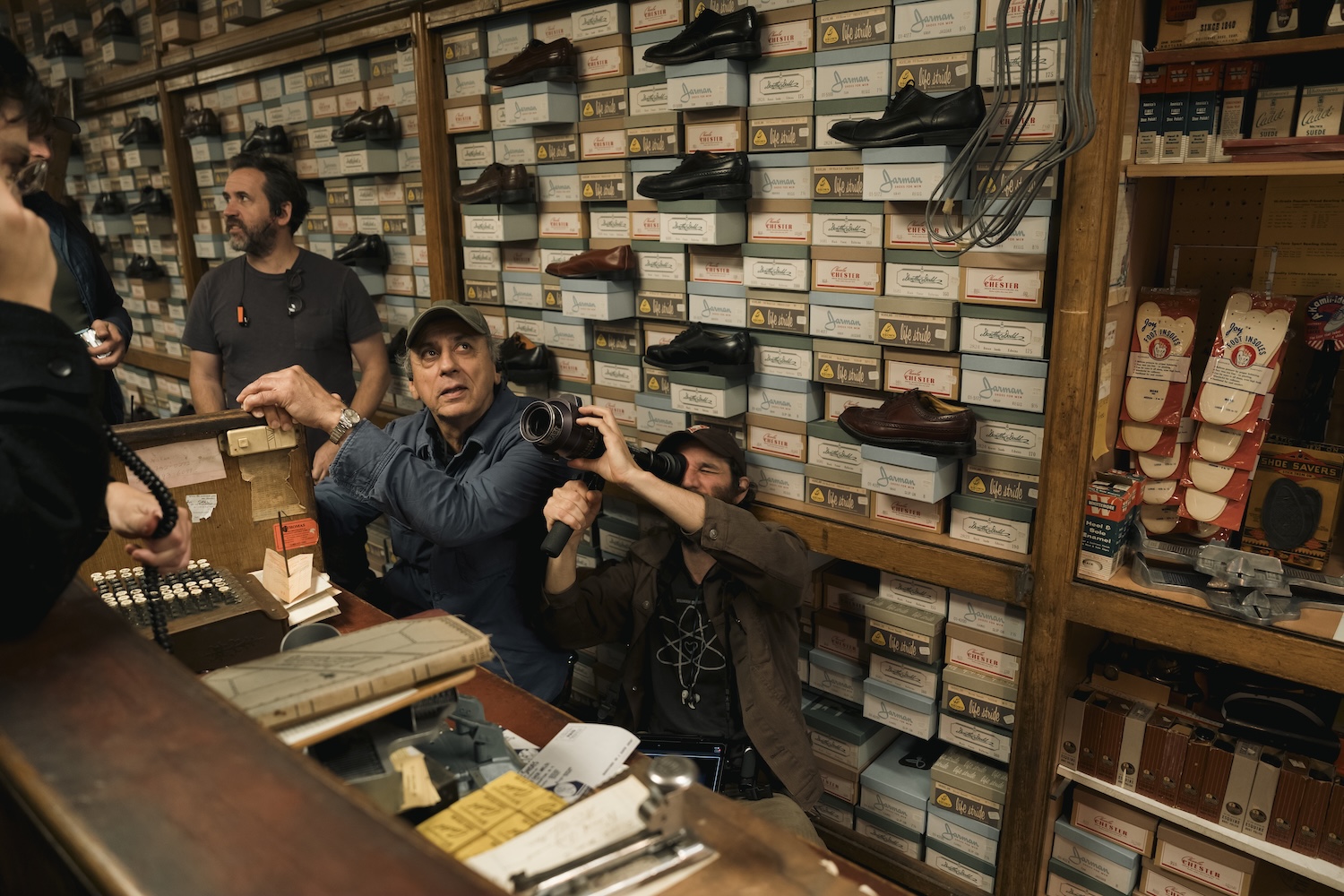
Iranian-French cinematographer Darius Khondji turned 70 in October of this year and shows no sign of slowing down in any way. His credits include such masterpieces as Marc Caro and Jean-Pierre Jeunet’s 1991 Delicatessen and 1995 The City of Lost Children, David Fincher’s 1995 Se7en and 2002 Panic Room, Wong Kar-wai’s 2007 My Blueberry Nights, Michael Haneke’s 2007 Funny Games and 2012 Amour, James Gray’s 2013 The Immigrant and 2016 The Lost City of Z, Bong Joon-ho’s 2017 Okja and 2025 Mickey 17, the Safdie Brothers’ 2019 Uncut Gems, and Ari Aster’s 2025 Eddington. He’s a true artist, able to shoot on film and digital cinema with equal craft. One of his three films out in 2025 is Josh Safdie’s debut solo effort, Marty Supreme (which I reviewed). I recently spoke with Khondji about that film via Zoom, and here is that conversation, edited for length and clarity.
Hammer to Nail: It’s an honor to speak to you. You don’t need me to tell you that you’ve had quite the impressive career, but what’s even more impressive to me right now is that you are the cinematographer on not one, not two, but three films released in 2025. What is your secret to this current burst of creative energy?
Darius Khondji: Passion, since the very beginning. I wanted to make films since I was a kid and I think somehow this flame hasn’t gone away. It’s amazing. I love it. I want it to last for a hundred years more.
HtN: Well, I certainly hope it does. And what an amazing variety of films just this year. Speaking of energy, I found the table-tennis scenes in Marty Supreme especially invigorating. What did you and director Josh Safdie discuss in terms of how he wanted you to shoot them?
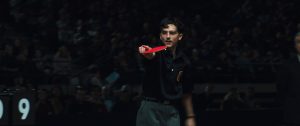
DK: He wanted to be very physical and at the same time very painterly, like an old classic boxing match. But at the same time, he wanted to be very physical and very real, very captivating. So we shot it with a few cameras, but in a really very classical way. We went away from commercial angles, such as a crazy angle to sell something. We wanted to go more towards the beauty of the dance of what these characters are doing when they are playing ping-pong. We played with different long lenses, but with different angles that were very classic angles. They were at the height of the characters. We put the camera at the height of the table but never crazy high or low angles or crazy shots that would make it look gimmicky. We wanted to stay away from gimmicky.
HtN: Speaking of long lenses, in the press notes you mentioned a 360mm lens, which is quite long. What scenes did you use that for?
A scene from MARTY SUPREME
DK: It came from a movie we watched from a great Italian director, Francesco Rosi, who had this cinematographer, Gianni Di Venanzo. And I remember reading an interview where they talk about these great long lenses, but it was a different type of lens. And at Panavision, they found us a lens that was extremely long that was in the cupboards that had not been used for years, a 360mm anamorphic Cinemascope lens. And it became like our best friend. We used it and just loved it. It was like a jewel. Josh held it in hands like it was a jewel, like an uncut gem. And we used this lens a lot, as if the film was shot like it was in the 1950s, the early days of Cinemascope, but shot with an extremely long lens. It makes the film different.
HtN: I was struck in this movie by the texture of the image, especially those pockmarks added to Timothée Chalamet’s face. And I know that Safdie really wanted the viewer to be transported back to 1952. How did you light the movie for that journey backwards in time and really get that texture?
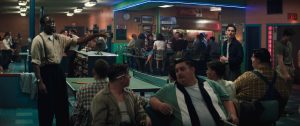
DK: Well, it was like this face you’re describing of Timothée, the 1950s film. I lit it thinking of how the ’50s looked, and with the help of production designer Jack Fisk and costume designer Miyako Bellizzi. Jack was an incredible help multilayering textures and making it really look like it was in the 1950s with an interesting, modern edge. Josh wanted something very real; he didn’t want the audience to be distracted by things that were done quickly, roughly done, and poorly done. And Jack Fisk gave us the ability to work like that, following with this long lens, following the characters; the canvas behind them was very real.
HtN: So, Eddington and Mickey 17, the two other films of yours out this year, were both shot digitally, whereas Marty Supreme was shot on 35. Do you approach a production any differently if it’s shot digitally versus on film?
DK: No, I don’t approach it differently. I approach digital as if it were film. I never really completely accepted somehow in me, emotionally, the digital. So when I photograph film digitally, I want to create the textures of what I’ve been living with in film. I always idealize digital. I always think that digital should be used as a digital medium, if I was doing a very special kind of movie. But I realized that even when I did a science-fiction film like Mickey 17, I wanted to have a more textural film, but Eddington was absolutely done like if it was on film. We wanted film originally. It’s a film. Even I have a hard time thinking that I shot it digitally. And Marty Supreme made me want to shoot film again. It really gave me this passion of skin tones shot on film. The feeling of analog was very, very strong.
A scene from MARTY SUPREME
HtN: Among the many things that impress me about your career is that you continue to work with the same directors over time. What advice do you have to offer about ensuring that these kinds of relationships last?
DK: It’s funny, Christopher, because I never think like that. I never assume that a film director is going to hire me again. Because I am working with this great filmmaker, I always would love to do one more film with them and then another film with them. But I think one film at a time. I’m just lucky that they hire me again. Honestly, I don’t want to sound humble, but it’s really the truth because every time it’s a new film and maybe they want to work with another cameraman; there are so many exciting cameramen around today. And no, I’m just very happy to work with them. (pauses) I just realized you have a Betty Blue poster behind you.
HtN: Yes, I do.
DK: That’s so exciting.
HtN: And wait a second. I have this right here, too. (pulls poster of Diva into frame).
DK: Diva. Wow! These are from my early years…I was not a cameraman at the time. Diva is shot by [Philippe] Rousselot and Betty Blue is Jean-François Robin.
HtN: (switching to French) I am half-French and spent my own early years admiring the films of director Jean-Jacques Beineix.
DK: (also in French) Me, too. Of course. There’s something of Jean-Jacques Beineix in you. (laughs)
HtN: (in French) Well, thanks for the conversation, and I hope to one day meet you in person.
DK: (in French) The pleasure would be all mine, Christoper. (in English) Thank you very much.
– Christopher Llewellyn Reed (@ChrisReedFilm)