

[Assorted quotes included herein, below, from teenage actor Kaison Marlow Eaves. Beyond the nepotism, a talented thespian in his own right (recently, Orpheus in HADESTOWN and Hamlet in, well, HAMLET).]
Dreams don’t die. Keep an eye on your dream.
Merrily We Roll Along, in its original incarnation, was a failure. A so-called “cult flop.” Strike that. In its original original incarnation, it was notable (although not an outright hit). The George Kaufman and Moss Hart play (in 1934) wasn’t a financial success but it received good notices. It isn’t performed much these days but it provided substantive material for a musical (in 1981) with a book by George Furth—a character-actor you’d undoubtedly recognise—and music and lyrics by the justifiably legendary Stephen Sondheim. That was a failure. An unanticipated failure, since the two had worked together on Company with relatively grand accolades. It, like Merrily… (and, in-between, Sweeney Todd: The Demon Barber of Fleet Street), was directed by Hal Prince. What could possibly go wrong? Everything. Among its issues was a cast largely consisting of youthful, inexperienced actors. In-and-of itself, that isn’t necessarily problematic. Regardless, the run closed after sixteen performances (and many previews).
During a tour of Australia in June, I was able to attend a performance of Merrily We Roll Along at WAAPA [Western Australian Academy of Performing Arts]. Like the 1981 edition, it had a young cast (university students, as one would expect, given the venue). They were relatively impressive and earnest. Australia is for actors these days like England was for musicians in the 1970s and ‘80s. However, they weren’t performing the 1981 version and no one does. Sondheim extensively rewrote the musical over the decade thereafter and, following an Off-Broadway revival in 1994, what we get today is that retooled tale.
Time goes by and dreams go dry.
“I had a very emotional experience seeing it for the first time. We went into the [WAAPA] performance completely blind! The show itself, even without the most incredible actors, is immensely moving. The way that it is constructed connects you directly to these characters.”

The general assessment in the years since—until the last few years, essentially—is that the show is “lesser Sondheim.” If this were so, even his lesser efforts are far better than many of the “best” efforts by others. This rollicking story of the mid-life successes and early-life failures of a trio of friends in reverse, from 1977 back to 1957, was enough to propel Richard Linklater into revisiting his Boyhood ruse by shooting a film adaptation over the same twenty-year period with Paul Mescal, Beanie Feldstein and Ben Platt.
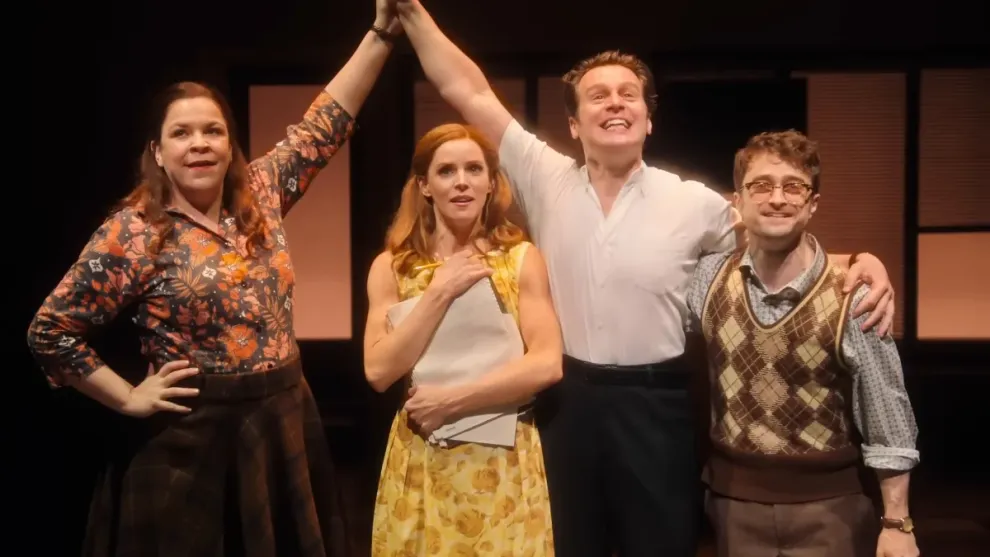
This isn’t that since that isn’t finished. Still fourteen years to go! This, instead, is a filmed stage-production. In other words, a recent 2023-4 revival becomes a 2025 film starring Jonathan Groff, Lindsay Mendez and Daniel Radcliffe in the same-order-as-above respective roles: Franklin Shepard, Charley Kringas and Mary Flynn.
[Why the Sony website synopsis begins, “Spanning three decades…” is beyond me. A topic for another day.]
Live theater presents an opportunity for unpredictable energy and controlled chaos. It is among the best forms of artistic collaboration in existence (along with operatic productions, musical-ensemble concerts of every sort [particular with associated / coordinated visuals] and the art of filmmaking—when it is artful—itself)! A disadvantage of the temporary nature of a theatrical production is that the performances of a truly great cast could be lost for the ages if there is no film or video* recording to document it. There is a documentary of Company for instance—D.A. Pennebaker’s wonderful Original Cast Album: Conpmay—which captures the behind-the-scenes antics of the recording of the aforementioned LP but the show (with that casting) is no more. The stage-to-screen presentation of Merrily… remedies that for this.
*[Legitimate recordings, that is. Not surreptitious shaky-cam audience recordings and assorted “slime” tutorials of variable quality.]
What you get, MWRA-wise: “movie (occasional stage) star” in Radcliffe, a “stage (occasional movie / television) star” in Groff and a terrific stage / television actor / singer in Mendez. The show begins with an overture introducing a handful of the musical themes, followed by the titular “Merrily We Roll Along” (which will be repeatedly revisited in various “Transition(s)” between scenes). We open in 1977 with “That Frank” when we learn a bit about the principal protagonist of the show and his rapidly-fading friendship with Mary. Frank has become a successful Hollywood film producer. At what cost? We’re about to find out! Par exemple, the entire scene has no Charley (Radcliffe). We see him in the initial opening and then he is gone. Where did he go? Back / ahead in 1973, lyricist Charley and songwriter Frank have a falling-out (fully articulated in “Franklin Shepard, Inc.”). So it goes, in reverse to 1968, then 1966, followed / preceded by 1964, 1962, 1960, 1958 and finally 1957, when the show ends / story begins (where this duo first meets Mary and becomes a trio).
I’ve made only one mistake in my life. But I’ve made it over and over.
The mistake? Saying “yes” when Frank meant “no” instead. Familiar?
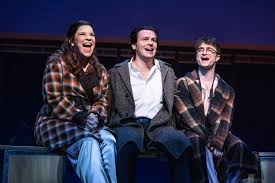
A still from MERRILY WE ROLL ALONG
“The moments that struck me in the filmed Merrily.., are the shifts in focus whenever something important is happening. Those times when these characters are making choices that will cause many problems for them ahead. The actors were extremely good at portraying the optimism that the characters lose along the way. It was impressive how they were able to jump from one scene to the next without having the advantage of their actions building from one scene to the next, especially in the final scene of the show.”
The conceit of time-in-reverse could be “all hat, no rabbit” in the hands of lesser talents. These characters are made richer by the multitude of their layers. What we get from Frank’s wife, Beth, for instance—both on-the-page and in Katie Rose Clark’s performance—following the custody proceedings when she sings “Not a Day Goes By” (at the conclusion of Act I). To introduce / conclude their relationship on a highly dramatic note, only to pull backward to their lighthearted beginnings following the “Fifth Transition” and their satire of political dynasties, “Bobby and Jackie and Jack” (which plays a bit differently now than it did when it was composed nearly five decades ago). Darkness, meet light.
It started out with a song.
If you could boil all of Merrily… down to a single song or scene—you can’t, admittedly, but tolerate this notion for a moment—“Good Thing Going” (in Act II) is the linchpin. It is prescient, albeit as a song that is supposedly for a show they hope to produce (not directly about them at all, in theory) and in its description of things the audience already knows will come to pass. The song is serious and it is seriously beautiful. Frank plays the piano for a gathering of party guests and Charley sings. When it ends, they’re asked for an encore. Charley says, “You know what true greatness is? It’s knowing when to get off.” Frank ignores Mary and Charley’s pleas to stop there and he insists that they play it again. He begins the melody on the piano and they sing, this time as a duet. As usual, he doesn’t listen to the advice of his friends. The party guests don’t bother to listen the second time around, either.
“The moments that struck me the most were songs like ‘Good Thing Going.’ I was noticing how it represents the falling-apart of this friendship. You wish that these characters made better choices. A big part of the story is how all of these small choices culminate in catastrophe.”
Going. Going. Gone.
Open-ended theatrical releases (rather than one-offs) of stage productions are few and far-between. Earlier this year there was another: the belated, pandemic-delayed cinematic debut of Hamilton. Connecting them both? RadicalMedia, the production company behind the filming of the aforementioned musical and MWRA, and Jonathan Groff, born forty years ago, with a Broadway debut (as an In My Life understudy / swing) twenty years ago but whose real fame began a year later with Spring Awakening (and a recurring role on Glee thereafter).
[Groff is currently appearing in the jukebox musical Just in Time—singing an assortment of classics made popular by Bobby Darin—until March 2026.]
Could a case be made that Jonathan Groff is the greatest living musical-theater performer? “He is my favourite. That might be because I like a lot of the shows in which he has appeared. He always does justice to all of the characters that he plays.” Particularly in Spring Awakening and Merrily We Roll Along. Groff has an unmistakable charisma, adding depth to characters with undeniably questionable behaviour.
One might wonder whether an ersatz theatrical experience can be achieved by sitting for two-and-a-half hours in a cinema. It can! With an audience, it can, indeed. Although still less preferred than seeing a live performance (which is not possible with this cast; this is your only option at the moment). Like the stage production, you have a limited opportunity to see it in a theater. Do it now or regret it later.
Check out Brandon Wilson’s Merrily We Roll Along review here as well
— Jonathan Marlow | SV ARCHIVE [aka SCARECROW VIDEO] Executive Director [among other things]
Sony Pictures Classics (in tandem with Fathom Entertainment); Maria Friedman; Merrily We Roll Along movie review