
A Conversation with Clint Bentley (TRAIN DREAMS)

Writer and director Clint Bentley doesn’t make films about the exceptional. He finds the exceptional in the ordinary. Stories about jockeys past their prime, incarcerated men staging plays, and now, with Train Dreams, an Idaho logger whose entire life unfolds in the shadow of the Pacific Northwest’s towering forests. Adapted from Denis Johnson’s beloved novella, Train Dreams (previously reviewed by lead critic Chris Reed) follows Robert Grainier (Joel Edgerton) through half a century of American expansion as he bears witness to both the magnificence and brutality of a rapidly changing world. It’s a film about grief, memory, the trees we fell and the ghosts that follow us, about a man who never makes history but whose quiet existence contains universes.
Bentley, who co-wrote the screenplay with his longtime collaborator Greg Kwedar (the duo behind the Oscar-nominated Sing Sing), spent years wrestling with how to transform Johnson’s slim, time-hopping novella into a film that could honor both its philosophical depth and narrative wooliness. Together they crafted something that feels both achingly specific to early 20th century Idaho and universally resonant to anyone who has ever felt lost by modernity. The result is a film that feels like a fever dream, elevated by Edgerton’s quietly hardened performance, Adolpho Veloso’s immersive cinematography, and Bentley’s unwavering commitment to finding the extraordinary within the simple. There are excellent supporting performances from Felicity Jones, Kerry Condon and William H. Macy, making Train Dreams one of the best films of the year. It can be watched on Netflix now.
Hammer to Nail: I got to see this movie 3 times! Once projected digitally, once on 35mm at the Paris Theater, once on a link. Each time I saw it I liked it even more! Greg said in the press notes that a breakthrough was when you guys stopped protecting every aspect of Denis Johnson’s text and embraced your own directorial vision. What’s an example of something you guys cut or changed that felt risky but ultimately liberated the adaptation?
Clint Bentley: The big example of that is the Claire character, played by Kerry Condon. There’s a character named Claire Thompson in the book, but she’s a widow who he’s transporting on his wagon to another place. They just have a couple lines back and forth. There’s not much there. This leads us to that big scene on the balcony, where she says, “the world needs a hermit in the woods as much as a preacher in the pulpit.” That was one where I remember it being a bit of a breakthrough, this thing where it was like, is this okay or not? Taking the spirit of that character and that line, and then using the rest to say things that I wanted to say about grief, ecology and all these things that Kerry delivers so beautifully.
I was given some advice early on to let the film be the film and release yourself from having to stay true to the particulars of a piece of literature as long as you’re loyal to the spirit of it. I took that to heart for better or worse.
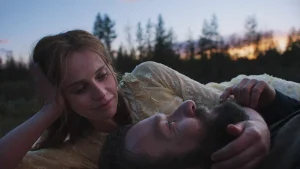
HTN: Five minutes into the film, we get one of the most important moments between Joel and Felicity, where he casually proposes to her. Lying down next to her on the lake. He asks her to say his name again. He loves the sound of it. It’s just a really beautiful moment as we also watch them plan their future cabin. What was important to you in this moment, which later comes back in dream sequences and montages?
CB: I think just their connection and how special it was. That’s a scene from the book. It’s very, very beautiful. He doesn’t even know why, but he proposes. I thought that was so special about his character and their relationship that he just feels drawn in a way that he doesn’t have some grand plan for the moment.
I remember when my now wife and I, when we started dating, she would just very casually call me from the other room. The sound of my name in her voice just did it for me. That was something that I just remember feeling very special about. That moment of falling in love with someone.
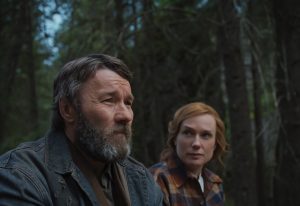
Joel Edgerton and Kerry Condon in TRAIN DREAMS
That scene actually where they’re laying there, that was scripted and meant to be much later in the film. Then as we were in the edit, Parker Laramie and I, our editor, were trying to figure out how to show their connection to each other in a way that the audience wasn’t getting early on. We just took that scene and plopped it down in the beginning. All of a sudden people saw that, they connected immediately. It birthed the rest of that sequence with them dreaming about their life and everything.
HTN: At the 36 minute mark, we have the final moment between Robert and Gladys. Kate ignores Robert as he tries to show her the flower. He gives the flowers to Gladys and, slightly defeated, says, “I’ll just go.” He walks off with his axe, looks back one more time, whistles at Kate, and that would be the last he ever sees of them, at least in what we think is reality. Just talk about crafting that final moment.
CB: Oh my gosh, that’s one that turned out very beautifully and it was one that became more beautiful by following what was being given by the world at the moment. That was initially crafted as this scene that was a moment between Robert and Kate as a two-year-old where they had a real connection. It was this scene where he made a game out of leaving and she says goodbye over and over. It was very sweet and beautifully written.
But the two-year-old on the day did not care at all about doing that. She had no interest. At first, with Adolfo, I was trying to figure out, okay, if we get an insert of the kid saying this, and then we get an insert of Joel, etc. We were trying to figure out how to make it work. Then the two-year-old was just trying to walk off and play with the toys on set.
Joel, Felicity and I, we all have kids around the same age who were around two at the time. We were like, “this is how it is, isn’t it?” We just realized that’s life. You’re trying to go through this big emotional moment and the kid doesn’t even care. We just decided to embrace it.. It became this really beautiful moment and felt more real by listening to the kid.
Then it became a moment between Gladys and Robert where they know something that the kid doesn’t. The added benefit of it was Joel trying to do this little trick with the flower in his hand. We did it the first time and the kid didn’t care at all and just walked off. That was the take that we used in the edit. But then, we did it like two or three more times and the kid loved it. She was like, “oh wow.” We used that take for the montage, in the plane, at the end when he’s remembering back. We use the one where she’s into the trick as if his memory of the event has become sweeter over time. So just an example of something where I knew the feeling that I wanted, but then life gave me something much better than I had initially thought of.
HTN: Shortly after at the 38 minute mark we have this conversation with Robert, Arn, and a couple of the other workers. The young man has a boyish arrogance to him. Arn says he used to think just like the young man. One of my favorite lines in the whole film is when he says, “This world is intricately stitched together, boys. Every thread we pull, we know not how it affects the design of things. We are but children on this earth, pulling bolts out of the Ferris wheel, thinking ourselves to be God.” It was just a great conversation. What was your thinking?
CB: That was one of those of taking what I had gotten from the book thematically and trying to expand on it. I think that “intricately stitched together” was something I stole from Cormac McCarthy at one point or another. We were trying to get across in this moment that looking at the last 200 years, which is a blip on the radar of the time of the earth and even the time of humans, we’ve changed so much. We’ve taken these big rivers and just decided we’re gonna straighten out this river. We’re gonna dam up that river and we’re gonna move, we’re gonna chop down this forest and put a Costco up here.
There is an arrogance to it that I don’t think is very controversial to say. We have no idea the impact that these things are having and the impact that these things will have over the course of a few centuries. I love when characters get into arguments in films, and neither is right, but neither is wrong at the same time. Arn saying to The boy, “This hurts us.” And the young guy saying, “Ah, fuck it, I got money in my pocket now, I’m fine.” Making the point that there’s always gonna be enough trees, which if you go up in that area, you go up into these wooded areas, it feels like that when you look at it, even though you know it is not true because of how quickly we’re taking them down. It’s kind of a tragedy, in Arn’s position, that once you recognize the damage and the destruction, it’s a bit too late.
HTN: It’s a smaller moment, but something that really stuck with me. A more large moment is at the 44 minute mark after waking up from a literal train dream, Robert sees the smoke outside the window and this leads into this absolutely harrowing moment as he screams for Gladys amidst the chaos. He runs up to their cabin to find it burning and it cuts to black as we find Robert in the snow standing amongst the desolate landscape. Again, just what was important to you in this moment?
Kerry Condon and Joel Edgerton in TRAIN DREAMS
CB: He’s standing in the ashes of his world there. It was important to try and be as realistic as possible in that situation when he’s going through the fire in a number of different ways. Showing just the immense otherworldly destruction that something that big would cause. It’s creating its own weather system of wind. There’s only so close you can get to it because of the heat from it. There’s really nowhere for him to go and hard to imagine that anything could survive in this place.
We were trying to be true to that tragedy, but there’s a strange beauty to things like that, to a tornado or to a big fire that I didn’t want to leave out either. To show this magnificence of it while it’s also ending his life as he knows it.
HTN: At the 53 minute mark, there’s this great moment between Ignatius Jack and Robert. You match cut shots of Jack killing the deer with Gladys doing the same. This leads into a montage that shows them musing over how the location would be good for a cabin, the cabin burning and her saying his name. At its conclusion, Robert is looking over the dead deer, holding on to his antlers, breaking into a full sob, saying that they’re not coming back. He apologizes, saying, “Sorry, I don’t know what came over me.” Talk about crafting that moment and how that montage came to life from the page to the screen in the editing room.
CB: I think emotionally, I wanted to show this character, the first time where he fully weeps. It’s because of this elk that’s laying there. Just seeing this, They kill the elk because they need to eat and yet something has died, that paradox. Him just recognizing this death of this animal unlocks something emotionally for him. But he’s a man at a time where he’s not fully able to process those emotions. It’s not really okay for a man to cry like that. So he apologizes for it just out of an almost knee-jerk reaction. I wanted to get that across.
The montage that came kind of late in the edit, as Parker and I were trying to find the language of the film and the language of the edit. We were threading those montages through more and more and it was honestly something that I think we tried to give the viewer a glimpse without him having to express it. Again, he’s not somebody who can explain very much of how he’s feeling and what he’s thinking. So I’m trying to give the audience a window into his mind. What’s going through his mind that leads to this emotional breakdown? There was a subtle crafting of that moment to give these glimpses of memories without overdoing it to the point where it gets in the way of Joel’s performance.
HTN: At the hour and 13 minute mark, there’s a very haunting dream that Robert has. It starts with the cabin lighting on fire as we hear Gladys. She wakes Robert up, tends to a few dishes, looks at him from a distance and smiles. Robert chuckles back. This leads into a nightmarish reenactment of what may have happened to Gladys and Kate in the fire. Robert is stuck on his bed, unable to interfere. He must simply watch as the horrors unfold. He wakes up to a similarly snowy landscape as the night of the fire and we have this Searchers-esque shot where from inside the cabin we see him step out with the blanket on. So again, just what was your thinking here?
CB: You’re describing it beautifully. I can listen to you describe the whole film! That’s a moment from the book that always was very striking where Gladys essentially comes back to tell him or to show him something. He doesn’t quite know what to make of it even as he’s experienced it. Trying to get that across with all of the strangeness of it, and also representing her experience. The fire from her perspective as she’s showing him in a much more impressionistic way than the straight ahead way that we did when he experiences the fire.
There’s this feeling that I’ve had before, and I’ve talked to several people who have experienced the same, I don’t think this is uncommon, after you’ve lost somebody, sometimes you have a dream of them, but it feels less like a dream and more like some kind of visitation. It feels as real as anything else that happened. Then you get away from it, and I look back on some of those experiences, they feel as real as memories that I have of these people. So part of that I wanted to try and get across was this blurring of the line between this world and the next, whatever that is. Somebody coming across the veil of it.
– Jack Schenker (@YUNGOCUPOTIS)