




A Conversation with Katie Jacobs (ARTISTS IN RESIDENCE)

When producer and director Katie Jacobs moved into a second-floor unit on East 2nd Street in New York City she didn’t know what she was getting into. Finding herself sandwiched between two legendary artists living on the first and third floors, Eleanor Magid and Lois Dodd, respectively, Jacobs became immersed in the rich history of the New York City art scene and an exhibition of the sheer strength of female independence. What came was Jacobs’ first documentary, Artists in Residence.
Artists in Residence tracks the lives of the three women who inhabited the three-story building on East 2nd Street: Magid, Dodd, and the late sculptor Louise Kruger, who lives on the second floor before Jacobs. From scrounging around scrappy, drug-infested neighborhoods to find an affordable place to live, to raising children by themselves, to starting their careers from the bottom up while overcoming sexism in their industries, the women of Artists in Residence are beacons of resilience and of the creativity that blossoms as a result.
The film celebrated two sold-out screenings at DOC NYC on November 14 and 20 and won the Grand Jury prize the festival’s Metropolis Competition, which is dedicated to stories about New Yorkers and New York City.
In a conversation edited for length and clarity, Jacobs shares the transformational experience of making Artists in Residence.
Hammer to Nail: What led you to these three artists, Lois Dodd, Louise Kruger, and Eleanor Magid?
Katie Jacobs: I’m from New York, but I was living in L.A. for like, 30 years or something, and I’d always wanted to come back here. My mom was still here, and her health had been failing, and I had friends over for Thanksgiving, and they were asking when I was going to move back to New York? My youngest daughter turned around my laptop and said, “Yeah, Mom, what about this?” So I live on the second floor of the building. I moved into Louise’s apartment, and when I went for my interview with the board, I met Eleanor and Lois. I come from the scripted world. I got my MFA from NYU, moved out, started answering phones for a producer in L.A. and then very soon after, started producing movies, then I directed and produced for TV. They [Eleanor and Lois] just inspired me to pick up a camera and to start interviewing them, because I had never seen women who lived this way and spoke this way and were so honest and comfortable in their own skin.
HtN: Lois and Eleanor are such unique, vibrant people, that we the audience feel like we know them personally just by watching this film. Can you share what it was like living with them?
Katie Jacobs: Well, when I came over to the building for my interview, I walked up the three stories to Lois’ apartment, walked in, had no idea where she slept, or where her son was raised, or anything, I sat down at her round table, and Eleanor took out a sheet of paper and said, “Well, I’ve never done an interview like this, so I googled what questions to ask you.” And they just blew my mind, they were really fun. I remember, maybe it was New Year’s Eve 2018, Lois calls and says, “I bought a bottle of whiskey. I think the three of us should ring in the New Year together.” And you know, I can’t say that I’ve ever had role models growing up. I was sort of living by the seat of my pants a little bit, I just wanted to work and wanted to work and wanted to work, and was not thinking about the realities of being a woman. So they sort of introduced me to how they made a go of being a mother while supporting their art and staying true to themselves. And it was something I benefited from and that I though lot of people could benefit from.
HtN: What were some of the challenges in presenting a story about the relationship between these three women while Louise is not with us?
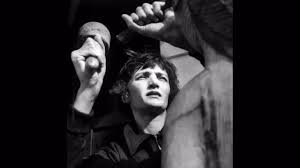
A still from ARTISTS IN RESIDENCE
Katie Jacobs: That was really challenging, because there was also the least amount of material on Louise. Louise was a very private person, and Lois and Eleanor really have communities, so it was a structural challenge. But when Henry Hayes, my editor, started working with me, we did things thematically, it was thematically that we were able to interweave their stories.
HtN: As a woman in the arts yourself, how did you relate to these artists’ observations about being a woman in this field and the expectation to be humble about your work and accomplishments?
Katie Jacobs: Until like, my 40s, I was just thinking, “Really, my job is to make money for my bosses.” I got away with it for a long time because I cared about the work being good. I think I felt like I was obligated to not walk in the door first, because there was no succeeding. You just have to hide, you know. I got far because I was really good at reframing my ideas as coming out from the male counterpart. And I didn’t give a shit, but I’m so old school. Like, I started getting studio deals 18 months after moving there [to L.A], and that was not before women were asked to sit on the executive’s laps. This was true, but I didn’t care because I wanted to succeed. I don’t want to be controversial, I just want to keep making stories. I like storytelling, but I was part of the problem, because while I was in Hollywood when asked about it, I would never tell the truth. But then I met these women; these women have made me less afraid.
HtN: Have you seen this environment change at all, or how do you see it changing?
Katie Jacobs: I hope it’s different for my daughters, and it is different. I respect that they’re not okay with that, nor should they be, nor should I be. Because saying “shh.. it’s all gonna work out,” and perpetuating it doesn’t do anybody any good. So that was a reality when I was doing my job. So better to reinvent yourself doing something else. So happy me, I found this.
HtN: While you’ve led an impressive career as a director and producer, this is your first time directing a documentary like. What was the biggest challenge your found from this experience?
Katie Jacobs: It was hard to maintain a sense of confidence. [On House], my turnaround on an episode is 10 days, with 24 episodes a year. But [in this film], I was in a vacuum for seven years without any feedback. So this was fucking thrilling. I never knew anybody would be interested, but I’m committed to finishing what I start. At the end of the day, I had to stick with what I wanted to make this movie about from the beginning, and just take a shot, and cross my fingers that someone would watch. I wanted a challenge, and this was even more challenging than I thought. Documentaries are hard. This is the biggest accomplishment I feel like I’ve ever made.
– Kaitlyn Hardy